

Aaron’s Priestly Garments Made Him Bear the Responsibility of Service
Exodus 28 does more than clothe Aaron in beauty. It appoints him to serve as priest while bearing on his body the names of Israel and the sign of holiness.
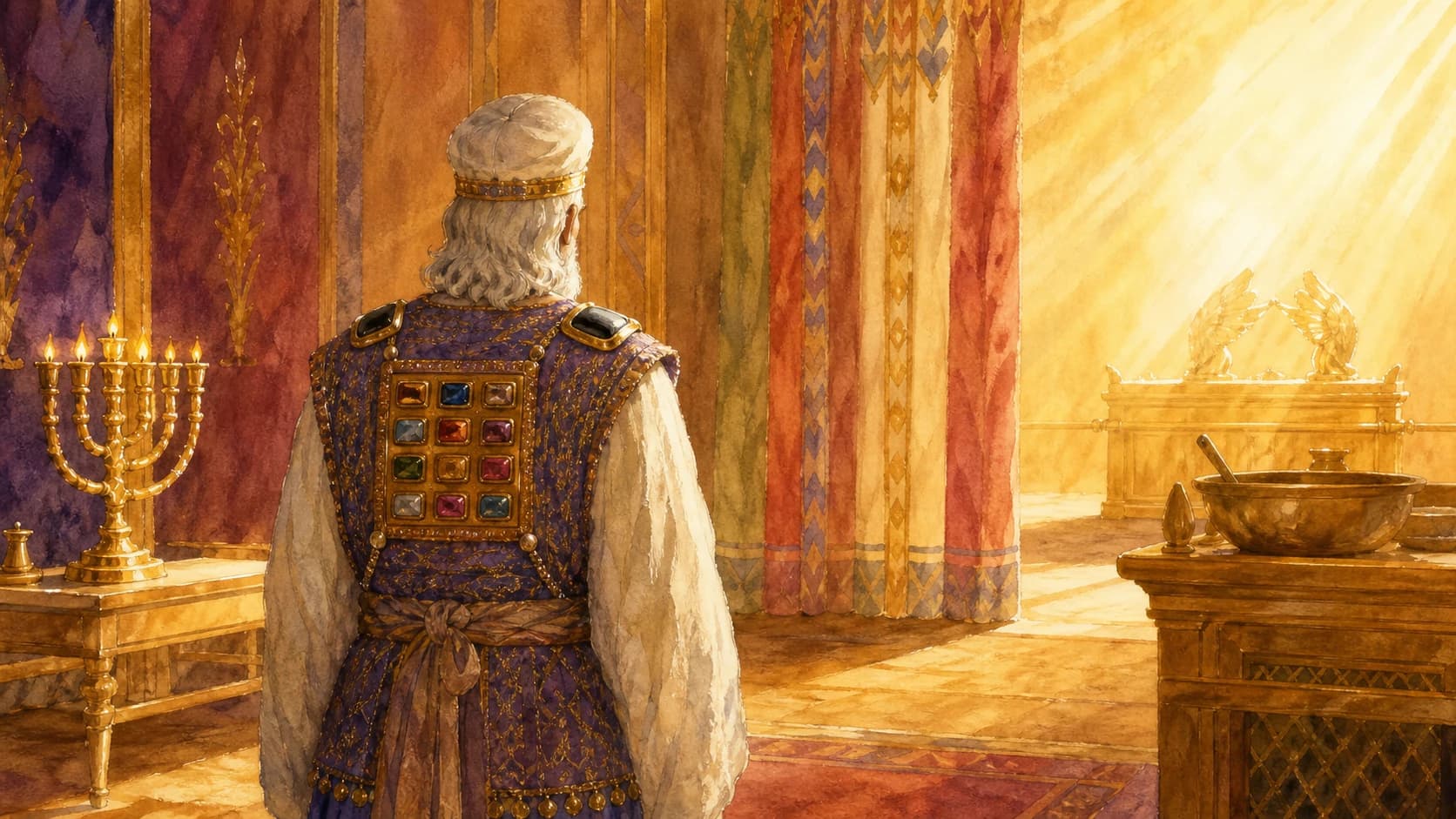
The priestly garments in Exodus 28 were not made simply to adorn Aaron. They set Aaron and his sons apart for service to God and placed the responsibilities of their office upon their bodies. Exodus 28 describes not only the garments’ materials and design, but also the engraving of names, where each piece was to be worn, when the garments were required, and what would result from wearing them.
Aaron and His Sons Put On the Garments and Assumed Their Office
God commanded Moses to bring Aaron and his sons—Nadab, Abihu, Eleazar, and Ithamar—near so that they could serve Him as priests. He then instructed Moses to make sacred garments for Aaron to give him dignity and honor.
These garments consisted of a breastpiece, an ephod, a robe, a woven tunic, a turban, and a sash. Skilled artisans made them from gold and from blue, purple, and scarlet yarn, and finely twisted linen. The artisans’ skill, the prescribed materials, and the methods of construction were all devoted to preparing the priests for their ministry.
Verse 41 again makes the relationship between the garments and the priestly office clear. Moses was to clothe Aaron and his sons, anoint them, ordain them, and consecrate them. Only then could they serve God as priests. The lengthy instructions for making the garments did not end with the completion of beautiful objects. They culminated in the priests being properly prepared to serve in the holy place.
Aaron Bore the Names of Israel on His Shoulders and Over His Heart
Two onyx stones were fastened to the shoulder pieces of the ephod. Six names of the sons of Israel were engraved on one stone and the remaining six on the other. Aaron was to bear all twelve names on his shoulders before the LORD as a memorial.
The breastpiece of judgment was also set with twelve stones arranged in four rows. Each stone was engraved with the name of one of the twelve tribes. Gold chains, gold rings, and a blue cord secured the breastpiece firmly to the ephod so that it would not come loose. Whenever Aaron entered the sanctuary, he was to wear over his heart the breastpiece bearing the names of the sons of Israel. The Urim and Thummim were placed inside it so that Aaron would always bear the means of making decisions for the Israelites over his heart.
The names on his shoulders and those over his heart repeatedly pointed to the same people. Aaron did not enter the sanctuary wearing garments that represented only himself. He came before the LORD bearing on his body the names of Israel’s twelve tribes and the responsibility of judgment on their behalf.
The Garments’ Detailed Instructions Established Boundaries for the Holy Place
Pomegranates and gold bells were attached alternately around the hem of the blue robe. The sound of the bells had to be heard when Aaron entered and left the Holy Place so that he would not die. A plate of pure gold engraved with the words “HOLY TO THE LORD” was fastened to the front of the turban. It was always to rest on Aaron’s forehead so that he might bear the guilt connected with the sacred gifts the Israelites consecrated.
Aaron and his sons also had to wear linen undergarments to cover themselves from the waist to the thigh. When they entered the tent of meeting or approached the altar to minister, they had to wear the prescribed garments so that they would not incur guilt and die. The passage does not treat these garments as optional decoration. Anyone drawing near to the holy place had to follow the appointed requirements for clothing and service.
As you read Exodus 28 again today, write beside each part of the priestly garments the role it served. The stones of the ephod bore the twelve names, the breastpiece carried the names and the responsibility of judgment, and the gold plate declared, “HOLY TO THE LORD.” Following these three elements reveals the chapter’s central theme: the priestly garments embodied not only beauty, but also responsibility for the people’s names, their judgment, and holiness.
Related articles
Numbers 20: Water Came from the Rock, So Why Were Moses and Aaron Barred from Entering?
Explore how water came from the rock in Numbers 20, what God commanded, why Moses and Aaron could not enter the Promised Land, and how Aaron’s priestly role passed to Eleazar.
Numbers 18: How Were the Duties and Portions of the Tabernacle Divided?
Numbers 18 defines the distinct duties of the priests and Levites, assigns offerings and tithes as their portions, and commands the Levites to present the best part of the tithes they receive.
Numbers 16: Why Did Aaron Stand Between the Dead and the Living?
Explore the events of Numbers 16—from Korah’s rebellion and the judgment involving the censers to the renewed plague—and discover why Aaron stood between the dead and the living.
 Bible Habit
Turn this article into today’s reading habit
Keep your McCheyne plan, sequential reading, notes, and progress together so the next passage is always clear.
- Today’s passages
- Reading checklist
- Notes and highlights