

Bezalel’s Craftsmanship and the Sabbath Both Follow God’s Command
Exodus 31 brings together the skilled work of building the tabernacle and the command to rest on the Sabbath. It shows how doing our assigned work with care is connected to stopping when the appointed time comes.
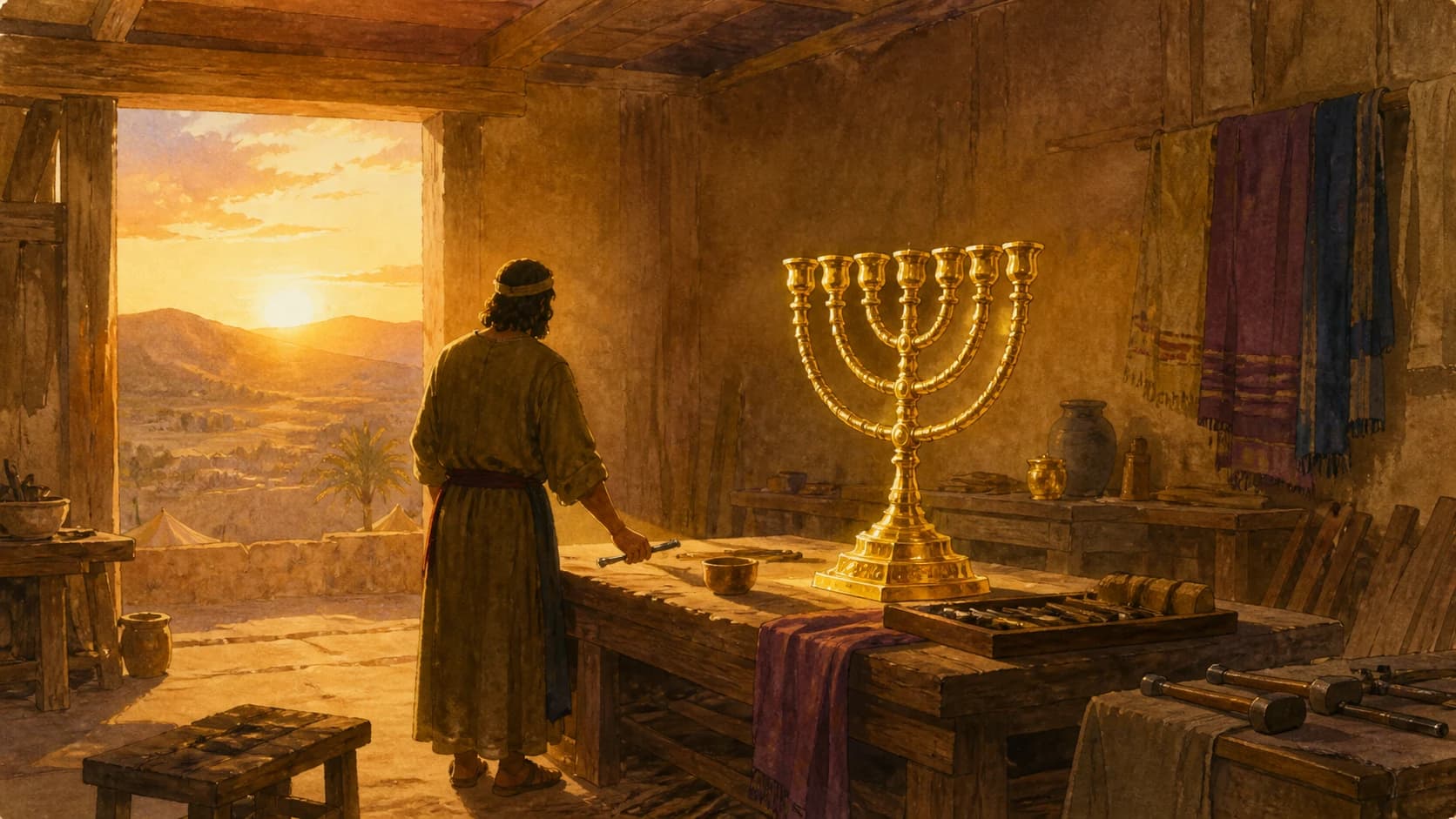
In Exodus 31, both the work of building the tabernacle and the observance of the Sabbath are placed under God’s command. God gave Bezalel and Oholiab the wisdom and skills they needed to make everything He had commanded. At the same time, He commanded Israel to work for six days and to rest without fail on the seventh.
God Appointed People and Gave Them Skill
God chose Bezalel from the tribe of Judah and called him by name. He filled him with the Spirit of God, giving him wisdom, understanding, knowledge, and all kinds of skills. Bezalel was entrusted with crafting artistic works in gold, silver, and bronze, cutting and setting stones, and carving wood.
Bezalel was not expected to do everything alone. God appointed Oholiab from the tribe of Dan to work alongside him. He also gave wisdom to all the skilled workers. The abilities given to these people were not meant merely to display their individual talents. They were to be used to make everything God had commanded Moses.
The passage also lists the objects they were to make in detail. They were to make the tent of meeting, the ark of the covenant law, and the atonement cover, as well as the table, lampstand, altar of incense, altar of burnt offering, and basin. They also had to prepare the garments for Aaron the priest and his sons, along with the anointing oil and fragrant incense. The people were not free to add whatever they wished or alter the purpose of these objects. Verse 11 confirms once again that they were to make them “just as I commanded you.”
The appointed workers, the wisdom they received, the companions who worked with them, and the objects they were to make all served one command. Their refined craftsmanship was not a means of unrestricted self-expression, but a gift to be used in faithfully completing the work God had appointed.
God Commanded the Sabbath Even After Assigning Such Detailed Work
Immediately after the list of objects needed for the tabernacle, God told Moses that Israel must observe the Sabbath. Although there was much to do and the work required exceptional skill, God did not tell them to keep working through the seventh day. They could work for six days, but the seventh day was to be a Sabbath of complete rest, holy to the Lord.
The command concerning the Sabbath is repeated several times. Verses 13 and 14 instruct Israel to observe the Sabbath. Verse 15 contrasts six days of work with rest on the seventh day. Verse 16 declares that the Israelites must observe the Sabbath throughout their generations as a lasting covenant. The severe consequence announced for anyone who worked on the Sabbath also shows that this rest was not optional.
Twice, God described the Sabbath as a sign between Himself and Israel. By observing it, the Israelites were to know that the Lord was the One who made them holy. The Sabbath was also grounded in the fact that God made the heavens and the earth in six days and rested and was refreshed on the seventh.
Both the Time to Work and the Time to Stop Were Appointed
Bezalel and his fellow workers had to make everything God commanded without leaving anything unfinished. Yet even work for the tabernacle had to stop on the seventh day. Just as God determined what they were to make, He also determined when they were to work and when they were to rest.
The central message of Exodus 31, therefore, is not merely that gifted people produced magnificent objects. The obedience of using their gifts to make everything God commanded stands alongside the obedience of observing the Sabbath even while an important work was underway. Stopping their hands on the appointed day was just as much an act of obedience as carrying out their work with care and precision.
One practical step for today is to read Exodus 31 again and separately mark what God told the people to “make” and what He told them to “observe.” This will help you see more clearly how the passage takes work seriously without allowing it to push aside the rest that God set apart as holy.
Finally, when God had finished speaking, He gave Moses the two tablets of the covenant law. Those stone tablets were inscribed by God’s own hand. The hands of those who built the tabernacle and the hands of the Israelites who stopped working on the Sabbath were both required to follow the word God Himself had given.
Related articles
How the Ten Commandments Transformed the Lives of a Formerly Enslaved People
Deuteronomy 5 teaches that Israel, once enslaved in Egypt, was to hear God’s covenant and live in a way that protected rest, life, and the property of others.
Why Does Numbers 28 Repeat the Offerings Appointed for Specific Times?
Numbers 28 begins with the regular burnt offerings presented each morning and at twilight, then adds offerings for the Sabbath, New Moon, and appointed festivals. Explore how these repeated commands ordered Israel’s days, months, and sacred seasons.
Numbers 19: Why Were the Ashes of the Red Heifer Necessary?
Numbers 19 explains how uncleanness caused by contact with a dead body could spread and how a person could be cleansed by following the prescribed ritual with water made from the ashes of a red heifer.
 Bible Habit
Turn this article into today’s reading habit
Keep your McCheyne plan, sequential reading, notes, and progress together so the next passage is always clear.
- Today’s passages
- Reading checklist
- Notes and highlights