

Introduction to Biblical Background Geography: Why Does Opening a Map Make the Text More Clear?
Biblical background geography is not about memorizing place names but about helping you see more clearly that God has worked within actual history and space. This article introduces a method to read texts in a three-dimensional way, following the journey of Exodus, the Gospels, and Acts.
Introduction to Biblical Background Geography: Why Does Opening a Map Make the Text More Clear?
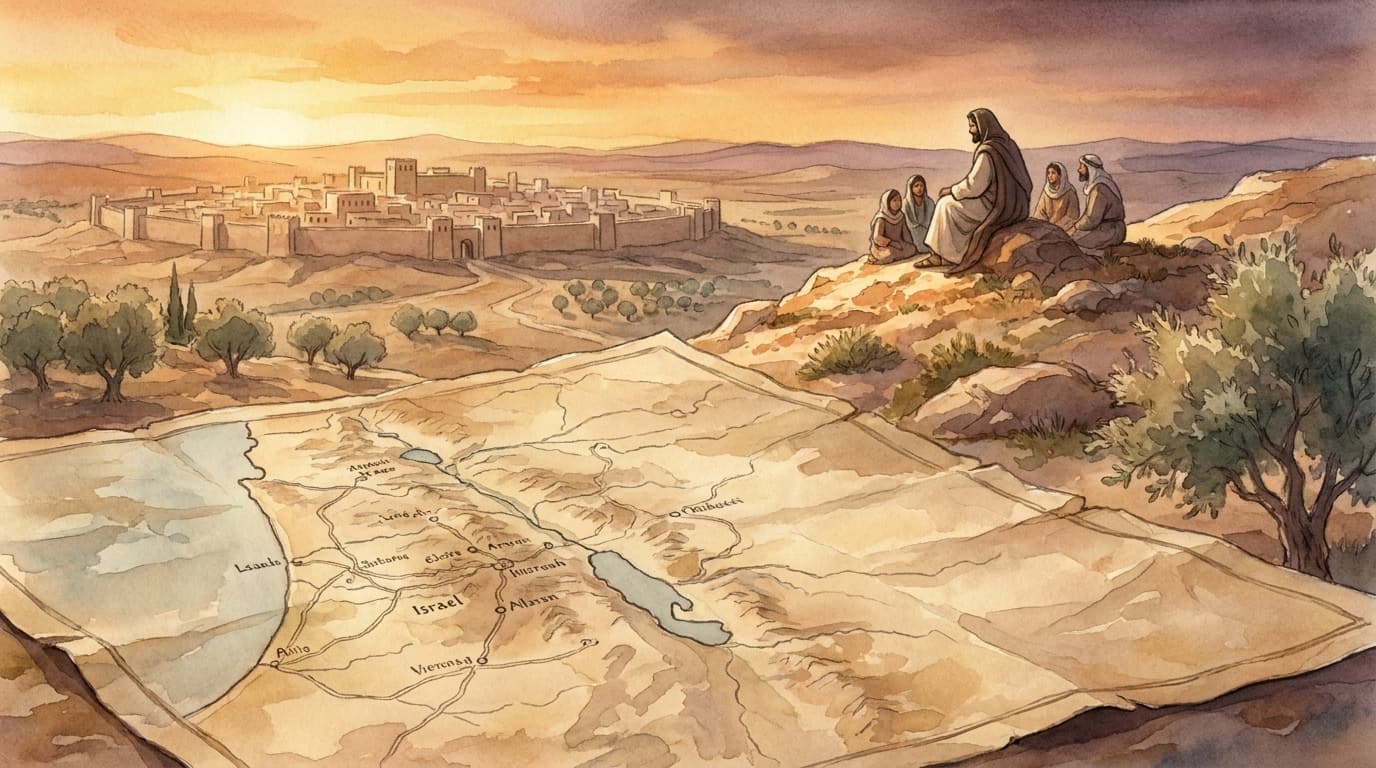
Some people find opening a Bible map more overwhelming than helpful. Place names seem unfamiliar, locations appear numerous, and it may feel like a test subject needing memorization. However, biblical maps are not meant for rote learning. They serve as a background that helps us read the Word more accurately. They are valuable tools that allow us to visually confirm that God worked within real historical events and spaces. The stories in the Bible are not vague legends or abstract imaginings—they took place in concrete locations such as deserts, mountains, cities, and coastlines. Luke 2:4 states, “So Joseph also went up from Galilee, from the town of Nazareth, to Judea, to Bethlehem, the town of David,” emphasizing that the gospel isn’t just an idea but the salvation of God entering the real world.
1. Why Look at Biblical Maps?
The benefit of biblical maps isn’t just about knowing place names. First, it helps organize the flow of events. When reading about Abraham’s journey, Israel’s Exodus, Jesus’ ministry routes, or Paul’s missionary trips, understanding the movement through locations makes the story much clearer. Second, the atmosphere of the text comes alive. Whether it’s a mountainous region, desert, or seaside, the tension and significance of scenes change accordingly. Third, it makes it easier to see that God was faithfully working throughout history. Psalm 103:19 says, “The Lord has established his throne in heaven, and his kingdom rules over all,” reminding us that God isn’t only sovereign in heaven but also actively working through earthly history.
While reading the Bible, expressions like 'ascending,' 'descending,' or 'crossing over' often appear. These aren’t mere descriptions of movement—sometimes they evoke deeper meanings. For example, going up to Jerusalem reflects not just geographical direction but also the focus on worship and festivals. Descending into Jericho might evoke danger and tension because of the rough terrain. When you look at maps, those words begin to feel as if the scenes are alive, moving before your eyes rather than passing across a flat page.
2. Mastering the Big Picture First
Trying to memorize every detailed place name from the start can be discouraging. It’s better to grasp the broad framework first. When reading the Gospels, knowing the general flow from north to south—Galilee to Judea via Samaria—helps. Jesus’ active ministry in Galilee and the gradual approach to Jerusalem naturally show the rising tension and focus. When reading Acts, keeping in mind that the gospel started in Jerusalem and expanded to Judea, Samaria, and then to the ends of the earth provides a helpful overview. Acts 1:8 clearly shows this direction: “You will be my witnesses in Jerusalem, and in all Judea and Samaria, and to the ends of the earth.”
In the Old Testament, distinguishing between the mountainous regions, plains, wilderness, and river basins of Canaan makes the stories clearer. The wilderness is not just a barren place but a recurring scene where God teaches dependence and His provision—manna and water from the rock. Israel complained in the wilderness but also learned about God’s faithfulness through these experiences. Therefore, maps are not just about memorizing locations—they are windows revealing the paths along which faith stories unfold.
3. Reading with Immediate Application to the Text
To make good use of biblical maps, follow a certain sequence:
- First, read the text. Instead of staring at the map first, look for repeated place names and movement phrases in the Scripture.
- Check direction and proximity. Is the journey long or short? Is it uphill or downhill? On land or across water?
- Ask about the role of the place. Why that particular location? For a wilderness, it might relate to testing or dependence; for the temple, worship and divine presence; for the sea, fear and human helplessness.
- Placing the scene within the flow of salvation history. Recognize which context—promise, judgment, restoration, or gospel proclamation—the place belongs to. This turns factual knowledge into meditation.
Joshua 1:9 states, “Have I not commanded you? Be strong and courageous. Do not be frightened, and do not be dismayed, for the Lord your God is with you wherever you go.” This isn’t just a general encouragement but specifically spoken to the people crossing the Jordan into the Promised Land. Understanding the location deepens the impact and weight of God’s words.
4. Practice with Key Texts
Some good initial texts for practice include:
The Exodus Journey
Exodus 13–20 are excellent passages to read with maps. Following the flow from Egypt through the wilderness to Mount Sinai illustrates salvation and training in one story. God’s act of salvation isn’t just a rescue but also a teaching about covenant living. Crossing the Red Sea and then immediately entering the wilderness shows that faith initiated by grace involves trials. Application in our daily lives is obvious: even after experiencing God’s grace, comfort isn’t immediate. God exposes our needs and impatience through hardships, then rebuilds us with His Word.
Jesus’ Ministry in Galilee
Galilee was where Jesus’ active ministry took place. Following His movements around lakeside towns and synagogues demonstrates how practical His work was. Mark 1:39 notes, “So he was preaching in their synagogues throughout Galilee and driving out demons.” Jesus didn’t stay in one place but went to people with His Word and power. When reading this alongside a map, a new understanding of the gospel as an active, real force rather than a static idea emerges.
Paul’s Missionary Journeys
Paul’s travels in Acts are among the most vivid when visualized on a map. The flow from Jerusalem outward into various cities and regions shows the expansive reach of the gospel. Traveling through port towns, inland cities, synagogues, markets, Jews, and Gentiles reveals the universality of the message. Paul didn’t move because of convenience but out of a sense of gospel obligation. Our lives today—workplaces, homes, schools, routines—also serve as our mission fields. Maps remind us that the story isn’t just about distant places but about where God has placed us—living as witnesses of the gospel.
5. How Historical Backgrounds Help Clarify
Understanding the historical context makes biblical geography even more meaningful. Regions with major roads and trade routes saw more movement of people, making them quick channels for the gospel. Conversely, wilderness or mountain areas often evoke images of isolation, testing, or refuge. Jerusalem wasn’t only an administrative hub but the heart of covenant and the Holy Temple. Ascending to Jerusalem wasn’t just about altitude but about the spiritual journey of approaching God with reverence.
These backgrounds aren’t merely decoration but reveal the texture of biblical truth. The Word isn’t just stories floating in human imagination but divine revelation happening at specific times and places orchestrated by God. Biblical background geography helps us humbly and accurately read these realities, emphasizing the concrete nature of God’s Word.
6. How to Incorporate Map Reading into Daily Life
Using biblical maps doesn’t require grand plans. It’s better to proceed gradually, focusing on small steps. For example, reading one passage a day and marking one place can be a simple start. Consider jotting down short notes: “What terrain is this?” or “Why did this event happen here?” Over a few weeks, your biblical understanding will become more vivid and three-dimensional.
When encountering unfamiliar place names, check the context first in Bible Reading. To explore how the same location appears elsewhere, you can use AI Bible Search. If you want to connect the flow of the story in manageable parts, refer to the 365-Day Reading Schedule. If you want to develop a steady background geography knowledge, look at Why Reading the Whole Bible is Important or 7 Tips for Bible Reading Habits. The key isn’t memorizing many details but genuinely engaging with the text more attentively and honestly, using maps to guide your understanding.
Ultimately, looking at biblical maps is about seeing more clearly how God’s plan of salvation unfolded in real history. It’s okay if you don’t memorize every place name. If you understand even one location in the text you read today, the scene becomes more vivid. As you keep reading step by step, you’ll begin to realize that the Bible isn’t just an ancient story but a true revelation of God working through time and space. And this realization will lead you, not merely as information, but as a way to trust and obey His Word more deeply.
Related articles
The Meaning of the Dead Sea and Reading Dryness Through Biblical Geography
This article explores the significance of the Dead Sea and its biblical geography, explaining why salt flats, deserts, and arid lands are often associated with dryness and judgment, while also reflecting on God's promise of restoration in Ezekiel, offering practical application for our hearts today.
The Meaning of Wilderness: How to Read Dry Seasons in Life
Exploring the biblical concept of wilderness as a space not just of desert, but of testing, provision, and restoration. Following passages from Exodus, 1 Kings, and Hosea, thoughtfully reflects on how to interpret dry seasons today.
The Site of Conversion Unveiled by Knowing Damascus: Biblical Background and Meaning
Follow the geography, history, and biblical significance of Damascus to see how Old Testament judgment and New Testament conversion intersect in one city. This article provides deeper biblical insights into Saul’s encounter on the road to Damascus.
 Bible Habit
Turn this article into today’s reading habit
Keep your McCheyne plan, sequential reading, notes, and progress together so the next passage is always clear.
- Today’s passages
- Reading checklist
- Notes and highlights