

Bible Reading Through the Whole Bible: Four Steps to Organize Before You Begin
Here are four steps to organize before beginning a whole-Bible reading plan, from choosing a reading method and building a practical routine to continuing steadily over time.

A Guide to Reading Through the Bible: Four Steps to Organize Before You Begin
It is common to feel overwhelmed after deciding to read through the Bible and then trying to begin. You may wonder where to start, whether it is best to read from beginning to end, or whether you should follow a reading schedule. Yet more important than a perfect method is the direction of reading all the way through. Reading through the Bible is not a race for speed; it is training in listening steadily to the whole Word of God.
Second Timothy 3:16 says, “All Scripture is breathed out by God and profitable for teaching, for reproof, for correction, and for training in righteousness.” Reading through the Bible helps us move beyond repeatedly reading only familiar passages and receive the whole Word God has given us in a balanced way.
1. What Does It Mean to Read Through the Bible?
Reading through the Bible means reading all 66 books from beginning to end, or reading the whole Bible according to an organized plan. Deeply meditating on one verse and reading through the Bible have different textures, but they do not compete. Reading through the Bible is like seeing the forest, while meditation is like looking closely at a tree. Someone who sees the forest understands the trees better, and someone who loves the trees can see the forest more deeply.
If you want to understand the basic idea of reading through the Bible, you can begin with What Does It Mean to Read Through the Bible?. When your direction is clear from the beginning, you are much less likely to lose your way in the middle.
2. Which Reading Method Should You Choose?
There are two broad approaches to reading through the Bible.
- Reading in order: Reading consecutively from Genesis through Revelation
- Following a plan: Reading the Old and New Testaments together, or reading a set amount for each day
The advantage of reading in order is that it lets you follow the story naturally. On the other hand, your pace may slow in unfamiliar passages such as Leviticus or Chronicles. A scheduled plan makes it easier to establish a daily rhythm because the amount for each day is already set, and it helps you experience the connections across the whole Bible by reading different passages together.
The more important question is not “Which method is better?” but “Which method can I keep following?” Someone who struggles to get started may do well with a plan that clearly sets the daily amount, while someone who values the flow of each book may prefer reading in order. If it is difficult to tell where you are in your plan, you can use the progress calculator to check your reading pace.
3. Practices of People Who Continue for the Long Term
Reading through the Bible does not continue for a long time through willpower alone. You need to make a place for it in your daily life. The following four practices can make a real difference.
- Set a reading time: Choose a fixed time, such as 15 minutes in the morning, 10 minutes at lunch, or 10 minutes before bed.
- Start with a small amount: If you read too much at the beginning, you can become exhausted after a few days.
- Make it possible to check off: Leaving a mark that you read creates continuity.
- Do not fear missed days: If you miss one day, do not give up; begin again the next day.
Many people stop in the middle because they think, “I could not do it today, so this week is ruined.” But reading through the Bible is completed not by people who never stumble, but by people who open the Bible again. Joshua 1:8 says, “This Book of the Law shall not depart from your mouth, but you shall meditate on it day and night.” The key is not an impressive achievement but the repeated practice of not turning away from the Word.
4. A Concrete Routine That Builds the Habit
If you are just beginning, a simple routine like the following is helpful.
- Fix the place where you sit. A corner of the dining table, a spot beside the sofa, or a desk will all work.
- When you open the Bible, take one quiet minute to get ready to read. Use it to set down your hurry.
- Read only the amount you have decided on. You may read more if you want, but keep the basic amount small.
- Leave only one sentence. “Today, obedience stayed with me” is enough.
- Return at the same time. This is what forms a habit.
If you need a reading flow organized by date, look at the 365-day reading schedule to see the amount for each day. What matters is not having more days when you read a great deal, but gradually having more days when you return and continue reading.
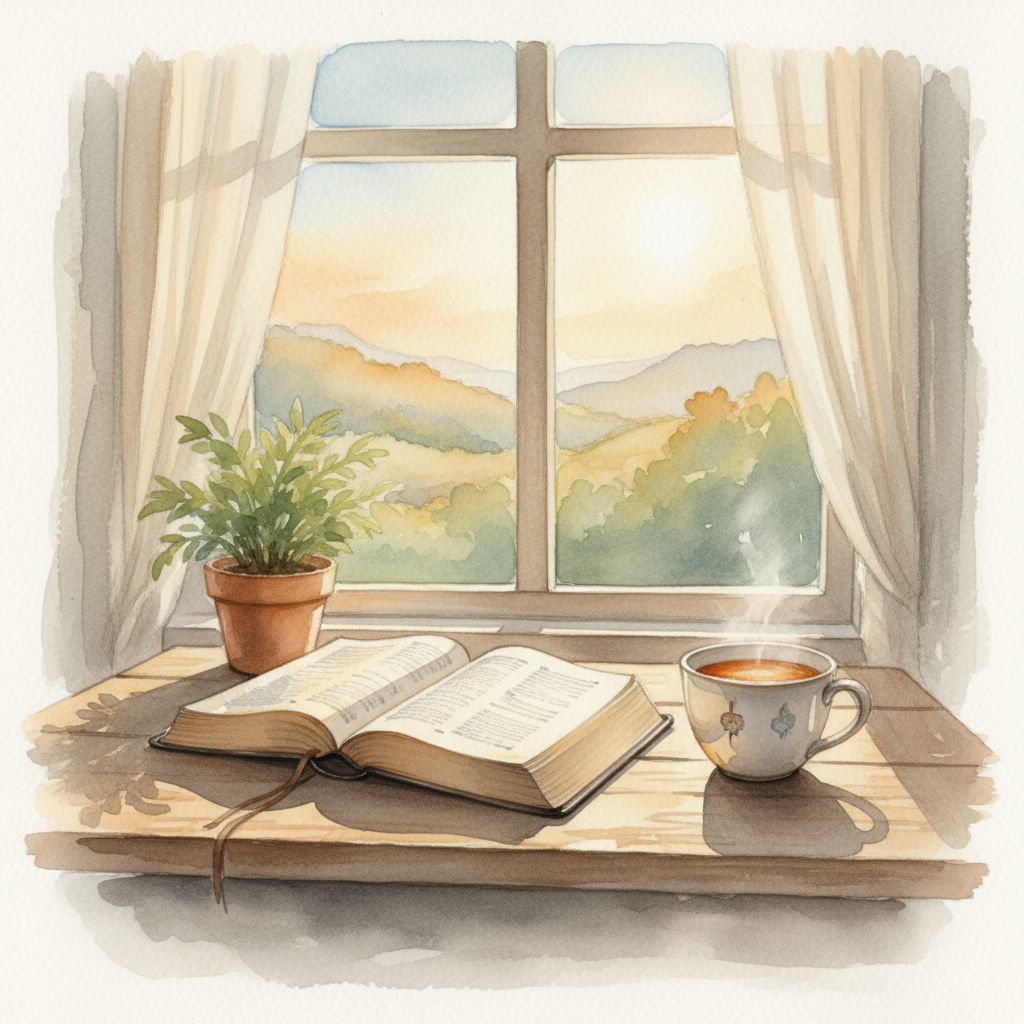
Reading Through the Bible Is a Step of Obedience Before It Is an Exercise in Understanding
There are many parts of the Bible that you will not understand as you read. That does not mean reading through the Bible is meaningful only when every verse becomes immediately clear. In Luke 24, Jesus opened the Scriptures to the disciples and made their hearts burn. As we continue reading the whole Bible, the Holy Spirit joins passages that once seemed scattered and helps us see a larger picture.
It is all right if you cannot make a perfect plan today. But the one chapter you read today and the one act of opening the Bible again tomorrow are not small. Reading through the Bible is not a project for people who know the most; it is the path of people who keep returning before the Word.
As Second Timothy 3:16 says, all Scripture is useful because it is given by God. Reading through the Bible is therefore not only a burden but also a place of grace. More important than how much you read today is the heart that sits down again before God's Word. As you continue one step at a time, this season of reading gradually shapes you into a person formed by the Word.
Related articles
Reading Through the Old Testament: Begin with the Flow of Each Book
This guide to reading the Old Testament explains why it can feel overwhelming and organizes the broad flow of the Pentateuch, historical books, wisdom books, and prophets together with a daily routine for continuing steadily.
New Testament Reading Guide: Steady Methods from Gospels to Epistles
A practical guide for those feeling overwhelmed about how to start and maintain their New Testament reading plan. It organizes biblically the suggested order, manageable quantities, application-focused routines, and ways to resume after interruption.
90-Day Bible Reading Plan: How to Read Deeply Instead of Speeding Through
An overview of the benefits, precautions, daily reading amounts, and practical routines for completing a 90-day Bible reading plan. This guide emphasizes understanding the big picture and Christ more clearly, rather than merely finishing quickly.
 Bible Habit
Turn this article into today’s reading habit
Keep your McCheyne plan, sequential reading, notes, and progress together so the next passage is always clear.
- Today’s passages
- Reading checklist
- Notes and highlights