

How Exodus 30 Sets Holy Service Apart
Explore how service before God was continually practiced and set apart through the instructions in Exodus 30 concerning the altar of incense, atonement money, bronze basin, anointing oil, and incense.
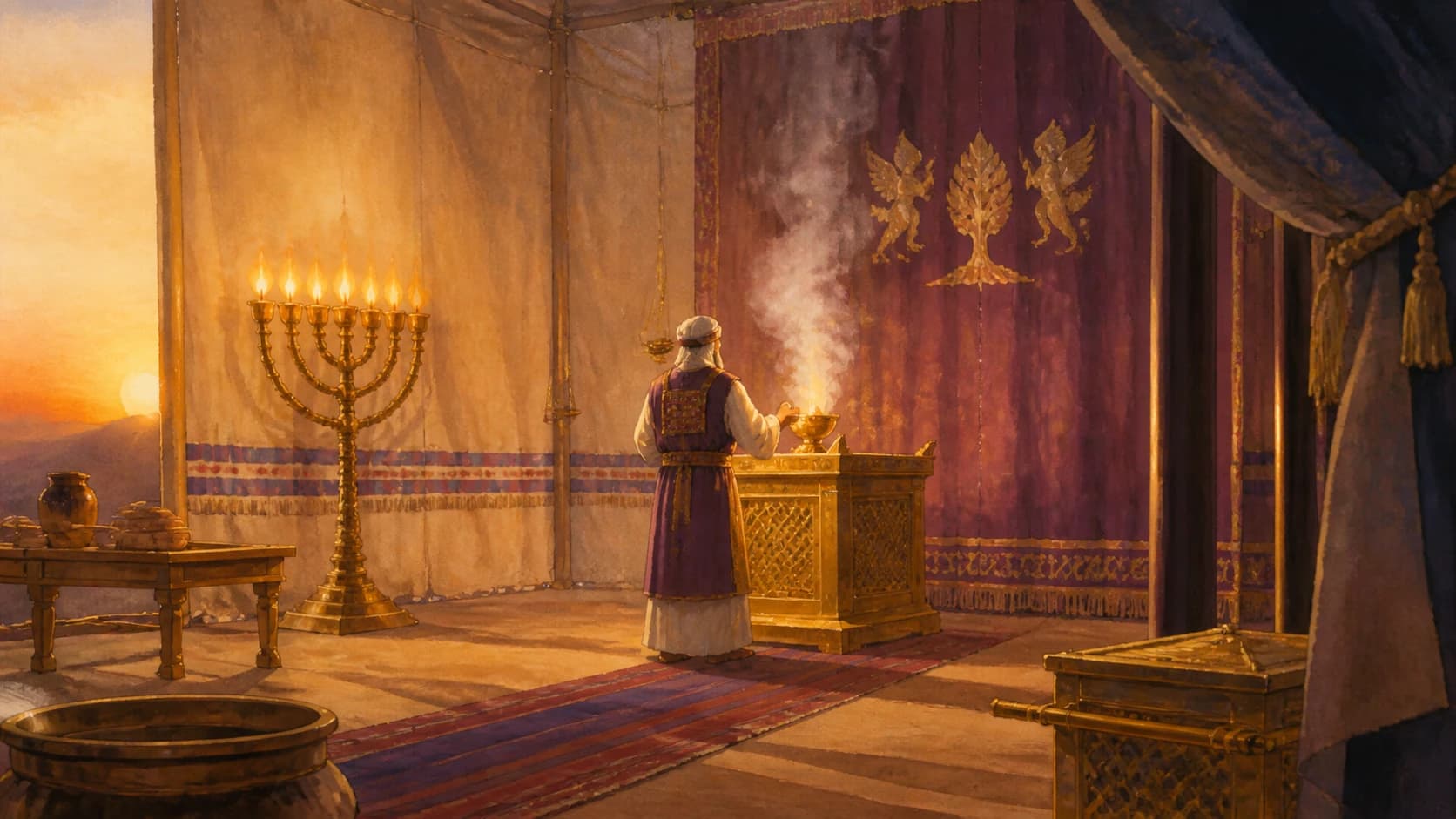
Exodus 30 commands that service before God be carried out repeatedly according to the prescribed way and kept distinctly separate from ordinary use. This distinction appears in the specific instructions concerning the altar of incense, atonement money, bronze basin, anointing oil, and incense. The people, places, and objects devoted to God’s service were to be treated according to the commands given in the passage, not according to human preference.
Incense Was Offered Every Morning and Evening
Moses was to make an altar for burning incense from acacia wood and overlay it with pure gold. The altar was to stand outside the curtain before the ark of the testimony, opposite the atonement cover where God promised to meet with Moses.
Aaron was to burn fragrant incense each morning when he tended the lamps. He was to burn it again in the evening when he lit them. The incense was not offered once and then forgotten. It was to continue throughout the generations as part of the morning and evening care of the lamps.
Not everything, however, could be placed on the altar. No unauthorized incense, burnt offering, or grain offering was permitted, nor could a drink offering be poured on it. The altar had a clearly defined purpose. Once a year, Aaron was to make atonement on its horns with blood from the sin offering. Both the continual burning of incense and the yearly act of atonement were commanded because the altar was most holy to the LORD.
Everyone Paid the Same Atonement Money
When the Israelites were counted, each person included in the census was required to pay a ransom for his life. Everyone twenty years old or older paid half a shekel according to the sanctuary shekel. The rich were not to give more than half a shekel, and the poor were not to give less.
Differences in wealth did not create differences in the payment. Everyone gave the same half shekel, and the collected money was used for the service of the tent of meeting. Before the LORD, it served as a memorial for the Israelites and was connected with making atonement for their lives. Everyone counted in the census stood under the same command.
The Priests Washed Their Hands and Feet Every Time They Entered
A bronze basin filled with water was to be placed between the tent of meeting and the altar. Aaron and his sons were to wash their hands and feet with its water whenever they entered the tent of meeting. They were also to wash before approaching the altar to present an offering made by fire.
Washing was not a ceremony performed only once when they first became priests. It had to be repeated every time they entered the tent of meeting or served at the altar. The passage states twice that they must wash so that they would not die, and this ordinance was to be observed by Aaron and his descendants throughout their generations. Holding a holy office did not remove the need for repeated cleansing.
The Anointing Oil and Incense Could Not Be Made for Other Purposes
The anointing oil, made from the prescribed spices and olive oil, was applied to the tent of meeting, the ark of the testimony, and its various furnishings. It was also applied to Aaron and his sons, consecrating them to serve as priests. The oil was used to set apart places, objects, and people for the service of the LORD.
For that reason, it was not to be poured on the body of an ordinary person or reproduced using the same formula. The incense placed before the ark of the testimony was likewise to be made from the prescribed ingredients in equal proportions, seasoned with salt, and kept pure and holy. Making the same incense for personal enjoyment was also forbidden.
In Exodus 30, holiness is not a vague feeling. It takes visible form in burning incense every morning and evening, requiring each counted person to pay the same atonement money, having priests wash whenever they enter, and reserving the anointing oil and incense for their appointed purposes. Service before God was shaped by a clear order: what had to be repeated was faithfully repeated, and what had been set apart was never mixed with personal use.
Today, read Exodus 30 again and mark every place where the words “throughout their generations,” “holy,” and “wash” appear. This will help you see at a glance which commands were repeated and what was kept separate from ordinary use.
 Bible Habit
Turn this article into today’s reading habit
Keep your McCheyne plan, sequential reading, notes, and progress together so the next passage is always clear.
- Today’s passages
- Reading checklist
- Notes and highlights