

Exodus 38 Records Even How the Tabernacle Materials Were Used
Exodus 38 describes the making of the altar of burnt offering, the basin, and the courtyard, then accounts for the amounts and uses of the gold, silver, and bronze. See how careful records confirm that the work was completed according to God’s command.
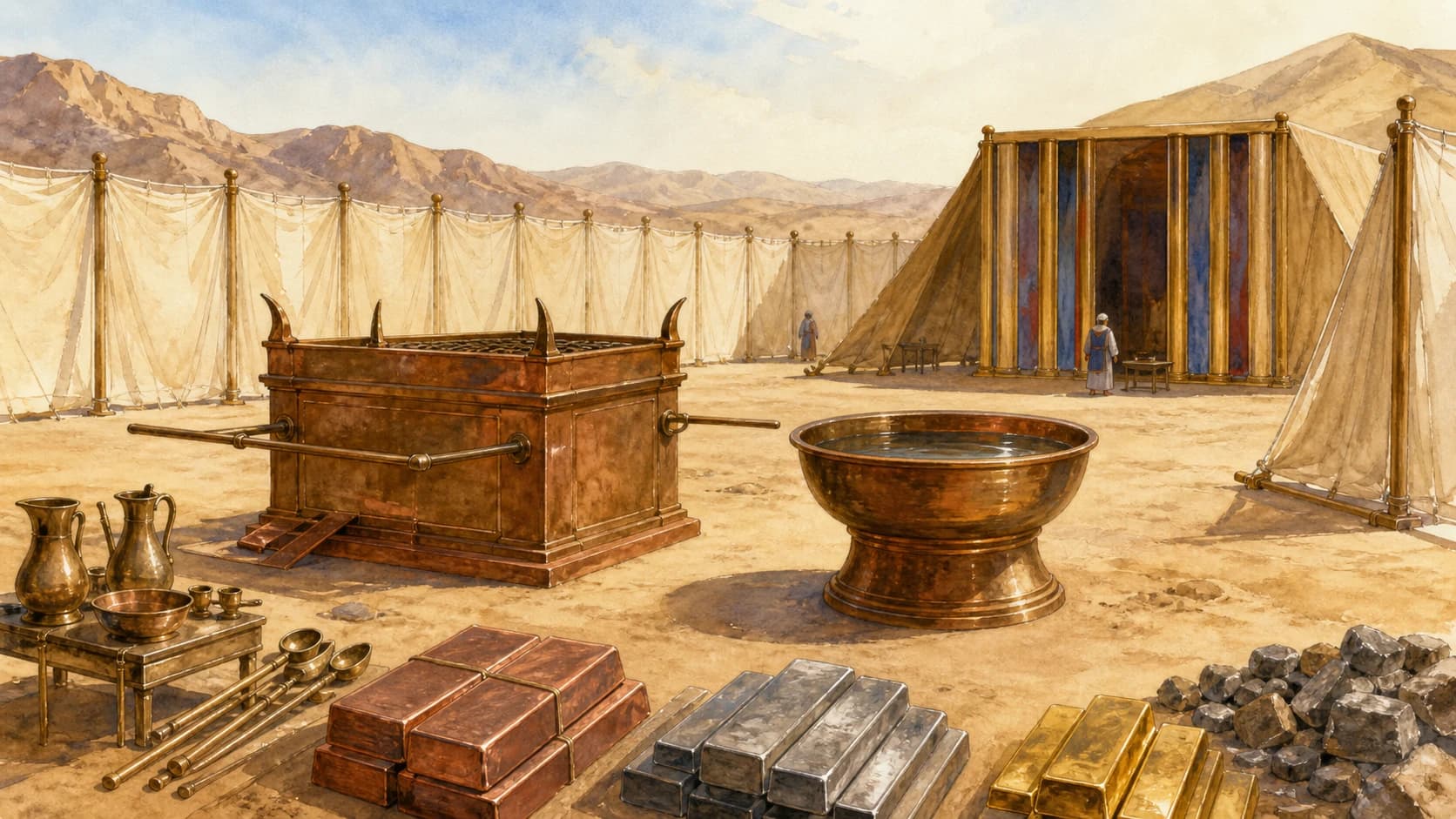
The central focus of Exodus 38 is that it records both the making of the tabernacle furnishings and the accounting of the materials used. The altar of burnt offering, the basin, and the courtyard were made according to the prescribed designs and materials. The chapter then gives a detailed account of the amounts and uses of the gold, silver, and bronze. By placing the completed work alongside the material records, the passage shows that the instructions Moses received were carried out in tangible objects and verifiable quantities.
The Altar of Burnt Offering Was Complete, from Its Dimensions to Its Means of Transport
Bezalel made the altar of burnt offering from acacia wood. It was five cubits long, five cubits wide, and three cubits high. The altar was square, with a horn at each of its four corners made as one piece with it. He overlaid it with bronze.
He also made all the altar utensils from bronze: the pots, shovels, basins, meat forks, and firepans. Four rings were attached to the bronze grating, and poles of acacia wood overlaid with bronze were inserted into the rings on both sides so the altar could be carried. The work did not stop with the altar’s outward form. Everything needed for the sacrifices, including the utensils and the structure for transporting the altar, was carefully provided.
The basin and its stand were also made of bronze. The passage explains that this bronze came from the mirrors of the women who served at the entrance to the tent of meeting. What they offered did not remain in its original form. It became the basin and its stand—specific objects used in worship.
The Dimensions and Materials of the Courtyard Matched on Every Side
The hangings on the south and north sides of the tabernacle courtyard were each one hundred cubits long. The west and east sides were each fifty cubits long. Each side had the appropriate number of posts and bases for its length. Matching sections of hangings, posts, and bases were also placed on both sides of the courtyard entrance.
The hangings around the courtyard were made of finely twisted linen. The post bases were bronze, while the hooks, bands, and post caps were silver. Blue, purple, and scarlet yarn and finely twisted linen were used for the curtain at the courtyard entrance. All the tent pegs for the tabernacle and its surrounding courtyard were made of bronze.
The passage describes the south, north, west, and east sides in sequence, repeatedly confirming their dimensions, numbers of posts, and materials. One side was not richly completed while another was overlooked. The hangings, bases, and connecting pieces on every side were finished according to the prescribed design.
Both the Craftsmen and the Person Who Kept the Account Are Named
The inventory of materials was recorded at Moses’ command by Ithamar, son of Aaron the priest. Bezalel made everything the Lord had commanded Moses, while Oholiab worked alongside him as an engraver, designer, and embroiderer.
Their names and responsibilities are clearly distinguished. Bezalel and Oholiab took part in the craftsmanship, while Ithamar accounted for the materials used. The tabernacle was not merely a finished work with a record of who made it. It was also a work for which the type and amount of every material had been calculated.
The Materials Given Could Be Matched with the Completed Work
The gold presented for the construction of the sanctuary totaled twenty-nine talents and 730 shekels. The silver amounted to one hundred talents and 1,775 shekels. This was the result of 603,550 men aged twenty and older, each contributing half a shekel.
The passage provides an even more detailed account of how the silver was used. One hundred talents of silver were used to make one hundred bases for the sanctuary frames and the curtain posts. The remaining 1,775 shekels were used for the post hooks, post caps, and bands.
The bronze presented totaled seventy talents and 2,400 shekels. It was used to make the bases for the posts at the entrance to the tent of meeting, the altar of burnt offering and its bronze grating, and all the altar utensils. Bronze was also used for the bases around the courtyard and at its entrance, as well as for all the tent pegs of the tabernacle and courtyard.
The altar, utensils, bases, and tent pegs described earlier in the chapter appear again in the final accounting of the materials. This allows readers to compare what was given with where it was used. Moses’ instructions became tangible objects through the craftsmen’s skill, and the completed work was further verified by the recorded amounts and uses of its materials.
One practical step for today is to make a brief record of the amount and use of one sum of money or item entrusted to you. As Exodus 38 records both what was received and where it was used, we can make our stewardship accountable not only in its results but also throughout the process.
Related articles
Deuteronomy 22 Teaches Us Not to Ignore a Neighbor’s Loss or Danger
Deuteronomy 22 commands God’s people to return lost animals, help fallen animals, and build parapets around their roofs. It explores our responsibility not to ignore losses and dangers we can plainly see.
Deuteronomy 19 Prevents Hasty Revenge and False Judgments
Through its laws concerning cities of refuge, boundary markers, and witnesses, Deuteronomy 19 distinguishes accidental death from intentional murder and prevents hasty revenge and false judgments.
Why Deuteronomy 17 Places Both Judges and Kings Under God’s Word
Deuteronomy 17 places everything—from investigating serious charges to handling difficult cases and limiting royal authority—under God’s commands, showing how human judgment can remain impartial.
 Bible Habit
Turn this article into today’s reading habit
Keep your McCheyne plan, sequential reading, notes, and progress together so the next passage is always clear.
- Today’s passages
- Reading checklist
- Notes and highlights