

Exodus 39 Shows the Work Completed as Commanded
Exodus 39 records how the priestly garments and tabernacle furnishings were made just as commanded, and how Moses inspected all the completed work and blessed the people.
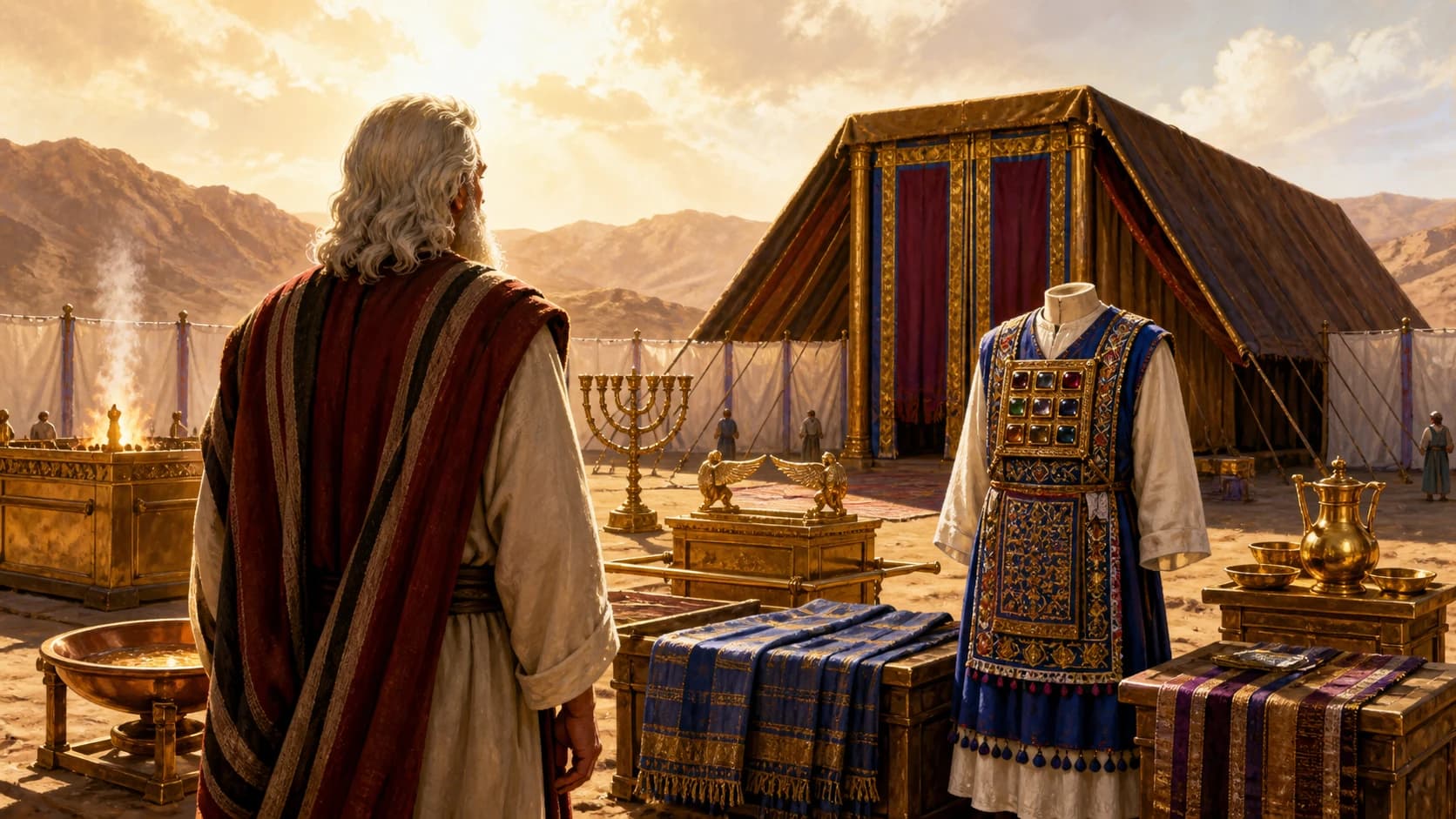
The central message of Exodus 39 is that the Israelites completed the tabernacle and the priestly garments just as the LORD had commanded Moses. The chapter does more than describe beautiful materials and skilled craftsmanship. It repeatedly confirms that both the process and the finished work matched the instructions they had received. At the end, Moses inspects everything, sees that it has been done as commanded, and blesses the people.
The Priestly Garments Were Made According to Every Detail of the Command
The Israelites made the finely crafted garments for service in the sanctuary, including the sacred garments for Aaron. The ephod was made with gold thread, blue, purple, and scarlet yarn, and finely twisted linen. They hammered the gold into thin sheets, cut it into threads, and worked it into the other yarns. The shoulder pieces and waistband were also made to match the ephod.
The names of the sons of Israel were engraved on two onyx stones. These stones were fastened to the shoulder pieces of the ephod as memorial stones for the Israelites. Twelve precious stones were mounted on the breastpiece in four rows, with the name of one of the twelve tribes engraved on each stone.
They also carefully followed the instructions for attaching the breastpiece to the ephod. They made gold rings and gold chains, then joined the rings with blue cords. In this way, the breastpiece was secured above the waistband and would not come loose from the ephod. After describing this work, the passage states that it was done “as the LORD had commanded Moses.”
The Same Confirmation Is Repeated for Each Garment
The robe worn under the ephod was woven entirely of blue yarn. Its opening was reinforced like the opening of a coat of mail so that it would not tear. Embroidered pomegranates and bells of pure gold were attached alternately around its hem. Once again, the passage confirms that the work was done as commanded.
They also made tunics, turbans, caps, undergarments, and sashes for Aaron and his sons. On a plate of pure gold, they engraved the words “HOLY TO THE LORD” and fastened it to the front of the turban with a blue cord. The passage does not say that the garments were complete merely because the materials were valuable or the designs were beautiful. It confirms that the command had been followed whenever each piece was made with the prescribed materials, form, and method of attachment.
This repetition shows that the garments used for service in the tabernacle were not designed according to the makers’ personal preferences. From the threads of the ephod and the rings of the breastpiece to the bells on the robe and the plate on the turban, the instructions they had received served as the standard for every part of the work.
Completion Included Bringing Everything Forward for Inspection
In verse 32, the Israelites finish all the work on the tabernacle, the tent of meeting. Yet the account does not end simply by saying that the project was complete. The people brought the tabernacle and all its furnishings to Moses. They presented everything—the tent coverings and frames, the ark of the covenant law, the table, the lampstand, the altars, the basin, the courtyard curtains, and the priestly garments.
Verse 42 summarizes once more that the Israelites had completed all the work just as the LORD had commanded Moses. Moses then inspected everything they had made. When he saw that it had been done as commanded, he blessed them.
In Exodus 39, therefore, finishing the work means more than simply producing the required objects. It means making every detail according to the instructions received, bringing forward everything that has been completed, and having it inspected against the original standard. The repeated phrase “as the LORD had commanded” and Moses’ final inspection make it clear that the tabernacle’s completion was judged not by human satisfaction but by its faithfulness to the command that had been given.
One thing you can do today is compare your finished work, item by item, with the standards you were originally given. As you read Exodus 39 again, consider marking each repetition of “as the LORD had commanded” and Moses’ final inspection.
Related articles
Why Does Deuteronomy 4 Tell Us to Remember and Obey?
Deuteronomy 4 explains why Israel must remember what they personally saw and heard God do, refuse to make idols, and obey his word without adding to it or taking away from it.
Why Did Israel Disobey Both Commands?
Deuteronomy 1 contrasts Israel’s refusal to go up when commanded with their later decision to go up after being told not to.
Why Does Numbers 33 Record Israel’s Journey?
Numbers 33 records Israel’s journey from Egypt to the plains of Moab and reveals the commands the Israelites were required to obey when they entered Canaan.
 Bible Habit
Turn this article into today’s reading habit
Keep your McCheyne plan, sequential reading, notes, and progress together so the next passage is always clear.
- Today’s passages
- Reading checklist
- Notes and highlights