

The Purpose of the Signs and Plagues in Exodus 7
In Exodus 7, we examine within the text the purpose for which God sent Moses and Aaron to Pharaoh and performed the signs and the first plague.
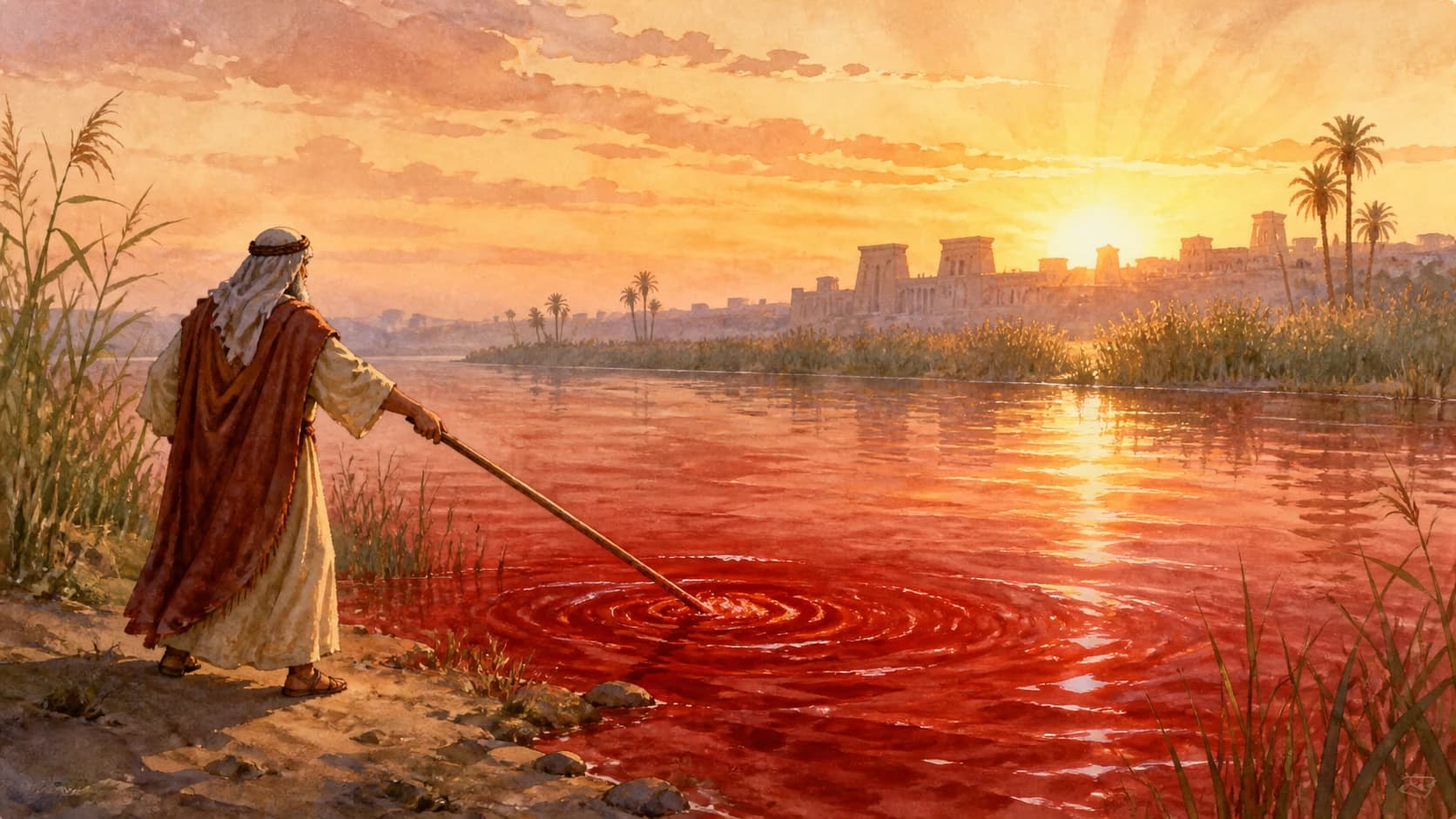
God performed signs and plagues in order to bring the Israelites out of Egypt and to let the Egyptians know that He is the Lord. Exodus 7 first makes this purpose clear, then shows the incident in which Aaron's staff and the waters of the Nile turned to blood. Moses and Aaron acted exactly as the Lord commanded, even in a situation where Pharaoh would not listen.
Why did God perform signs and plagues?
The Lord had already told Moses that Pharaoh would not listen to his words. Yet Pharaoh's refusal could not stop God's word. God said that He would stretch out His hand against Egypt and bring great judgments upon it, and that He would bring out His own people, the Israelites, from that land.
The text states that purpose clearly. When God brings the Israelites out of Egypt, the Egyptians will know that He is the Lord. The same purpose appears in the message He commanded to be delivered before the Nile was struck. Through the river turning to blood, Pharaoh would come to know that God is the Lord.
Therefore, the signs and plagues in Exodus 7 are not merely meant to show astonishing scenes. God revealed who He is before Pharaoh, who rejected His command. He also declared that He would bring the Israelites out of that land.
Moses and Aaron followed the command exactly
God told Moses the command he had received, and then had Aaron speak that message to Pharaoh. Moses and Aaron acted at once, exactly as the Lord had commanded. Even when Pharaoh demanded a sign, the two men followed the procedure God had spoken.
When Aaron threw down his staff before Pharaoh and his officials, it became a serpent. The magicians of Egypt also threw down their staffs and produced the same appearance, but Aaron's staff swallowed up their staffs. Even so, Pharaoh's heart was hardened, and he did not listen to Moses and Aaron. This outcome was also exactly what the Lord had said.
The text does not say that Moses and Aaron were the ones who succeeded in persuading Pharaoh. What is emphasized about the two of them is not the power to produce results, but their obedience in doing what was commanded. Even when Pharaoh would not listen, they delivered the word they had received and threw down the staff.
Pharaoh still did not listen even after the Nile turned to blood
The Lord sent Moses back to Pharaoh again. Moses had to tell Pharaoh to let the people of Israel go so they could serve God in the wilderness. Because Pharaoh still would not listen, God announced that when the Nile was struck, the water would turn to blood.
Moses and Aaron again acted exactly as the Lord had commanded. In front of Pharaoh and his officials, they struck the Nile with the staff, and the water turned to blood. The fish died, the river stank, and the Egyptians could not drink the water of the Nile. They dug around the riverbank to find water to drink.
But the Egyptian magicians also did the same by their secret arts, and Pharaoh's heart was hardened. He did not listen to Moses and Aaron, went back to his palace, and paid no attention to the matter. Even after the Nile turned to blood, Pharaoh's refusal continued.
Today, mark one repeated phrase in the passage
Exodus 7 does not explain the reason behind every difficult event. What we can clearly confirm in this chapter is that God stated His purpose, Moses and Aaron acted according to His command, and Pharaoh did not listen even after seeing the signs and plagues.
Today, while reading the whole chapter of Exodus 7, mark the phrase “as the Lord had commanded.” If you read the passages before and after each occurrence of this phrase, you can see more concretely what command Moses and Aaron received and how they actually acted. Rather than adding many of your own thoughts, it is enough to look carefully once at the actions of the two men, which the text repeats again and again.
Text Basis
- Exodus 7:1-7
- Exodus 7:8-13
- Exodus 7:14-25
Related articles
Why Does Deuteronomy 4 Tell Us to Remember and Obey?
Deuteronomy 4 explains why Israel must remember what they personally saw and heard God do, refuse to make idols, and obey his word without adding to it or taking away from it.
Why Did Israel Disobey Both Commands?
Deuteronomy 1 contrasts Israel’s refusal to go up when commanded with their later decision to go up after being told not to.
Why Does Numbers 33 Record Israel’s Journey?
Numbers 33 records Israel’s journey from Egypt to the plains of Moab and reveals the commands the Israelites were required to obey when they entered Canaan.
 Bible Habit
Turn this article into today’s reading habit
Keep your McCheyne plan, sequential reading, notes, and progress together so the next passage is always clear.
- Today’s passages
- Reading checklist
- Notes and highlights