

Genesis 10: Government Revealed in a Genealogy
Genesis 10 may look like a list of unfamiliar names, but it shows God’s rule over the history and diversity of the nations after the flood. Meditate together on everyday faithfulness and God’s providence in the repeated genealogy.
How to Read Genesis 10 Slowly: Learning God’s Rule Among Unfamiliar Names
Genesis 10 is one of the chapters that many readers pass through most quickly. It does not continue with a series of dramatic events, and unfamiliar names and places run on for a long time. Yet Scripture does not preserve meaningless lists. Instead, in a chapter like this we learn how carefully God deals even with what is not easily noticed by human eyes. Genesis 10 shows how humanity spread after the flood, while also quietly but clearly testifying that the history of the nations lies under God’s rule.
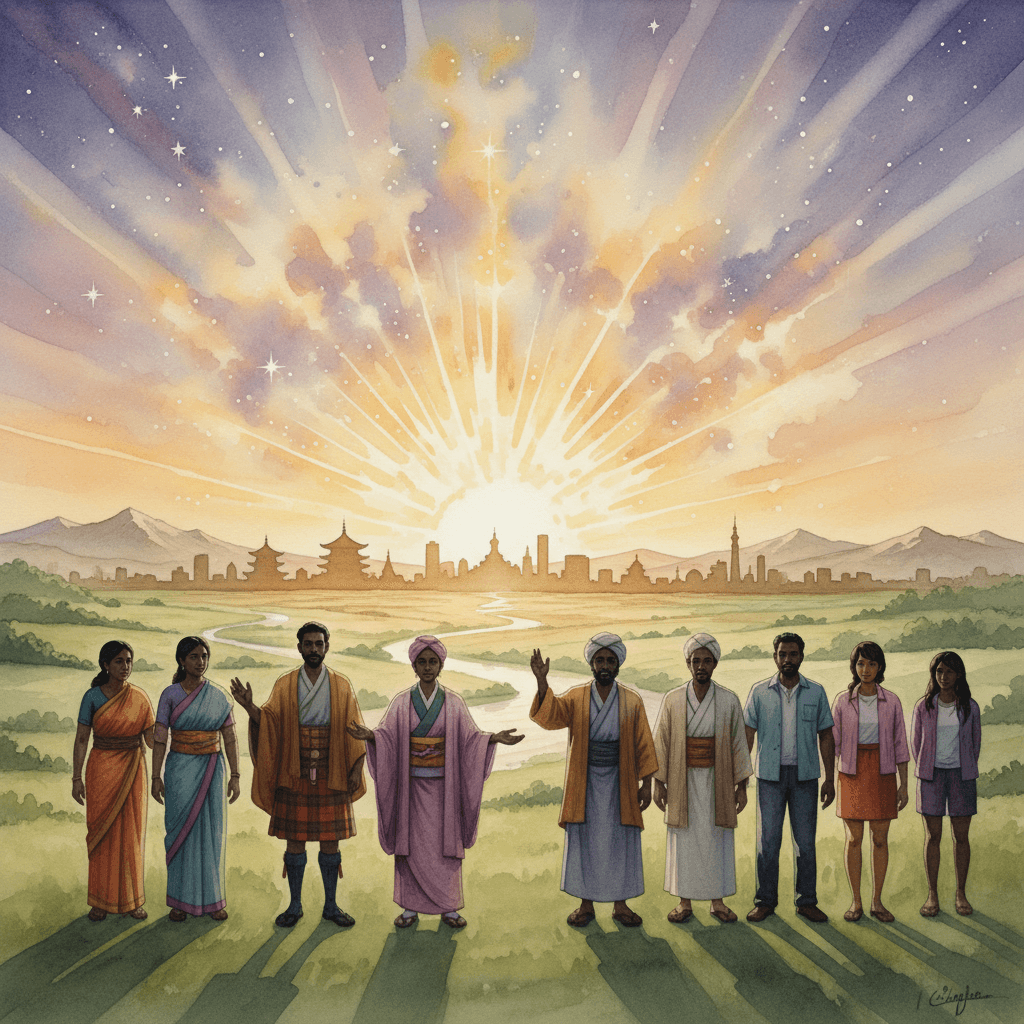
This chapter organizes the origins of various peoples and regions by following the lines of Noah’s three sons, Japheth, Ham, and Shem. Similar expressions are repeated throughout the passage. Genesis 10:5, 20, and 31 each show that the peoples were divided “according to their lands, their languages, their clans, and their nations.” This is not merely an organizing sentence. Scripture does not say that the diversity of human society arose by chance from chaos. There are lands, languages, clans, and distinctions between nations. It means that a world that appears different in many ways lies within God’s knowledge and permission.
This point also matters to us today. When we look at the world, we usually see division and conflict first. Because countries, cultures, languages, and ideas differ, conflict can seem even larger. At times, even the news makes the world feel as though it is endlessly breaking apart. But Genesis 10 opens a perspective within that complexity: God is still the Lord of history. People look at maps and think about borders, but Scripture looks at history and leads us to think about God’s providence.
A brief thought about the historical background makes the meaning of this chapter clearer. In the ancient Near Eastern world, genealogies organizing the origins of dynasties and peoples were very important. A genealogy was not merely a document recording whose son someone was; it was a framework of memory showing where a community came from and with whom it was connected. In that sense, Genesis 10 does not speak narrowly about Israel’s history alone. It places all the nations within its view. Here it becomes clear that God is not confined to being the God of one nation, but has been working from the beginning as Lord of the whole world.
One name that stands out in the passage is Nimrod. Genesis 10:8-9 says, “Cush fathered Nimrod; he was the first on earth to be a mighty man. He was a mighty hunter before the LORD.” It then records that the beginning of his kingdom was several cities in the land of Shinar. Scripture does not hide human ability and influence here. There are people who are genuinely strong and prominent, and there are names that appear large in history. Yet Scripture’s interest is not to praise that strength itself. Power that does not fear God easily turns toward exalting itself. Scripture makes us see God’s sovereignty as greater than human greatness.
Therefore, the important question when reading Genesis 10 is not “Who is the strongest?” but “Who is holding history in his hands?” The names are many and the flow is complex, but the whole passage says that God has not forgotten humanity. What may look to our eyes like a single line of names is, to God, real lives and real history. Birth, dispersion, settlement, and the formation of nations do not occur outside God’s knowledge.
This truth is also a great comfort in daily life. Some days our own lives can feel like a genealogy. There is no dramatic event, only tasks lined up one after another. There is no visible achievement, and from another person’s perspective an ordinary day simply repeats. But Genesis 10 tells us that such time is not meaningless before God. People tend to remember only dramatic scenes, but God knows and counts each name. Quiet faithfulness, unnoticed effort, repeated service in caring for a family, and time spent honestly keeping one’s place at work also belong within God’s record.
Here is a short example. Someone may think that life is too ordinary to have anything to do with the kingdom of God, because there is no grand ministry and no highly recognized position. But when that person reviews the day, the picture changes. Keeping a promise, choosing honesty before a small temptation, speaking gently to family despite being tired, and returning to the Word when the heart is unsettled are not small things. Scripture does not treat such faithfulness lightly. Like the names in Genesis 10, an unnoticed place also lies within God’s larger story.
Another point we must not miss is Scripture’s view of the nations. Genesis 10 shows the beginnings of peoples. It is not merely a source explaining the distribution of ancient peoples. It can also be read as preparing the stage on which God will unfold redemptive history among the nations. People easily turn differences into standards of boundaries and superiority, but Scripture sees diverse peoples as those under God’s rule. When Christians meet people from other cultures and backgrounds, they should remember first not fear or contempt, but the image of God and the gospel needed by every person.
There is also a practical way to read Genesis 10 more deeply. Mark repeated words. When you notice expressions such as “land,” “language,” “clan,” and “nation,” the center of the chapter becomes clearer. Rather than trying to memorize every name, follow the structure. Holding on to the broad movement of Japheth, Ham, and Shem already makes the passage less daunting. Ask, “Why did God preserve this record?” when reading a genealogy. Then information becomes meditation. Bible reading is not only the search for moving verses; it is also learning the order emphasized by the passage. If you need help building a steady Bible-reading habit, you can also consult Seven Bible Reading Habits.
It is also helpful to view this kind of passage within the flow of the whole Bible rather than reading it as an isolated fragment. The list of nations in Genesis 10 connects to the story of Babel that follows and, farther ahead, to God’s plan to bless all nations through Abraham. In the end, Scripture does not stop with the story of scattered nations; in Christ it moves into God’s history of salvation, in which he calls his people from every nation, tribe, people, and language. Genesis 10 can therefore be read not merely as an ancient list of peoples, but as a passage opening the broad horizon of redemptive history.
The more unfamiliar the passage feels, the more important it is to read slowly. If you hurry through it, only names remain and the message fades. But when you observe repetitions and follow the structure, a passage that first seemed dry can instead cultivate a God-centered perspective. If you want to read consistently each day, you can use Today’s McCheyne Reading Chart or the 365-day reading schedule. When you are curious about an unfamiliar name or a related passage while reading the Bible, checking the context through AI Bible Search can also help.
Genesis 10 does not capture us with spectacular miracles or dramatic reversals. Instead, through a calm list and repeated sentences, it shows that God is ruling the world. This is actually more realistic. Our lives are not always dramatic either. Most days are filled with nameless effort, repeated responsibilities, and choices that receive little attention. Yet right there, God does not stop his rule.
Genesis 10:32 summarizes the whole chapter: “These are the clans of the sons of Noah, according to their genealogies, in their nations, and from these the nations spread abroad on the earth after the flood.” What appears scattered is not destroyed. What appears diverse has not escaped God’s hand. Therefore, our perspective today can also change a little. Rather than becoming impatient at a complicated age, we can trust God’s rule more deeply; rather than trying to make our own name great, we can learn faithfulness in the place entrusted to us. That is the direction of faith Genesis 10 quietly teaches.
 Bible Habit
Turn this article into today’s reading habit
Keep your McCheyne plan, sequential reading, notes, and progress together so the next passage is always clear.
- Today’s passages
- Reading checklist
- Notes and highlights