

Why Did Esau Sell His Birthright in Genesis 25?
In Genesis 25, we look at how Esau traded his birthright for red stew, and consider one action for protecting what is precious in the face of immediate need.
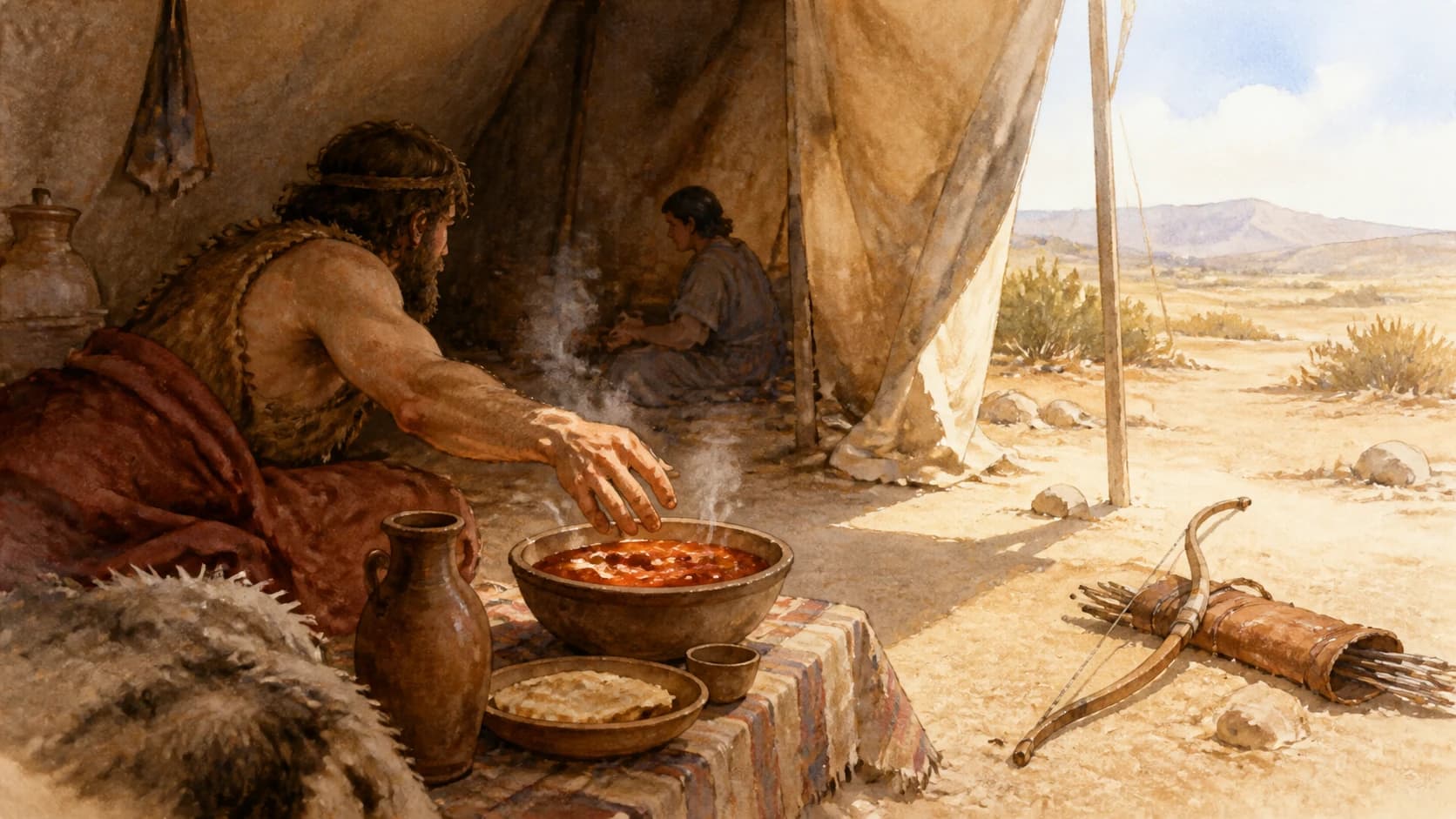
Esau put his immediate hunger first and sold his birthright to Jacob, and the passage says that he despised his birthright. Genesis 25:19-34 records everything from the birth of Esau and Jacob to the moment the birthright is traded. In this article, we confirm from the words and actions in the passage why Esau sold his birthright.
What Did Esau Have to Choose?
Esau was born first to Isaac and Rebekah. Jacob came out after him, holding on to Esau’s heel with his hand. The two were born together, but the birthright belonged to Esau, who came out first.
Their lives after they grew up were different from each other. Esau became a skilled hunter and lived in the field, while Jacob dwelt in tents. One day, when Jacob was simmering stew, Esau came back from the field. He was in a very exhausted state.
Esau asked Jacob to let him eat the red stew. Jacob did not serve the food right away. Instead, he first demanded that Esau sell him his birthright. Esau had to choose between meeting his hunger and keeping his birthright.
Hunger Seemed Bigger Than the Birthright
Esau said that he was about to die. Then he asked what good the birthright would do for him. His words reveal what he considered more important in that moment. He placed the need for food right then ahead of the birthright.
Jacob did not receive only a verbal promise. He required Esau to swear to it that very day. Esau swore and sold his birthright to Jacob. This decision was not left as a passing statement; it was confirmed by an oath.
The passage does not describe Esau as trading without knowing what his choice meant. Jacob demanded the birthright, and Esau spoke of it as if it were not beneficial to him. Then he personally swore and sold it. The passage shows, step by step, the request and response between the two men.
What His Eating and Leaving Revealed
After the deal was finished, Jacob gave Esau bread and lentil stew. Esau ate and drank. Then he got up and left. Right after this brief action, the passage judges that Esau despised his birthright.
The reason Esau sold his birthright is clear within the passage itself. He was extremely tired and wanted food. He said that the birthright was of no benefit to him. In the end, he gave up the birthright in order to satisfy the need right in front of him.
This scene does not say that hunger itself was wrong. What the passage points out is Esau’s attitude of treating the birthright lightly. He did not stop at asking for what he needed; he exchanged the birthright he possessed for food.
Putting Off an Important Decision Today
We, too, can speak lightly of important things when we are tired or in a hurry. In that moment, what we can get right away looks biggest. But Esau’s choice shows that urgent need does not erase the value of what is precious.
There is one thing to do today. If you need to make an important decision while you are tired or feeling pressed, first delay the decision once and read Genesis 25:29-34 again at this link. Then write down, in one sentence each, what you want right now and what you would give up because of that choice. It is a small, concrete way to check whether you are speaking only from the urgency of the moment, as Esau did.
Text Basis
- Genesis 25:19-28 (ESV)
- Genesis 25:29-34 (ESV)
Related articles
Deuteronomy 16 Commands Remembrance, Joy, and Justice
Explore how Deuteronomy 16 connects the three annual festivals and the command to appoint judges, showing how remembering the exodus from Egypt leads to shared joy and impartial justice.
Why Does Deuteronomy 11 Set Before Israel a Blessing and a Curse?
Deuteronomy 11 calls Israel to remember what God has done, teach his word in everyday life, and obey his commands when faced with the choice between blessing and curse.
What Responsibility Did Deuteronomy 3 Give Those Who Had Received Their Land?
Deuteronomy 3 recounts the defeat of King Og of Bashan, the allocation of land east of the Jordan, the command to lead their fellow Israelites into battle, and the responsibility entrusted to Joshua.
 Bible Habit
Turn this article into today’s reading habit
Keep your McCheyne plan, sequential reading, notes, and progress together so the next passage is always clear.
- Today’s passages
- Reading checklist
- Notes and highlights