

Joshua at a Glance: Learning Obedience in the Promised Land
This overview of the Book of Joshua covers the entry into Canaan, conquest, land distribution, and covenant renewal, highlighting God's faithfulness and the meaning of obedience. Explore key verses and practical applications in one glance.
Joshua at a Glance: Learning Obedience in the Promised Land
The Book of Joshua depicts a period after Moses. It centers around God leading His people into the land promised to their ancestors after the exodus and wilderness wandering. When reading Joshua, don’t view it merely as a story of battles, but also as a story of a faithful God fulfilling His promises and the people's response before His word. The book can be divided into three main streams: entering Canaan, conquering the land, and dividing and renewing the covenant.
The opening words of the book serve as the key to the entire narrative. God promises Joshua, “Just as I was with Moses, I will be with you; I will not leave you nor forsake you” (Joshua 1:5). The command to be strong and courageous is repeated several times (Joshua 1:6, 7, 9). Courage here is not about self-confidence but a trusting attitude rooted in God's presence. Additionally, Joshua 1:8 clearly shows the core application of this book: “Keep this Book of the Law always on your lips; meditate on it day and night, so that you may be careful to do everything written in it.” Joshua’s leadership rests not on military skill but on obedience to God's word.
1. Entering Canaan: God Opens the Way
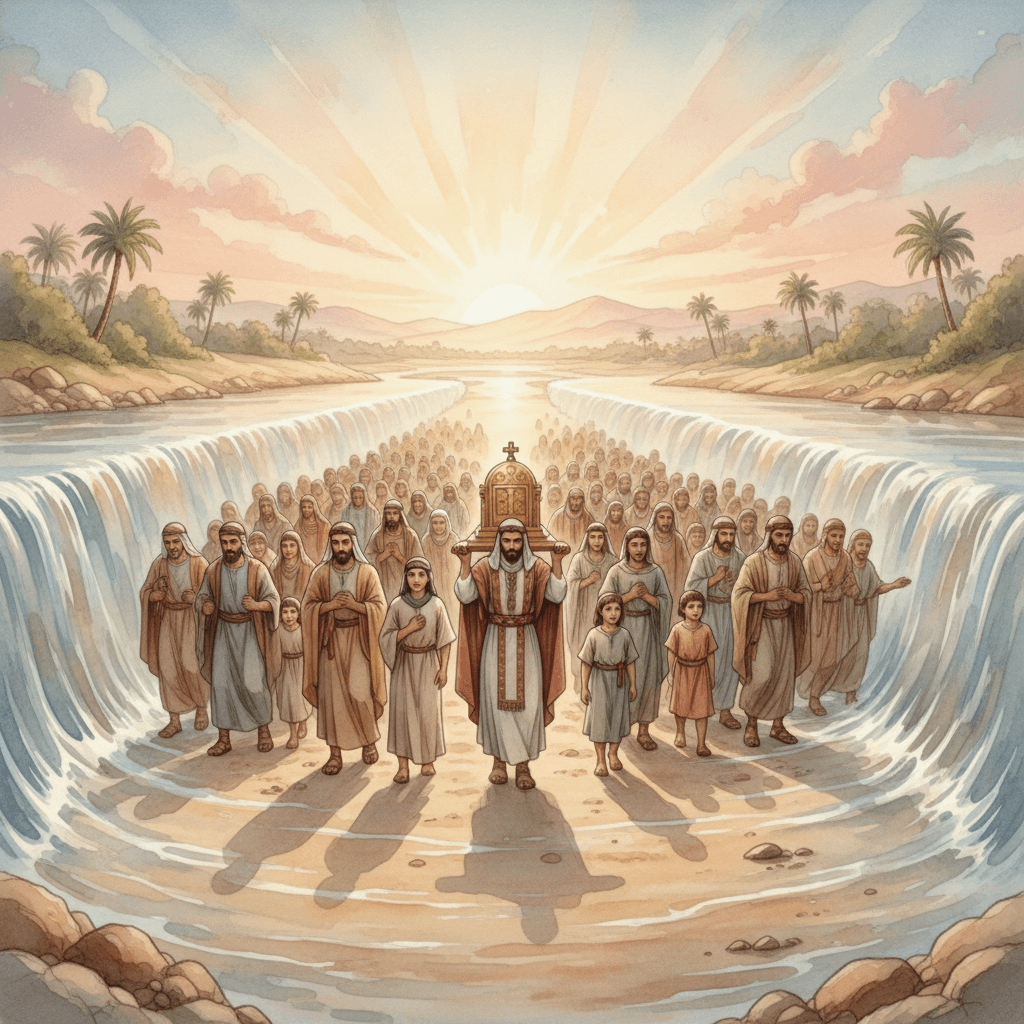
Chapters 1 to 5 describe crossing the Jordan River into the promised land. Especially significant is the event of crossing with the Ark of the Covenant, signifying that just as God parted the Red Sea, He also works similarly for this new generation. The faithful God does not change despite the change of generations. The God who led Israel in the wilderness now personally leads His people at the entrance of Canaan.
The story of Rahab before confronting Jericho is also crucial. Although she was a foreigner, hearing about Israel’s God and believing responded with faith. From the very beginning, Joshua shows that God's salvation is not dependent on bloodline or background but on faith. Hebrews 11 and James 2 refer to Rahab as an example of faith. Her story is not just a side episode but a vital passage demonstrating how God saves individuals.
Furthermore, the scenes where Israel undergoes circumcision and observes the Passover in chapter 5 are vital. These acts reaffirm them as the covenant people before conquering. It shows that victory depends not on military power or numbers but on God's covenant. Joshua’s start emphasizes worship and obedience over military strategy.
2. Conquest Records: Victory and Holiness Go Hand in Hand
Chapters 6 to 12 recount the conquest. The fall of Jericho was not due to human strategy but obedience to God's command. The unconventional circling of the city was not a typical tactic, and that’s precisely why it demonstrated that the victory belonged to God. Israel obeyed, and God brought down the city.
Conversely, the failure at Ai reveals how severely disobedience within the community is dealt with through the sin of Achan. Joshua 7 is a section that must be read carefully. What seems like a small greed is enough to shake the entire community. We often restrict our caution to obvious large problems, but God does not overlook hidden disobedience. Therefore, Joshua is both a book of victory and holiness.
When reading this, we must not dismiss God's holiness and judgment lightly. The conquest of Canaan should be seen as a scene of God's righteous judgment, carried out after patience. At the same time, it reveals that Israel also faces God's holiness when they disobey. Joshua shows that God is not partial but works according to His covenant and holiness.
3. Land Distribution: The Promise Becomes Reality
Chapters 13 to 21 detail the land division. While it may read like a list of place names, this section testifies to God's faithfulness. The promise is not an abstract word but is fulfilled through actual land, boundaries, and inheritance. God shows the truth of His word through concrete achievement, not vague comfort.
Joshua 21:45 declares, “Not one of all the Lord’s good promises to Israel failed; every one was fulfilled.” This verse serves as a summary of the entire book. Although God's promises may seem delayed, they are never lost. The promises to Abraham, the guidance during exodus, and wilderness training all point to this declaration.
Connecting Joshua with earlier books like Numbers and Deuteronomy is important. Seeing how promises made there are fulfilled in Joshua clarifies the broader biblical flow. This connection becomes even clearer when reading through Bible Reading. To check your progress, you can use Progress Calculator to organize your reading flow. For understanding the importance of continuous Bible reading, see Why Reading the Whole Bible Matters.
4. Covenant Renewal: Serve Only God to the End
Chapters 22 to 24 focus on final words and covenant renewal. In particular, chapter 24 is Joshua’s farewell sermon. He recounts God’s deeds and urges the people to choose whom they will serve. And he leaves a well-known declaration: “But as for me and my household, we will serve the Lord” (Joshua 24:15). This is not just a motto but a covenant decision to align one’s life with God's promises.
Joshua’s conclusion is not a celebration of victories but a call to serve only God until the end. The key point is that entering Canaan was not the ultimate goal. The true purpose was to live within God’s covenant. More important than possessing land is who they serve in that land.
A Message to Today’s Christians
The message Joshua offers to today’s believers is clear:
- First, when facing new challenges and responsibilities, what is needed is not vague confidence but trust rooted in God's promises. The assurance that God is with us underpins boldness.
- Second, don’t take small disobediences lightly. God cares more about inner holiness than outward success.
- Third, God's promises are greater and more precise than our impatience. Even if delayed, His word will never return empty.
- Fourth, obedience is not about emotional highs but a continuous attitude of walking by Scripture. Joshua 1:8 emphasizes daily meditation and obedience more than a single decision. Understanding Devotion helps apply this. If you wish to stay close to God's Word briefly each day, you can maintain the habit through Today’s Manna.
As you reflect on Joshua, don’t just follow the tension of battles but also observe God’s constant character. He is a faithful presence, a promise-keeper, and a holiness-demanding God. Reading Joshua prompts us to ask: do I hesitate because of the size of my problems, or do I cling to His word and step in obedience?
Let’s finish with Joshua’s enduring words: “Be strong and courageous. Do not be afraid; do not be discouraged, for the Lord your God will be with you wherever you go” (Joshua 1:9). Remember also the concluding declaration: “Not one of all the Lord’s good promises to Israel failed; every one was fulfilled” (Joshua 21:45).
When reading Joshua, rather than skimming through the content, it’s beneficial to ask: Who is God? And how should I respond in obedience to His word? Ultimately, the heart of the story of entering the promised land is a God who keeps His promises. Knowing this God is the greatest fruit of reading Joshua.
Related articles
What Responsibility Did Deuteronomy 3 Give Those Who Had Received Their Land?
Deuteronomy 3 recounts the defeat of King Og of Bashan, the allocation of land east of the Jordan, the command to lead their fellow Israelites into battle, and the responsibility entrusted to Joshua.
Why Does Numbers 34 Establish Both Boundaries and Those Responsible for the Allotment?
Numbers 34 describes the boundaries of Canaan in detail and entrusts the division of the inheritance to Eleazar, Joshua, and the tribal leaders. This article explores why both the boundaries and those responsible for the allotment were clearly established.
How Zelophehad’s Daughters and Joshua Filled the Gaps
Numbers 27 recounts two decisions in succession: granting an inheritance to Zelophehad’s family, who had no sons, and appointing Joshua to succeed Moses.
 Bible Habit
Turn this article into today’s reading habit
Keep your McCheyne plan, sequential reading, notes, and progress together so the next passage is always clear.
- Today’s passages
- Reading checklist
- Notes and highlights