

The Meaning of the Lord's Supper: A Table That Remembers the Gospel
The Lord's Supper is not merely a ceremony but a place to remember and proclaim the new covenant established through Christ's body and blood. Following 1 Corinthians 11, this article calmly considers its meaning and its application to life today.
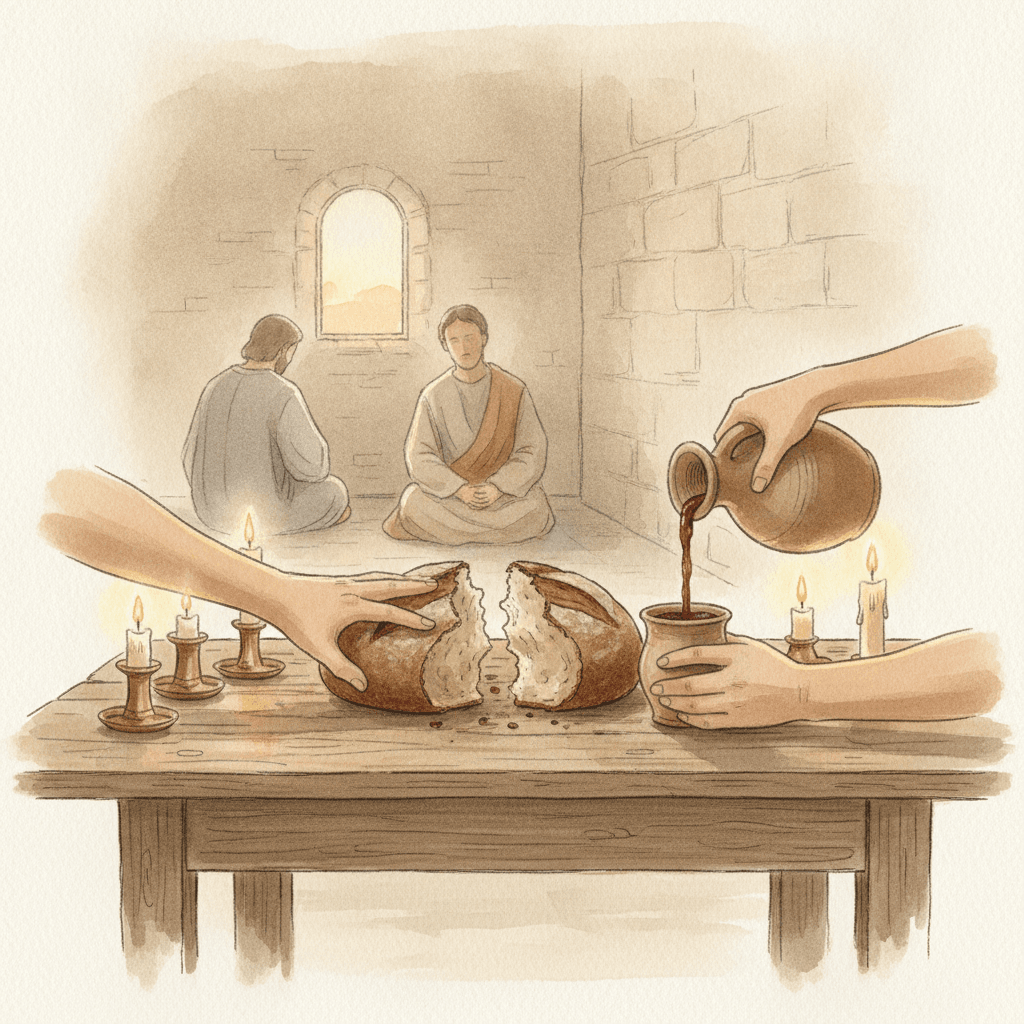
The Meaning of the Lord's Supper: A Table That Remembers the Gospel
The Lord's Supper is so familiar a ceremony that it can actually become a place where the heart grows numb. When a piece of bread and a sip from the cup pass quickly, it is easy to receive the moment merely as a reverent atmosphere. But the Lord's Supper is not decoration for worship. It is the time when the church places the gospel before its eyes and confirms it again, a table where we confess that Jesus Christ's cross remains the basis of our life today.
The center of the Lord's Supper in Scripture is clear. On the night he was arrested, Jesus broke bread and gave it to his disciples, saying, “This is my body, which is for you; do this in remembrance of me,” and about the cup he said, “This cup is the new covenant in my blood; do this, whenever you drink it, in remembrance of me” (1 Corinthians 11:24–25). The bread and the cup themselves are not the center. The center is the Lord's body, broken for us, and the Lord's blood, poured out for our sins.
There is a clear background to Jesus giving these words at a table: Passover. Exodus 12 tells us that when the blood of a lamb was put on the doorposts and lintel, judgment passed over that house. Israel continued to keep Passover in memory of that night. Then, at the very place of that feast, Jesus revealed that he is the true Lamb. What now saves God's people is not the blood of an animal but Christ's sacrifice, offered once for all.
If we miss this meaning, the Lord's Supper quickly becomes a religious habit. If we hold on to it, the bread and cup become unmistakable signs of the gospel. In the small actions of seeing with our eyes and receiving with our hands, we newly sense how great and holy a price God paid for sinners. Even on a day when faith feels blurred, the Lord's Supper speaks the same truth: the way to God rests not on our mood or merit but on Christ's blood.
First Corinthians 11 is a passage we must hold firmly when understanding the Lord's Supper. Paul rebukes the disorder in the Corinthian church and urges them not to treat the Lord's Supper carelessly. Rich and poor were together in that church, but some ate and drank first until they were full while others were left out. They received the same bread while despising one another. Paul's reason for rebuking them was not merely a matter of etiquette; their hearts were out of step with the gospel.
The Lord's Supper does not speak only of an individual's experience of grace. It also shows that those who belong to one Lord are one body. If I confess that I have been forgiven by the Lord's blood while despising a brother or sister, I have moved away from what the bread and cup proclaim. The Supper quietly shines a light on whether there is someone in the church whose name we know but around whom we have built a wall, or whether we have cared only for our comfortable place and treated someone as invisible. Before that table, the truth of our relationships appears more clearly than our religious words.
That is why Paul says, “Everyone ought to examine themselves before they eat of the bread and drink of the cup” (1 Corinthians 11:28). Examining yourself does not mean coming only after you have become perfect. It is not a demand that only people without fault may participate. Rather, it is close to a call to acknowledge sin, know that we cannot stand without grace, repent, and come to the Lord. The posture suited to the Lord's Supper is not self-confidence but reliance on the Lord's mercy.
The church has regarded the Lord's Supper as very important from long ago. The early church received baptism and the Lord's Supper as holy signs entrusted directly by the Lord. As time passed, many discussions arose about how to explain the meaning of the bread and cup, but the center held by the historic church did not change. The Lord's Supper is not a sacrifice that repeats Christ's once-for-all atonement; it is a table that remembers and proclaims the cross already completed.
This confession touches the gospel proclaimed in Hebrews. Jesus offered himself once and bore sin, and his sacrifice does not need to be repeated. The Lord's Supper is therefore not an act of sacrificing Jesus again. It is the place where we receive by faith the redemption he has already accomplished. The church does not create a new salvation with bread and cup. It simply holds gratefully to the grace already given.
The Lord's Supper contains more than remembrance; it also contains hope. Paul says, “Whenever you eat this bread and drink this cup, you proclaim the Lord's death until he comes” (1 Corinthians 11:26). The Supper makes us look back to remember the cross and look forward at the same time. It teaches us to wait for the Lord who will return, the kingdom of God that will be completed, and the feast where tears and sin will end.
This hope gives more strength to daily life than we might expect. Some weeks the weight of ordinary life feels greater than our faith. There are days when pending work, unresolved relationships, and repeated guilt take the heart all the way down. At such times, the Lord's Supper does not offer a grand solution all at once; it helps us settle again in whose grace we live. We hold on to the truth that we are not people who prove themselves by achievement, but people who live by the Lord's body and blood.
For example, we may make a mistake at work and keep replaying the scene when we get home. There are days when a relationship becomes awkward because of one sentence we said, but pride keeps us from making peace first. Remembering the Lord's Supper on such a day changes the direction of the heart a little. If God received me freely, I can stop hiding and admit my sin. If the Lord reconciled me, I have a reason to reach out first as well.
The Lord's Supper may not be a ceremony that raises our emotions dramatically. On one day tears may come; on another we may feel entirely calm. What matters is not the intensity of emotion but the direction of faith. Whom am I relying on now? By what am I justified? What makes the church the church? The Lord's Supper brings these questions back before the gospel.
When receiving the bread and cup in Sunday worship, it is good to stand before questions like these, even briefly. Am I trusting my condition more than the Lord's grace? Do I speak of forgiveness with my lips while pushing someone away in my heart? Was the strength that held me through the week achievement and recognition, or the grace of the cross? The Lord's Supper is not a place meant to press us into condemnation; it is a place that calls us back to the cross.
Therefore, even though it is a familiar ceremony, it is good not to pass through it lightly. The bread and cup are small and quiet, but the heart of the gospel is contained in them. The Lord gave his body for us, established the new covenant with his blood, and called the church into that grace. The more rightly we consider the Lord's Supper, the more humbly we see ourselves and the more clearly we see the cross. A person who remembers that table even in the middle of a busy week learns again how to live by grace.
 Bible Habit
Turn this article into today’s reading habit
Keep your McCheyne plan, sequential reading, notes, and progress together so the next passage is always clear.
- Today’s passages
- Reading checklist
- Notes and highlights