

The Cloud Covered the Tabernacle When Moses Set It Up as Commanded
Exodus 40 records how Moses set up the tabernacle and arranged all its furnishings in the commanded order, after which the cloud covered it and directed Israel’s journey.
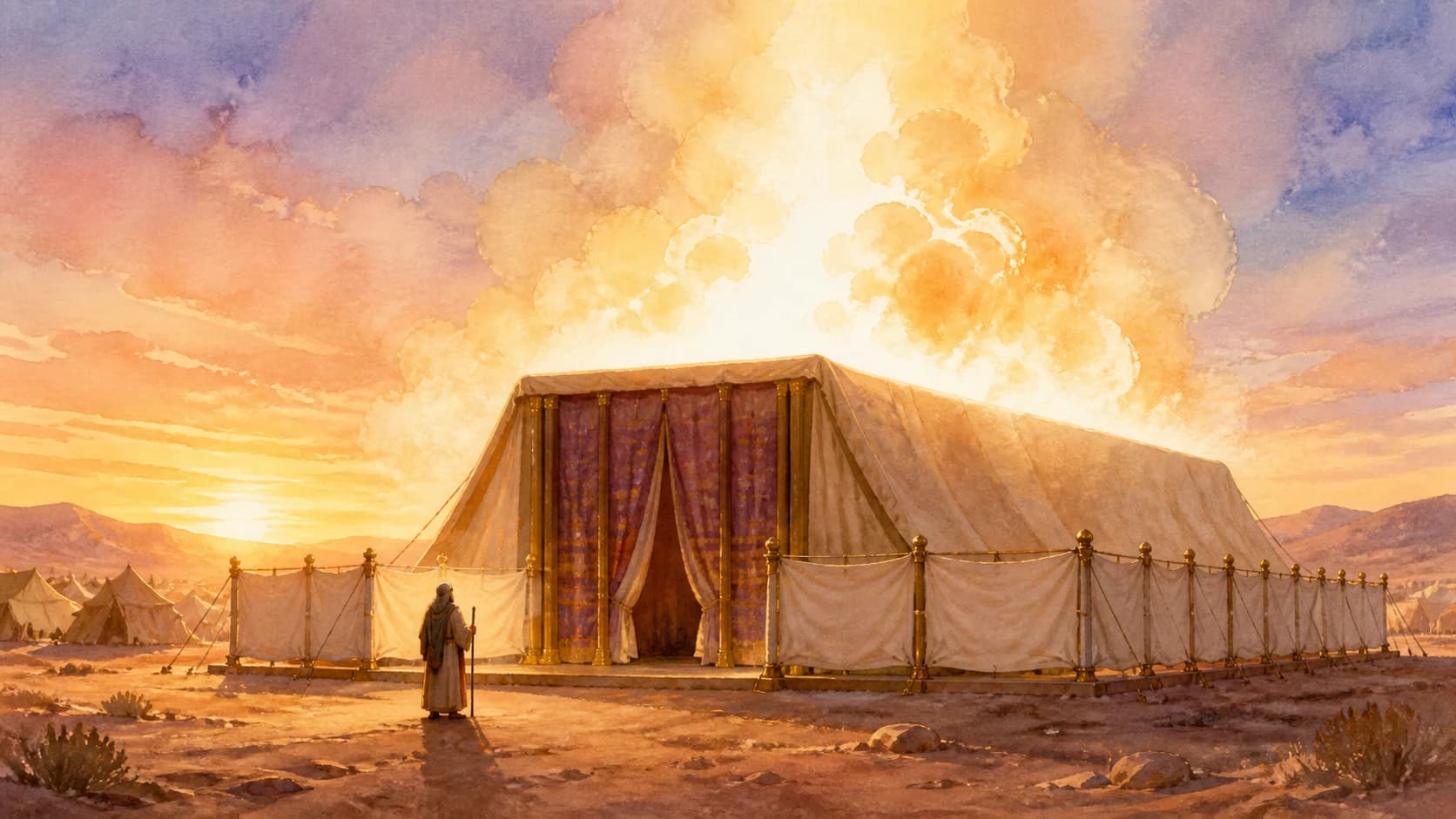
The central message of Exodus 40 is that Moses completed the tabernacle just as the LORD had commanded him, and then the cloud covered it and directed Israel’s movements. Throughout the account of the tabernacle being set up, the phrase “as the LORD commanded Moses” appears repeatedly. This repetition makes it clear that the location of the tabernacle, the purpose of its furnishings, and the priests’ manner of service were not determined by Moses himself but by the instructions he had previously received.
Moses Followed the Commanded Order Exactly
The LORD told Moses to set up the tabernacle on the first day of the first month. He was to place the ark of the testimony inside and screen it with the veil, arrange the items on the table, and light the lamps on the lampstand. The gold altar of incense, the altar of burnt offering, and the basin were also to be placed in their designated locations, and curtains were to be hung at the entrances to the tabernacle and the courtyard.
The tabernacle and all its furnishings were to be anointed with oil and consecrated. Aaron and his sons were to be brought to the entrance of the tent of meeting, washed with water, clothed, and then anointed. In this way, they were set apart to serve as priests. Setting up the tabernacle involved more than arranging a structure and its furnishings. Those who would serve within it also had to be washed, clothed, and anointed.
Verse 16 first summarizes that Moses did everything just as the LORD had commanded him. Verses 17 through 33 then describe, step by step, how this was carried out. Moses laid the bases and erected the frames and posts. He placed the tablets of the testimony inside the ark, set the atonement cover over it, and screened the ark with the veil.
Moses placed the table on the north side and arranged the bread upon it. He set the lampstand on the south side and lit its lamps. He burned incense on the gold altar and presented the burnt offering and grain offering on the altar of burnt offering. He filled the basin with water for washing. Whenever Moses, Aaron, and Aaron’s sons entered the tent of meeting or approached the altar, they washed their hands and feet.
The Repeated Phrase Aligns the Command with Its Fulfillment
From verses 19 through 32, the words “as the LORD commanded Moses” appear again and again. This phrase ties the different tasks together into a single sequence. Setting up the tent and its coverings, screening the ark of the testimony, arranging the bread, lighting the lamps, burning incense, presenting offerings, and washing hands and feet were all carried out in accordance with the instructions Moses had received.
The passage does not merely say that Moses completed the tabernacle in general terms. It confirms each furnishing’s location and use in order. The basin, in particular, was not simply placed in position. Moses and the priests used its water to wash whenever they entered the tent of meeting or approached the altar. The command was fulfilled not only in making the furnishings but also in the actual work of worship.
In verse 33, Moses erected the courtyard around the tabernacle and the altar and hung the curtain at the courtyard entrance. Only then does the passage say that Moses finished the work. From the appointed starting date to the final courtyard curtain, completion meant carrying out every command without omission.
The Cloud over the Tabernacle Determined When the People Set Out and Stopped
After Moses finished the work, the cloud covered the tent of meeting, and the glory of the LORD filled the tabernacle. The cloud and the glory were so overwhelming that even Moses could not enter the tent of meeting. The completed tabernacle stood in the midst of Israel, with the cloud resting above it.
The cloud did more than cover the tabernacle. Whenever it lifted, the Israelites set out on their journey. If it did not lift, they remained where they were until the day it rose. The cloud was above the tabernacle by day, and fire was within it by night. The entire house of Israel could see it throughout all their travels.
Exodus 40 therefore brings together the completion of the tabernacle and the order governing Israel’s journey. Moses prepared the tabernacle, its furnishings, and the priests’ service according to the command he had received. From then on, the Israelites did not decide for themselves when to depart. They moved according to whether the cloud above the tabernacle lifted or remained in place.
One action to take today is to reread Exodus 40 and mark every occurrence of “as the LORD commanded,” along with what happened when the cloud “lifted” and when it “did not lift.” Following these repeated phrases will help you see, as one continuous sequence, both the order in which the tabernacle was set up and the sign that determined when Israel traveled or remained in place.
Related articles
Why Does Deuteronomy 4 Tell Us to Remember and Obey?
Deuteronomy 4 explains why Israel must remember what they personally saw and heard God do, refuse to make idols, and obey his word without adding to it or taking away from it.
Why Did Israel Disobey Both Commands?
Deuteronomy 1 contrasts Israel’s refusal to go up when commanded with their later decision to go up after being told not to.
Why Does Numbers 33 Record Israel’s Journey?
Numbers 33 records Israel’s journey from Egypt to the plains of Moab and reveals the commands the Israelites were required to obey when they entered Canaan.
 Bible Habit
Turn this article into today’s reading habit
Keep your McCheyne plan, sequential reading, notes, and progress together so the next passage is always clear.
- Today’s passages
- Reading checklist
- Notes and highlights