

Genesis 24: Rebekah’s Obedience and Impatience
Exploring Rebekah's obedience and impatience in Genesis 24 and 27. Reflecting on how hope can falter when waiting is abandoned, through our current families and choices.
Genesis 24: Rebekah’s Obedience and Impatience
When we think of Rebekah, it's not easy to summarize her in just a few words. The pure kindness she shows at the well immediately comes to mind, but as time passes, her choices become more complex. That’s why her story feels more relatable. Even faithful people can’t explain a lifetime with just one good decision, and those who know God can falter in their impatience at any moment.
It's helpful to read Genesis 24 and 27 together when considering Rebekah. One side reveals the beauty of obedience, while the other shows the shadow of control in the heart. Having both scenes of the same person’s life reminds us to reflect. I wonder if I have once walked in pure obedience but now hold on with anxiety and calculation.
In Genesis 24, Abraham’s servant travels to Mesopotamia to find a wife for Isaac. This task wasn’t simply about a family’s marriage; it was connected to the covenant God made with Abraham. Abraham desired a wife from his own relatives, not among the Canaanites, and the servant prays at the well for a sign from God—to find a woman who offers water and also draws water for his camels.
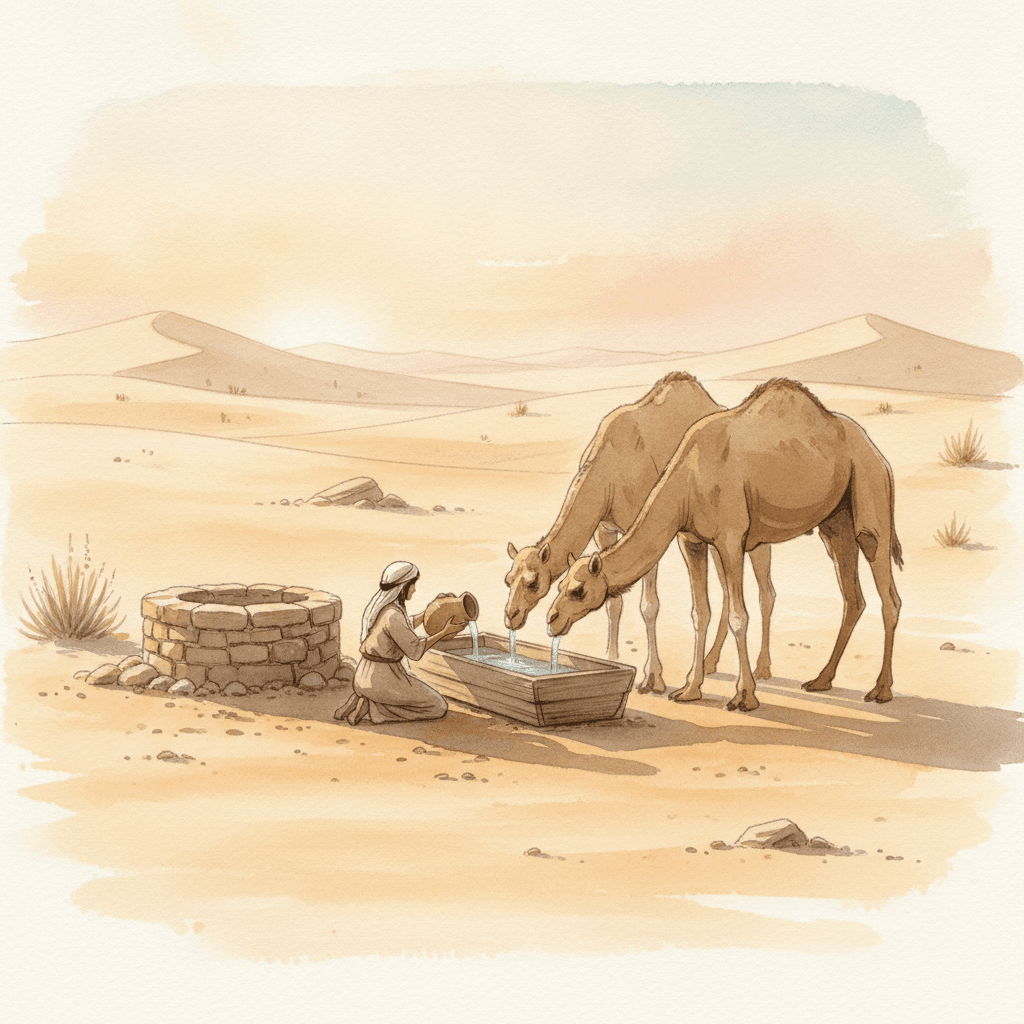
Then, Rebekah appears. She readily offers water to the servant and draws enough for his camels. This scene is brief but involves significant effort. For many camels to drink enough water takes considerable time and strength—it’s not just polite friendliness but genuine service.
Rebekah’s faith is evidenced more in her attitude of everyday life than in grand words. Someone who acts first, regardless of being observed or not; someone who isn’t stingy toward strangers—Rebekah was that person. We often talk about faith, but at home, we can be quick to become sharp over small requests. When a family member asks for a glass of water before leaving for work, or when exhausted after work and faced with dishes, faith reveals itself unexpectedly in such moments.
Later, the family suggests staying a few more days, but the servant wants to leave without delay. People then ask Rebekah directly, “Will you go with this man?” and she responds, “I will go” (Gen 24:58). It’s a brief answer, but not a light one. She’s about to marry a man she has never seen, leaving her familiar family and hometown, with no clear guarantee of the future.
Still, Rebekah doesn’t hesitate. She considers God’s guidance as more valuable than comfort and chooses obedience. Faith moments like these happen. There are times to apologize that have been delayed, to stop comfortable lies, and to cut away familiar sins. If we keep waiting for all conditions to be perfect before acting, obedience will keep being pushed away. Sometimes, we need the courage to step forward before everything is in place.
The final scene of Genesis 24 is warm. Isaac, out in the field meditating, meets Rebekah, and he brings her into his mother Sarah’s tent as his wife. The Bible notes that Isaac loved Rebekah (Gen 24:67). Even within the grand flow of the covenant, God does not overlook human loneliness and comfort. The stories of salvation history include the actual lives of one man and one woman.
However, a beautiful beginning doesn’t guarantee a smooth ending. Over time, Rebekah’s life shows other aspects. The Bible doesn’t overly romanticize characters; even faithful people have weaknesses, which often appear more clearly within families. Therefore, biblical stories aren’t romantic biographies but mirrors to reflect our hearts.
In Genesis 27, tension erupts. Old Isaac calls Esau to bring a delicacy so he can bless him. When Rebekah hears this, she immediately moves. She calls Jacob, instructs him to get goats, dresses him in Esau’s clothes, and covers his hands and neck with goat skin to deceive his father. This scene weighs heavily on the reader.
What makes this part more painful is that Rebekah was not unaware of God’s plans. She was part of a covenant family, had heard God’s promises, yet couldn’t entrust God’s will to His timing. The longer the wait, the more faith can grow, but also the stronger the urge to manufacture the outcome with her own hands. Rebekah’s problem wasn’t just about the goal but also the method.
We often find ourselves in similar situations. We push our child’s ideals for the sake of their happiness; we hide the truth to maintain family peace; we persuade ourselves that small lies are acceptable if they lead to good results. Even in church, the desire to steer others under the guise of “better direction” can creep in. But God doesn’t call faith genuine just because the purpose seems right; He also cares about the method.
Rebekah’s deception seemed to immediately achieve the desired result—Jacob receives the blessing. But what remains after is not peace but fracture. Esau is angry, Jacob becomes a fugitive, and the family is torn apart. Rebekah, who tried to protect her beloved son, ends up enduring a long separation from him. Sin may seem like a shortcut, but in the end, it costs relationships.
Lies within a family leave deeper wounds. Even if outwardly calm, inside the home, calculation and fear can grow. When parents take sides and children watch their moves, homes slowly crumble. A faithful home isn’t one without conflict but one where, in the face of uncertainty, honesty is pursued.
The reason this story doesn’t end in despair is that God’s covenant doesn’t fall apart because of human failure. He even knows about Jacob’s crooked beginning and works to refine him over many years. This doesn’t mean humans’ mistakes are trivial. It vividly demonstrates how easily our means and calculations can distort, and how profoundly God’s faithfulness endures.
Reflecting on Rebekah naturally turns our hearts inward. Am I holding onto the right things but in an unkind way? Am I speaking of God’s will yet trying to push my plans? Do I hurry in waiting, trying to manipulate outcomes? These questions are uncomfortable but unavoidable.
In everyday life, the lessons become clearer. When a child's grades or career worry us, it’s easy to cross boundaries of advice and control. At work, the temptation to spin facts more favorably before evaluations arises. Even in relationships, we may attempt to manipulate rather than persuade. In such moments, it’s helpful to pause and ask: Am I trusting and waiting in faith, or am I driven by anxiety to bring about a result?
Seeing both beginnings and endings of Rebekah’s story makes things clearer. Her kindness at the well was beautiful. She reached out to strangers and responded with “I will go” when asked about following God’s path. But later, her faith was shaken by impatience and calculation. These contrasting scenes remind us that relying solely on a once-deep resolve isn’t enough for today’s faith.
Faith isn’t sustained by a single moment from the past. It’s revealed today in tone, choices, and honesty. Past blessings don’t cover up harshness now. That’s why it’s essential to frequently examine ourselves before God. Are we rushing decisions? Controlling too much? Mistaking our own will for God’s?
Rebekah’s example in Genesis 24 shows the beauty of obedience. In Genesis 27, it reveals how much a restless heart can sway us. Between these scenes, we learn that faith isn’t just about knowing the right direction but about walking rightly in that direction. Ultimately, what God will accomplish is safe in His hands. Believers who trust this tend to be more honest, more willing to surrender, and more focused on the heart’s journey than just the results.
Reading Rebekah’s story brings to mind small, everyday choices rather than grand resolutions. Can I ease up in conversations, resist the urge to spin facts when I’m anxious, or refrain from trying to control others in the name of love? Faith shows itself not just in passionate moments but also in the attitude of patience. Today, the obedience I need to cling to might be the quiet honesty that refuses to rush.
Rules:
- Keep the natural English style (no literal translation)
- Maintain Markdown format (##, -, [], etc.)
- Do not change internal links; only translate link text
- Never alter image markdowns (
)
- For Bible verses, use the standard translation in the target language, such as NIV, ESV, or another widely recognized version
Related articles
What Did Jacob’s Deception Leave Behind in Genesis 27?
Jacob gained Isaac’s blessing by pretending to be Esau. Following Genesis 27, this article looks at how that deception led to blessing, anger, and exile.
How Did Abraham’s Servant Meet Rebekah in Genesis 24?
In Genesis 24, we follow Abraham’s servant as he prays and meets Rebekah, and confirm the guidance of God that the passage describes.
 Bible Habit
Turn this article into today’s reading habit
Keep your McCheyne plan, sequential reading, notes, and progress together so the next passage is always clear.
- Today’s passages
- Reading checklist
- Notes and highlights