

Genesis 11 Commentary: Why Did God Scatter Despite the Same Words Gathered?
The Tower of Babel in Genesis 11 reveals not just the origin of linguistic diversity, but also humanity's pride in exalting oneself without God and God's sovereign response. Let’s explore the gospel's meaning for our lives today.

Genesis 11 Commentary: Why Did God Scatter Despite the Same Words Gathered?
Genesis 11 is a brief chapter, yet it vividly exposes human sinfulness and God's sovereignty. Many people first think of the language division as the main event when recalling this chapter. Naturally, that's important. But the Bible doesn’t stop at explaining the origin of language diversity. Instead, it shows where human ambition without God leads, and why God's intervention is necessary.
The main focus is Genesis 11:4: "Then they said, ‘Come, let us build ourselves a city, with a tower that reaches to the heavens, so that we may make a name for ourselves; otherwise we will be scattered over the face of the whole earth.’" Within this single verse, human motives and desires are summarized. They gathered together to create something. They had the technology, the determination, and cooperation. On the surface, it seems like a monumental step in civilization. But the Bible first shines a light on their true motivation: “to make a name for ourselves.” That is the core issue.
God created humanity in His image, and our purpose is to glorify the Creator. However, fallen humans seek to elevate themselves rather than Him. This is the recurring theme of sin that the Bible reveals again and again. The temptation in Eden also involved the desire to become like God. At Babel, people relied more on their own strength than on God’s guidance. Sin is not always blatant evil; sometimes it appears cloaked in order, achievement, unity, or progress.
Another phrase worth noting is “let us make a name for ourselves.” The people feared scattering. But in the overarching biblical narrative, this refusal to obey God's plan is more than mere anxiety — it's a rejection of God's will. God commanded humans to fill the earth (Genesis 1:28; 9:1). Humanity was meant to spread across the world and manage God's creation. Instead, the people of Babel desired a central hub that they could control, refusing to accept God's direction. They chose gathering over obedience, safety over mission, human calculation over divine plan.
Historical context also helps us understand this passage. The land of Shinar (Sumer) was part of ancient Mesopotamia, a region known for baked bricks, kiln-firing, and asphalt-based architecture. The phrase in Genesis 11:3, "bricks instead of stones, and tar for mortar," reflects the technological characteristics of that region. Ziggurats—the step pyramids—symbolized humanity’s attempt to reach into the divine realm. The biblical account demonstrates how advanced human civilization’s technology and organization could be. But more importantly, it questions not the technology itself but the attitude of the heart using it.
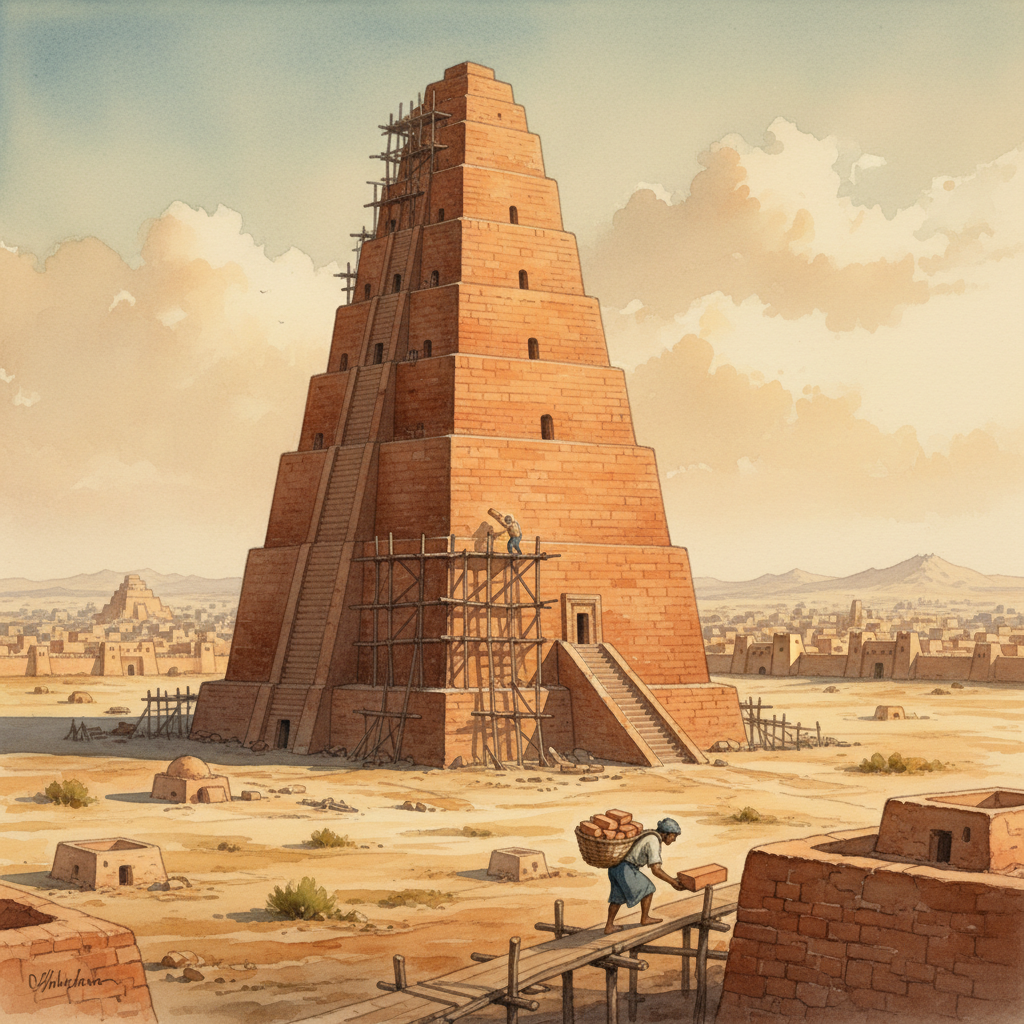
What’s intriguing is the tone. The people wanted to build a tower reaching the heavens, yet Genesis 11:5 states, “The Lord came down to see the city and the tower the people were building.” This short verse sharply highlights human arrogance. People thought they were elevating themselves, but from God's perspective, their efforts were so insignificant that He had to come down to check. Human pride always overestimates itself, seeing itself as greater than it is. In contrast, God remains unshaken—He doesn't panic but judges human plans within His sovereignty.
At this point, some might ask, "Why did God hinder their cooperation and progress?" But the text does not condemn cooperation itself. Scripture values unity rooted in God, and distinctly teaches us to love and serve one another. The problem lies in unity apart from Him. Confidence without repentance, safety without obedience, success without worship — though they may seem strong externally, they ultimately crumble before God. Humanity can gather together, but gathering alone isn't inherently good. The purpose of their gathering matters most.
In this sense, the Babel event resonates with our lives today. We do not build towers with bricks alone. Some people build their careers, others seek reputation, and some accumulate numbers, achievements, or social recognition. Working itself isn’t wrong; being diligent and faithful in our roles pleases God. But if beneath all that, the desire to "make a name for myself" dominates, even the same efforts become very different in character.
For example, after completing a task, instead of thanking God, we may think, “Now, people will see me differently.” Or, we might speak rightly, but with the hidden intention of proving our judgment was correct rather than establishing truth. Even outwardly pious acts can be motivated by a desire to elevate one’s own name. Babel is precisely such a mirror — reflecting that heart.
Furthermore, Babel is less about language and more about the heart. The people spoke the same words, but they did not share the same truth. Communication does not guarantee unity in goodness. In fact, in sin, better communication can lead faster toward error. Therefore, Scripture emphasizes not just efficiency in communication but the importance of what is at the center. The unity that truly matters is alignment with God's will.
Complementing this passage with Acts 2 offers a clearer contrast. In Babel, sin caused linguistic chaos, but at Pentecost, God's power was proclaimed in many languages. God breaks the false unity born from pride, but in Christ, He establishes genuine unity through the gospel. Humanity's attempt to reach Heaven alone fails, but God sent His only Son to draw sinners to Himself. Thus, opposite to Babel's pride, the gospel shows that instead of humans climbing up, God comes down to sinners in Christ — the path to salvation.
From this, we learn again the order of the gospel. Humans cannot reach God on their own, no matter how tall the tower. Only Jesus Christ's death and resurrection reconcile us to God. Salvation is not a reward earned by human effort but a gift of grace from God. Therefore, believers do not seek personal fame but elevate His name.
Practical application is closer than we think. Ask whether your plans align with God's purpose. When you succeed, remember to thank God rather than brag about yourself. Let go of the urge to control due to uncertainty. These are ways to bring the Babel story into today’s context. Sometimes, God allows our plans to be thwarted — and at those moments, we may feel frustration or failure. Not all obstacles are signs of judgment, but believers should examine their hearts in such moments. Are we holding onto our own name more than God's glory?
Genesis 11 isn't about outright rejecting human civilization. It teaches that the greater our abilities, the deeper our need for humility. The ability to build well is different from the duty to build rightly. The fact that many gather is different from standing rightly before God. Babel shows both human potential and the danger of turning away from God.
More broadly, this passage fits into the consistent biblical story from Genesis to Revelation. It shows human pride and God's salvation plan in a unified thread. To read along this line, you can use Bible Reading or 365-Day Reading Schedule. For a clearer understanding of Babel’s background and the significance of reading through the Bible, check out What is Bible Reading? and Why is Bible Reading Important?.
Ultimately, this chapter leaves us with a fundamental question: What am I building now, and for whose name am I doing it? Even when we live the same day, some seek to leave their name, others seek to obey God's will. The Babel story isn’t just about a massive tower of bricks but about the unseen direction of the heart. After reading Genesis 11, we are prompted not just to look at ancient Babylon but to examine our hearts. All attempts to exalt oneself without God will eventually falter; yet, humbling ourselves before God, though it appears quiet, remains the most steadfast path.
As you meditate on Genesis 11, remember that it’s not merely to criticize the Babel people but to reflect on our own hearts. Their shortcomings mirror ours today. So this passage isn’t for condemnation but a call from God to repentance and humility. Believers are called from building their own names to lifting His. God opposes the proud but gives grace to the humble. The more we see the story of Babel, the more we should humble ourselves and clearly see how great and certain Christ’s grace is.
Related articles
 Bible Habit
Turn this article into today’s reading habit
Keep your McCheyne plan, sequential reading, notes, and progress together so the next passage is always clear.
- Today’s passages
- Reading checklist
- Notes and highlights