

Why Did Moses Tell the People to Stop Bringing Offerings for the Tabernacle?
Exodus 36 recounts how Moses told the people to stop bringing offerings because they had more than enough, and how the skilled workers built the tabernacle according to the prescribed dimensions and methods of assembly.
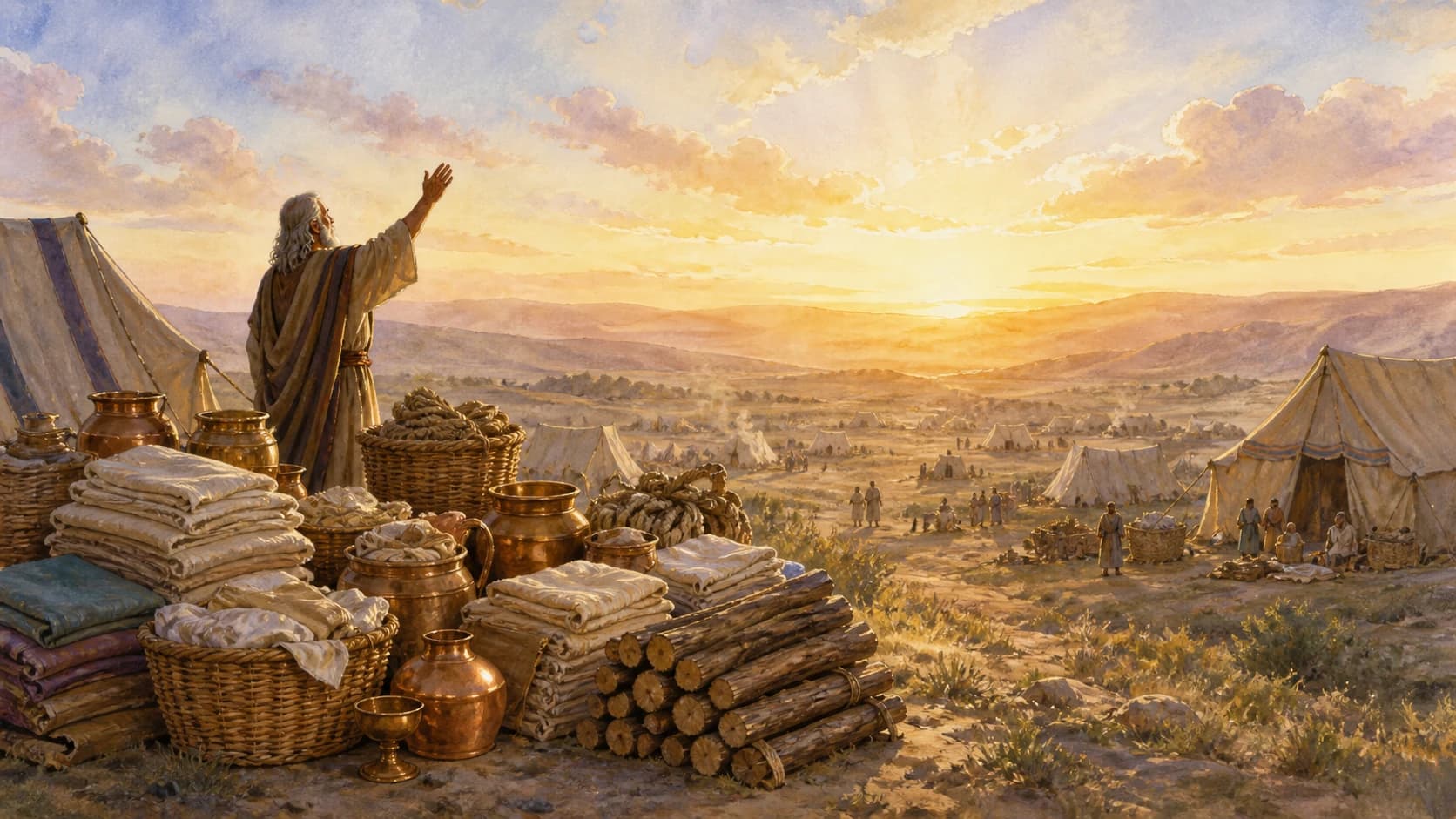
Moses told the people to stop bringing offerings for the tabernacle because there was already more than enough to complete all the work. Exodus 36 recounts how the people brought offerings morning after morning and how the workers reported that materials were left over. The chapter then shows that preparing the tabernacle was not simply about gathering an abundance of materials. Those materials also had to be used according to the pattern the LORD had commanded.
The People Brought Freewill Offerings Every Morning
Moses summoned Bezalel, Oholiab, and all the others whom the LORD had given wisdom. Among them were those whose hearts moved them to take part in the work. They received from Moses the offerings the Israelites had brought for the construction of the sanctuary.
The people’s participation did not end after a single offering. Verse 3 says that they continued to bring freewill offerings morning after morning. The workers were given wisdom and understanding to carry out the work of the sanctuary, while the people freely provided the materials they needed. Building the tabernacle involved both those who brought the materials and those who fashioned them into the objects that would be used.
Yet continuing to bring offerings was not the ultimate goal. The purpose was to make what the sanctuary required, so the amount of material that had been collected also needed to be assessed.
The Workers Were the First to Report That There Was More Than Enough
The workers responsible for the sanctuary left their work and came to Moses. They reported that the people were bringing more than was needed to carry out the work the LORD had commanded. Because they were handling the materials themselves, they could determine how much was needed and how much remained.
After hearing their report, Moses sent an order throughout the camp: no man or woman was to make anything more as an offering for the sanctuary. The people then stopped bringing their gifts. The passage makes it clear that they already had enough to complete all the work—and even more than enough.
The acts of bringing and stopping appear side by side in this account. The people willingly brought offerings every morning, but when they were told that enough had been collected, they stopped. Since the goal was to provide what the tabernacle required, both giving enough to avoid any shortage and stopping once there was a surplus were necessary.
The Materials Were Used to Make the Tabernacle According to the Commanded Pattern
Beginning in verse 8, the chapter describes in detail what the workers made. They fashioned ten curtains of equal length and width and joined them in two sets of five. The two sets were connected with blue loops and fifty gold clasps so that the tabernacle formed a single unit. They also made the goat-hair curtains covering the tabernacle according to the prescribed number and dimensions, joining them with bronze clasps to form one covering.
The same order is evident in the frames. Each frame had two projections set parallel to one another. They made twenty frames and forty silver bases for both the south and north sides. The required number of frames and bases were also placed along the west side and at the two rear corners. Five crossbars were made for the frames on each side and at the rear, with the middle crossbar extending from end to end.
The curtains and frames did not remain separate pieces. Loops and clasps, projections and bases, rings and crossbars fit together to form one covering and a unified tabernacle structure. The skilled workers did not use the materials however they pleased. They followed the prescribed number of curtains, dimensions, quantities, positions, and methods of connection. The words in verse 1, “just as the LORD had commanded,” are reflected throughout the detailed construction that follows.
Abundant Provision Led to Careful Construction
The main point of Exodus 36 is not simply that a large number of offerings were collected. The people willingly brought the necessary materials, the workers recognized when there was enough, and Moses ordered the people to bring no more. The skilled workers then used what they had received to build the commanded structure with precision.
Moses’ order to stop was therefore not a dismissal of the people’s generosity. It was a response to the report that there was already more than enough to complete all the work. Preparing the tabernacle was not about collecting without end, but about receiving what was needed and then using it faithfully for its intended purpose.
If you choose one practical step today, write down the materials you need and the work you are responsible for before you begin. Once you have enough, do not remain focused on gathering more. Instead, concentrate on using what you have prepared to carry out the task entrusted to you. You can review the full construction sequence in Exodus 36 through Read the Bible.
Related articles
Why Does Deuteronomy 4 Tell Us to Remember and Obey?
Deuteronomy 4 explains why Israel must remember what they personally saw and heard God do, refuse to make idols, and obey his word without adding to it or taking away from it.
Why Did Israel Disobey Both Commands?
Deuteronomy 1 contrasts Israel’s refusal to go up when commanded with their later decision to go up after being told not to.
Why Does Numbers 33 Record Israel’s Journey?
Numbers 33 records Israel’s journey from Egypt to the plains of Moab and reveals the commands the Israelites were required to obey when they entered Canaan.
 Bible Habit
Turn this article into today’s reading habit
Keep your McCheyne plan, sequential reading, notes, and progress together so the next passage is always clear.
- Today’s passages
- Reading checklist
- Notes and highlights