

Learning Faithfulness at the Closed Door: The Moment Sarah’s Laughter Was Changed
A reflection on Genesis 21, contemplating God's faithfulness and the grace of His promises even in long delays, through the birth of Isaac.

How Does God Work at the Door That Has Been Closed for a Long Time?
The birth of Isaac isn’t just joyful news of a baby arriving to a family. It’s a pivotal biblical scene that vividly demonstrates God's certainty in fulfilling His words. The passage begins: “And the LORD visited Sarah as he had said, and the LORD did unto Sarah as he had spoken. For Sarah conceived, and bare Abraham a son in his old age, at the set time of which God had spoken” (Genesis 21:1-2). In these two short verses, the phrase "as He had spoken" is repeated. The Bible clearly shows from the very beginning that this birth was not due to human effort or coincidence but rooted firmly in God's faithful word.
To understand this scene more profoundly, it’s helpful to look at the background leading up to it. Abraham and Sarah waited years for God's promise. Their waiting was not merely days or months of delay. As time passed, their bodies aged, and circumstances seemed to drift further from God's promise. Especially for Sarah, who had long been unable to bear children, this was a deeply personal and societal issue. In ancient times, whether or not one had children was closely tied to personal hope, family stability, future security, and social standing. Having no descendants was not only a source of personal pain but also a matter of social concern and anxiety. Against this backdrop, Sarah’s pregnancy was an extraordinary and humanly inexplicable event.
Therefore, the Bible records this not as a simple case of an elderly woman giving birth but as an event where God Himself opened the way. Where human calculation might have concluded that all hope was lost and expectations abandoned, God manifested His promise in reality. Here, we learn again the core of faith: faith is not just convincing ourselves that good things will happen. Faith is clinging to the character of God who has spoken.
Sarah’s response is even more impressive. She exclaims, “God hath made me to laugh, so that all that hear will laugh with me” (Genesis 21:6). Laughter here is not merely an emotional expression. The previous awkwardness, embarrassment, and human judgments have transformed into a joyful, awe-filled laughter. In Genesis 18, Sarah chuckled quietly behind the tent, her laughter tinged with disbelief. But the laughter in Genesis 21 is entirely different. Now, her joy is a response to how God has fulfilled His promise. God did not just change the circumstances but also changed Sarah’s heart in interpreting those circumstances.
This moment raises a very practical question for us: How do we interpret delayed times? When things seem to stall, or our prayers seem to be slow to change, we tend to slip into two reactions. One is impatience, trying to rush outcomes through human means; the other is resignation, giving up hope altogether. However, the story of Isaac teaches that neither approach is rooted in faith. The Bible urges us to look beyond mere possibility and to see the God who makes possibilities happen.
Such moments occur in our lives too. Long-awaited things may not unfold as hoped at the expected time. We might work hard to restore relationships, only to find the other person’s heart remains distant. We may keep battling our inner weaknesses without visible change. During these times, it’s easy to conclude, “It’s too late.” But Scripture often testifies that God’s work begins precisely at this point. Seemingly late moments do not signify God's absence; instead, they often reveal that His ways and timing differ from ours.
Of course, this doesn’t mean all delays will be resolved in the way we desire. God’s promises in Scripture must always be understood within His divine will. God is not a guarantor of our every wish but is sovereign, working according to His goodness and wisdom. But what is clear is that God never forgets His people. He does not make hollow promises; He works at the most perfect time within His good and sovereign plan. Therefore, faith does not romanticize impatience nor deny reality. Faith observes the reality but also sees the God who is greater than that reality.
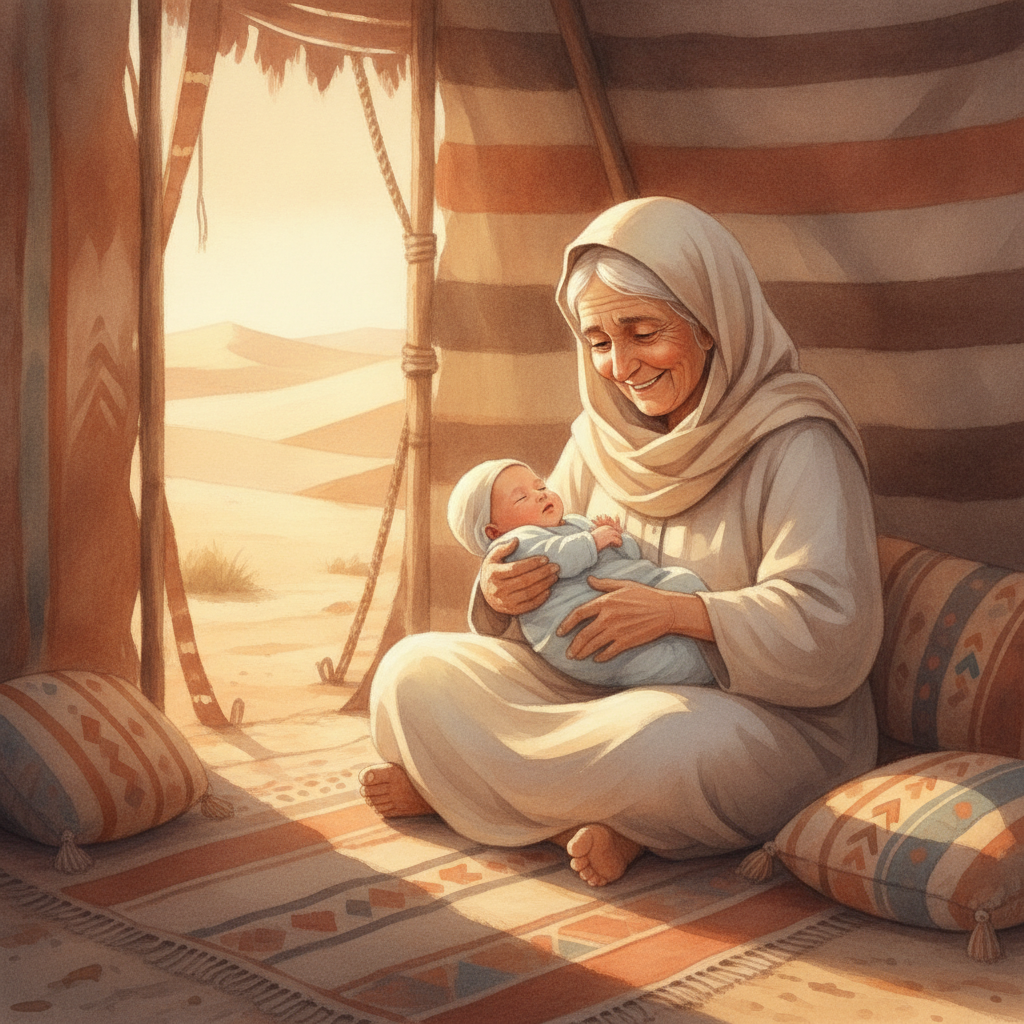
The birth of Isaac is also a significant thread throughout the Bible. It vividly illustrates the theme of the “child of promise.” Paul states in Galatians, “Now we, brethren, as Isaac was, are the children of promise” (Galatians 4:28), emphasizing that God's salvation history is based not on human effort or fleshly pride but on His promise and grace. Ultimately, this story transcends a family’s miracle, serving as a symbol of how God leads His people through His salvation plan. When human pride diminishes and God's grace becomes more prominent, the light of His covenant shines.
This principle also aligns with the Gospel. We cannot stand before God relying on our own righteousness or strength. Sinners are justified only through faith in Christ. God makes promises by grace, fulfills them, and justifies those who trust in Him. When reflecting on Isaac’s birth, we do not merely learn a lesson about “waiting for good things to happen.” We gain confidence in the Gospel—“God is faithful and His plans surpass human limits”—which is what sustains believers.
Another important point is that Abraham and Sarah’s journey was not a perfect, straight path of unwavering faith. Their lives included wavering, fears, and traces of human choices. Yet, God did not revoke His covenant. This truth is a great comfort to us. God does not work because we are perfect. His faithfulness exceeds our weakness, so His plan remains intact. This is not an excuse to take our weaknesses lightly but an invitation to come before Him again in repentance and trust.
Today, as we reflect quietly before this passage, what door in your life feels long closed? Are you quick to draw conclusions before waiting? Even when God seems silent, He does not forget His promises. Even when immediate results seem small, God is working unseen, shaping our faith and refining our gaze. Consistently reading and meditating on the Bible is more crucial in such times. Using tools like 오늘의 말씀 or 성경 읽기, staying within the flow of God’s Word trains us not to rely on emotion but to stand on His promises. Reconsidering what 묵상이란 truly means can help interpret our waiting in a way that pleases God.
Just as Sarah’s laughter was transformed, our perspective can change too. The same situation, seen through the eyes of faith and knowing God’s character, looks very different. Spiritual maturity isn’t just about problems resolving quickly but about knowing God more deeply. Walking day by day according to His Word may seem slow, but through that path, we learn increasingly about His faithfulness. If you need resources to cultivate a regular Bible study habit, references like 성경 읽기 습관 7가지 or 성경 통독이 중요한 이유 can be helpful.
Isaac’s birth does not romanticize waiting itself. Waiting can be long, painful, and exhausting. Yet, waiting with God is never a wasted time. In those moments, we learn to trust God’s Word more than our own impatience. Sometimes, looking back later, those very delays reveal God’s faithfulness more clearly than any immediate success. Today, our task is not to force optimism but to fix our gaze on the God who has promised. Let’s not despair at closed doors but instead trust that He is working even there. At that time, our laughter, like Sarah’s, will turn from doubt into a song of thanksgiving, testimony to His faithfulness.
Related articles
Isaac Was Born as the Word in Genesis 21 Said
What does Isaac’s birth in Genesis 21 show us? The passage confirms that God carried out what He had spoken to Sarah at the appointed time.
Traces Left in a House That Missed Waiting: Reading Ishmael Between Genesis 17 and 25
Exploring Ishmael’s life along Genesis 17 and 25, reflecting on God's covenant, mercy, and human impatience. A biblical perspective on waiting and wounds, helping us see those aspects through faith.
Encountering God in Hidden Places: Hagar's Lesson on Despair
Through the story of Hagar and Ishmael in Genesis 21, we explore how God's promises and mercy reveal themselves together. Even in the wilderness of despair, God hears, sees, and causes us to see the wells we couldn't notice before.
 Bible Habit
Turn this article into today’s reading habit
Keep your McCheyne plan, sequential reading, notes, and progress together so the next passage is always clear.
- Today’s passages
- Reading checklist
- Notes and highlights