

Encountering God in Hidden Places: Hagar's Lesson on Despair
Through the story of Hagar and Ishmael in Genesis 21, we explore how God's promises and mercy reveal themselves together. Even in the wilderness of despair, God hears, sees, and causes us to see the wells we couldn't notice before.
Encountering God in Hidden Places: Hagar's Lesson on Despair
As we read the Bible, some characters briefly appear yet leave a lasting impression. Hagar is one such figure. Her story is not merely a tragic tale of a woman; it demonstrates how, even amid human calculations and wounded relationships, God fulfills His purpose and does not turn a deaf ear to the cries of those in pain. Especially in Genesis 21, we see that the fulfillment of God's promises does not always come with the same kind of joy for everyone. For one person, it might be overwhelming happiness; for another, it could lead to the harsh realities of the wilderness. This scene resonates with us today because sometimes a joyful news for one can be a source of loss for another, and life can suddenly shift from the familiar to the unfamiliar.
The background of Genesis 21 is clear. God faithfully fulfilled His promise by giving Sarah a son, Isaac. It was not human skill or planning but God's faithfulness that brought this to pass. The Bible affirms that even when God's promises seem delayed, they are never in vain. However, after this promise is fulfilled, tensions within Abraham's household deepen. Sarah became uneasy upon seeing Hagar's son Ishmael and demanded that Hagar and Ishmael be cast out. Abraham was deeply troubled by this, but God reassures him that through Isaac, the covenant lineage will continue—and He also promises to make Ishmael into a great nation (Gen 21:12-13). Here, we observe an important balance: God's covenant is explicitly continued through Isaac, yet this does not exclude Hagar and Ishmael from His mercy.
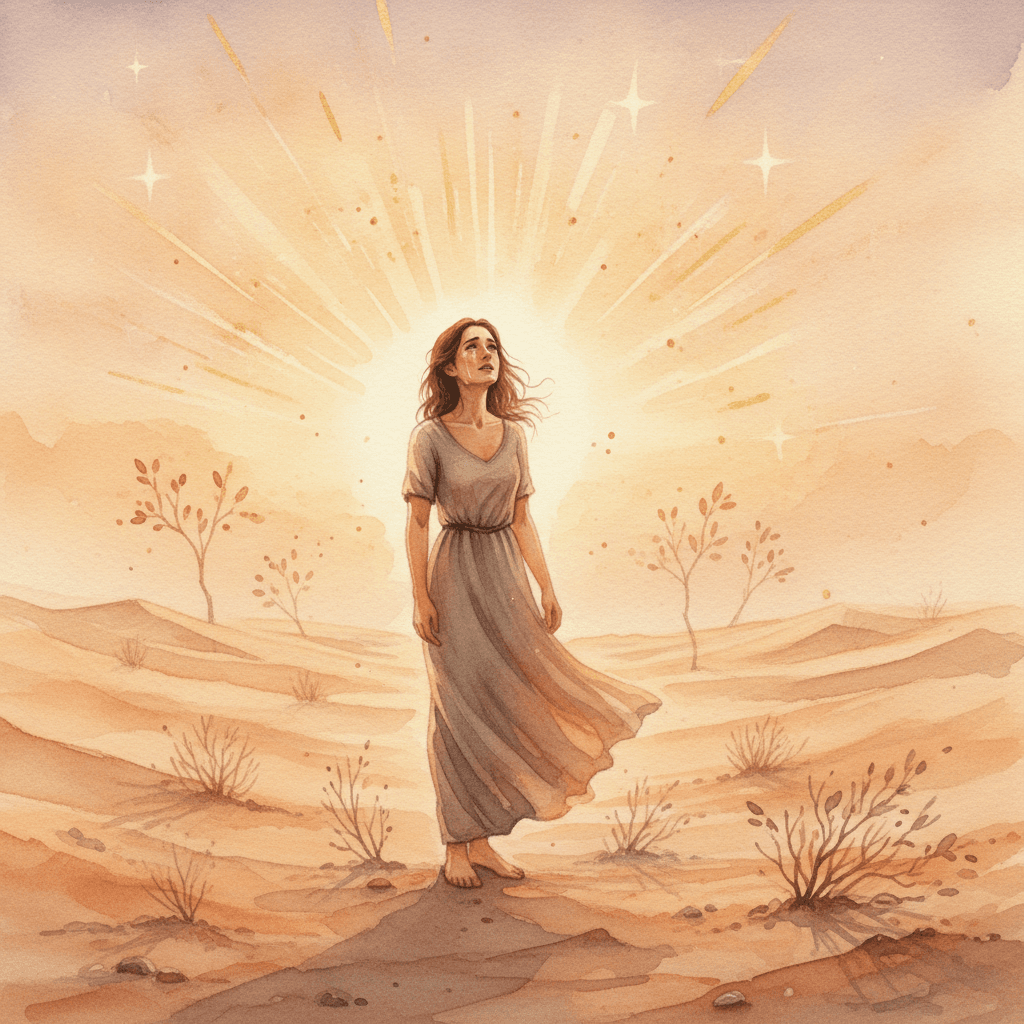
Hagar leaves with a leather bag containing bread and water. The Wilderness of Beersheba was not an easy place to survive. Water was life, and losing it meant facing death. Considering this background, Hagar's despair after water runs out becomes even more vivid. She leaves her son under a bush, too overwhelmed by the situation to watch him die, and sits far away, crying aloud. This scene is profoundly human. It's not just about a lack of faith; it shows how easily one can collapse in the face of overwhelming reality. Believers are not necessarily unshakable but are those who, when they falter, are restored by God's grace.
At that moment, the Bible records: “God heard the voice of the boy” (Gen 21:17). Both Hagar's tears and Ishmael's cries are heard by God. This clearly indicates that God is not distant but present right in the midst of suffering. Then, God tells Hagar, “Do not be afraid,” and this is no vague comfort or psychological reassurance. It is a declaration grounded in God's presence and promises. It’s not that the situation has lightened but that God, who fully understands and sovereignly works in that situation, calls for confidence.
The subsequent scene is even more striking: “God opened her eyes, and she saw a well of water” (Gen 21:19). The text does not say that a new well suddenly appeared; it was there all along but unseen by Hagar. Despair narrows our vision, and anxiety blinds us from the help God has prepared. Often, God's aid comes in ways that reveal what was always there—by opening our eyes to the blessings already given, or through His Word, daily supplies, and unnoticed acts of care. This teaches us that faith is not about denying reality but about trusting that God is still at work and choosing to see with renewed eyes.
While reflecting on Hagar's story, we must be cautious not to interpret it as a mere 'everything will be fine in the end' comfort. The passage also highlights how human impatience and disbelief can cause deep wounds. Choosing not to wait for God's timing can cause conflicts that linger in families. Sin distorts relationships and often burdens the weaker with more suffering. Hagar is clearly wounded, yet the Bible does not portray her as entirely righteous. Throughout Genesis, all humans are depicted as being under the influence of sin, and all need God's grace. Therefore, we should not emotionally favor one character over others but recognize the broken human reality caused by sin and God's mercy working amid it.
Moreover, this passage reveals that God's sovereignty and mercy do not oppose each other. God establishes His covenant clearly, yet He also does not ignore the cries of those seemingly pushed outside that covenant. This truth is even clearer within the Gospel. God justifies sinners, and that grace is entirely based on Jesus Christ’s perfect work. Our status as God's children is not earned by our deeds or feelings but is a gift through faith. Therefore, even on days of wounds, believers can cling more firmly to God's promises than to their emotions. The Gospel is not just good news that things will get better but a sure proclamation that God remains faithful in Christ and will never forsake His people.
Looking at everyday life, Hagar's story connects with many moments: when plans fall apart, when we feel wronged in relationships, or our position suddenly feels insecure. Many assume everything is over at these moments, but the Bible shows that even in places we consider the end, God still works. Some face unexpected changes at work, while others struggle with comparison and sorrow after long waiting. During such times, we need not false optimism that denies reality but to reaffirm the biblical truth that God hears and sees even in the wilderness. Remember that there might be wells we cannot see now, but when God opens our eyes, the path appears.
If you wish to study this story more slowly, you can revisit Genesis 21 in Bible Reading multiple times from beginning to end. Mark who is speaking, who is crying, and where God intervenes to trace the flow more clearly. Additionally, reflecting on Meditation helps deepen understanding, not merely gathering information but allowing the Word to illuminate your heart. Notice how Abraham grieves, Sarah fears, Hagar despairs, and Ishmael cries—these are all woven into one chapter. The Bible doesn’t present these characters superficially, enabling us to see ourselves within their stories. Are we caught up in someone’s perspective? Are we more driven by anxiety over the present than the promises of God? Are we too exhausted to recognize the grace we already have?
In conclusion, Hagar’s story remains: God's promises remain unshaken, and His mercy is never light. The wilderness is not the end but a space where God's character is made even clearer. Just because something is unseen doesn’t mean it is abandoned, and unhearable doesn’t mean ignored. The Bible still whispers today, quietly but surely: No life forgotten before God, even in places pushed aside by people. Hagar’s journey does not end with sorrow; even in the depths of despair, God continues to hear, see, and cause wells of life to surface at the right moment. This does not diminish suffering but gives us hope amid hardship. And our hope rests not in our own strength but in God's unchanging faithfulness and abundant mercy — the very God who keeps His promises.
Related articles
Isaac Was Born as the Word in Genesis 21 Said
What does Isaac’s birth in Genesis 21 show us? The passage confirms that God carried out what He had spoken to Sarah at the appointed time.
Meditation on Genesis 16: Faith in Waiting
Reflecting on Genesis 16, we follow Sarai, Hagar, and Abram's choices to understand why rushing often leads to wounds. We connect God's perspective and the faith needed to wait for His promises to our daily lives.
Learning Faithfulness at the Closed Door: The Moment Sarah’s Laughter Was Changed
A reflection on Genesis 21, contemplating God's faithfulness and the grace of His promises even in long delays, through the birth of Isaac.
 Bible Habit
Turn this article into today’s reading habit
Keep your McCheyne plan, sequential reading, notes, and progress together so the next passage is always clear.
- Today’s passages
- Reading checklist
- Notes and highlights