

How Exodus 25 Instructed Israel to Build the Sanctuary
Exodus 25 commands Israel to receive freewill offerings and make the sanctuary and its furnishings according to the pattern God revealed. At its center was the place where God would dwell among His people and speak to them.
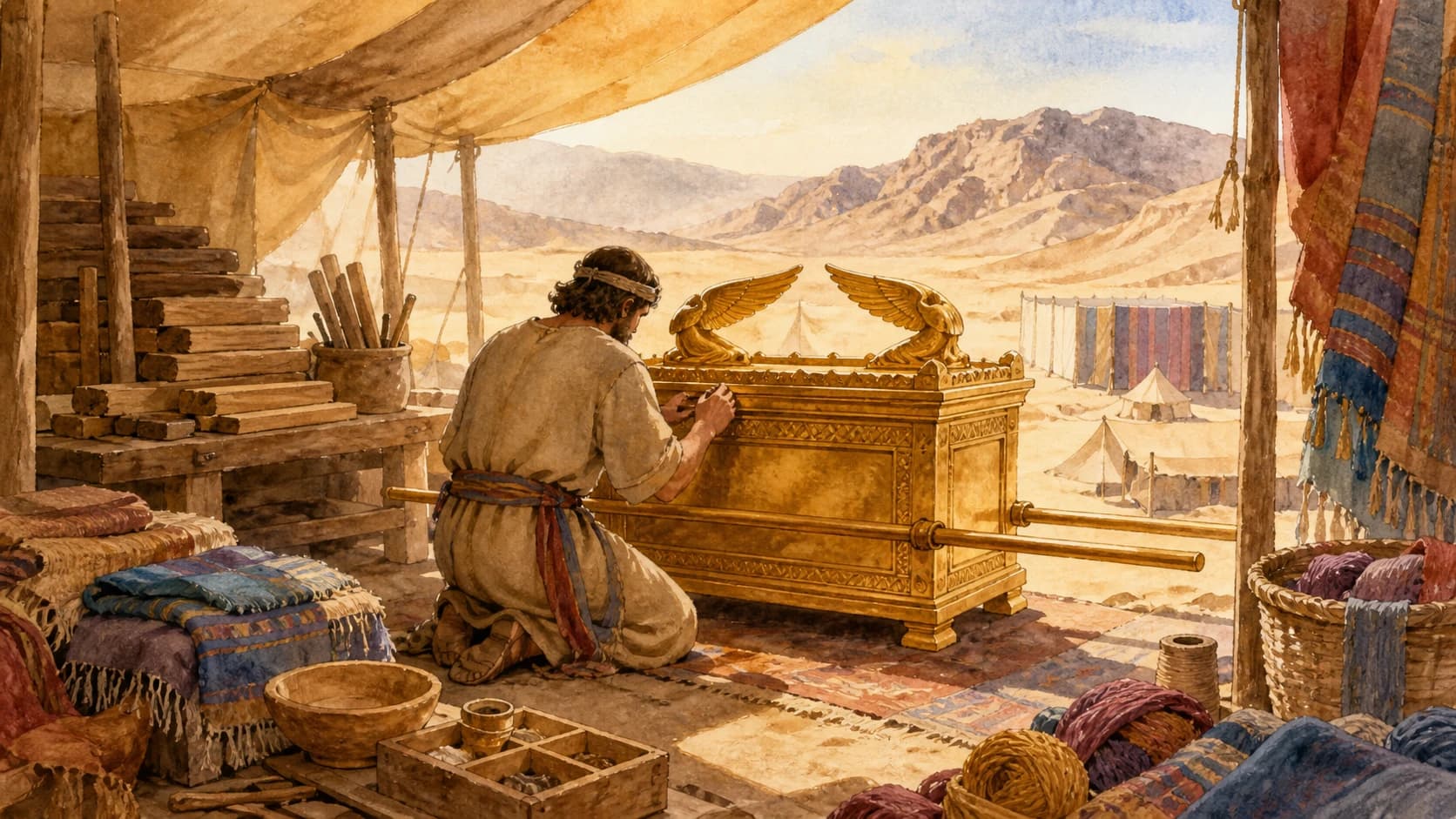
In Exodus 25, the sanctuary was to be built with offerings given willingly by the people and according to the pattern God showed Moses. The chapter gives instructions in sequence for the ark of the testimony, the table, and the lampstand. At the heart of it all was the place where God would dwell among the Israelites and speak His commands to Moses.
Offerings Were to Be Received from Willing Hearts
God first told Moses to have the Israelites bring Him an offering. But Moses was not to collect it indiscriminately. He was to receive an offering for God from everyone whose heart moved them to give.
The required materials are listed in detail. They included gold, silver, and bronze; blue, purple, and scarlet yarn; fine linen and goat hair; various animal skins; and acacia wood. Olive oil for the lamps, spices, onyx stones, and other gemstones were also to be received.
These materials correspond to the instructions for the furnishings that follow. The ark of the testimony and the table were to be made of acacia wood and overlaid with pure gold. The lampstand and its accessories were to be made of pure gold. The offerings collected at the beginning were not meant to be stored away. They were the materials used to make the sanctuary and its furnishings as God commanded.
The Sanctuary Had to Follow the Revealed Pattern
God commanded the Israelites to make a sanctuary so that He might dwell among them. At the same time, He instructed them to make the tabernacle and all its furnishings according to the pattern He showed Moses. In verse 40, He again warns Moses to make them according to the pattern shown to him on the mountain.
This repetition shows that enthusiasm alone was not enough to build the sanctuary. The people had to give the materials willingly, and those materials had to be used according to God’s instructions. The builders were not free to alter the dimensions or design according to their own preferences. They had to follow the measurements and structure God had established.
The instructions for the ark of the testimony are especially detailed. It was to be made of acacia wood according to precise dimensions and overlaid with gold inside and out. Four rings and carrying poles were to be made so that the ark could be carried, and the poles were never to be removed from the rings. The tablets of the testimony that God would give Moses were to be placed inside the ark.
The mercy seat was to be made of pure gold, with two cherubim formed as one piece with it at either end. Their wings were to spread upward, overshadowing the mercy seat. The cherubim were to face each other while looking toward the mercy seat. The mercy seat was then placed on top of the ark containing the tablets of the testimony. Each material, measurement, and position was specified because every part had to conform to the pattern God had revealed.
At the Center Was the Place Where God Would Meet and Speak
God said that He would meet with Moses above the mercy seat, between the two cherubim over the ark of the testimony. From there, He would tell Moses everything He commanded for the Israelites. At the center of the sanctuary was not the splendor of its materials, but the place where God would meet His people and speak.
The table described next also had a specific purpose. The table, its carrying poles, and its various utensils were to be made, and the bread of the Presence was always to remain on the table before God. The lampstand was to be made with six branches extending from its central shaft, with its cups, buds, and blossoms formed as a single piece. Its seven lamps were to be positioned so that they cast light in front of it.
The tablets of the testimony rested inside the ark, and above them, at the mercy seat, God spoke to Moses. The bread of the Presence remained on the table before God, and the lamps shone forward. Each furnishing had a different form and place, yet together they made up the sanctuary according to the pattern God had shown.
As you read Exodus 25 again in full, follow the phrases “willing heart,” “according to the pattern shown,” and “I will meet with you.” They make the flow of the chapter clear. The people willingly provided the necessary materials, and those who built the sanctuary had to use them according to the prescribed pattern. God promised to dwell among His people in the sanctuary prepared in this way and to speak to Moses there.
One practical step for today can be found directly in verse 2. If there is something you have decided to give to God, offer it gladly rather than reluctantly. In Exodus 25, the freely given offerings were not accumulated for personal satisfaction. They became the materials used to build the sanctuary God had commanded.
Related articles
Numbers 19: Why Were the Ashes of the Red Heifer Necessary?
Numbers 19 explains how uncleanness caused by contact with a dead body could spread and how a person could be cleansed by following the prescribed ritual with water made from the ashes of a red heifer.
Numbers 17: Why Did Aaron’s Staff Sprout?
Explore how twelve staffs were placed together, why only Aaron’s staff budded and produced fruit, and why it was preserved before the Ark of the Covenant.
Leviticus 21 Establishes Boundaries for Priestly Service
Leviticus 21 explains how the boundaries of priestly service and the sanctuary were upheld through regulations concerning the dead, marriage, the high priest, and physical defects.
 Bible Habit
Turn this article into today’s reading habit
Keep your McCheyne plan, sequential reading, notes, and progress together so the next passage is always clear.
- Today’s passages
- Reading checklist
- Notes and highlights