

Exodus 26 Builds a Tabernacle That Connects and Separates
Exodus 26 commands that multiple curtains and frames be joined into one structure while a veil separates the Holy Place from the Most Holy Place. Explore the order created by the tabernacle’s design and arrangement.
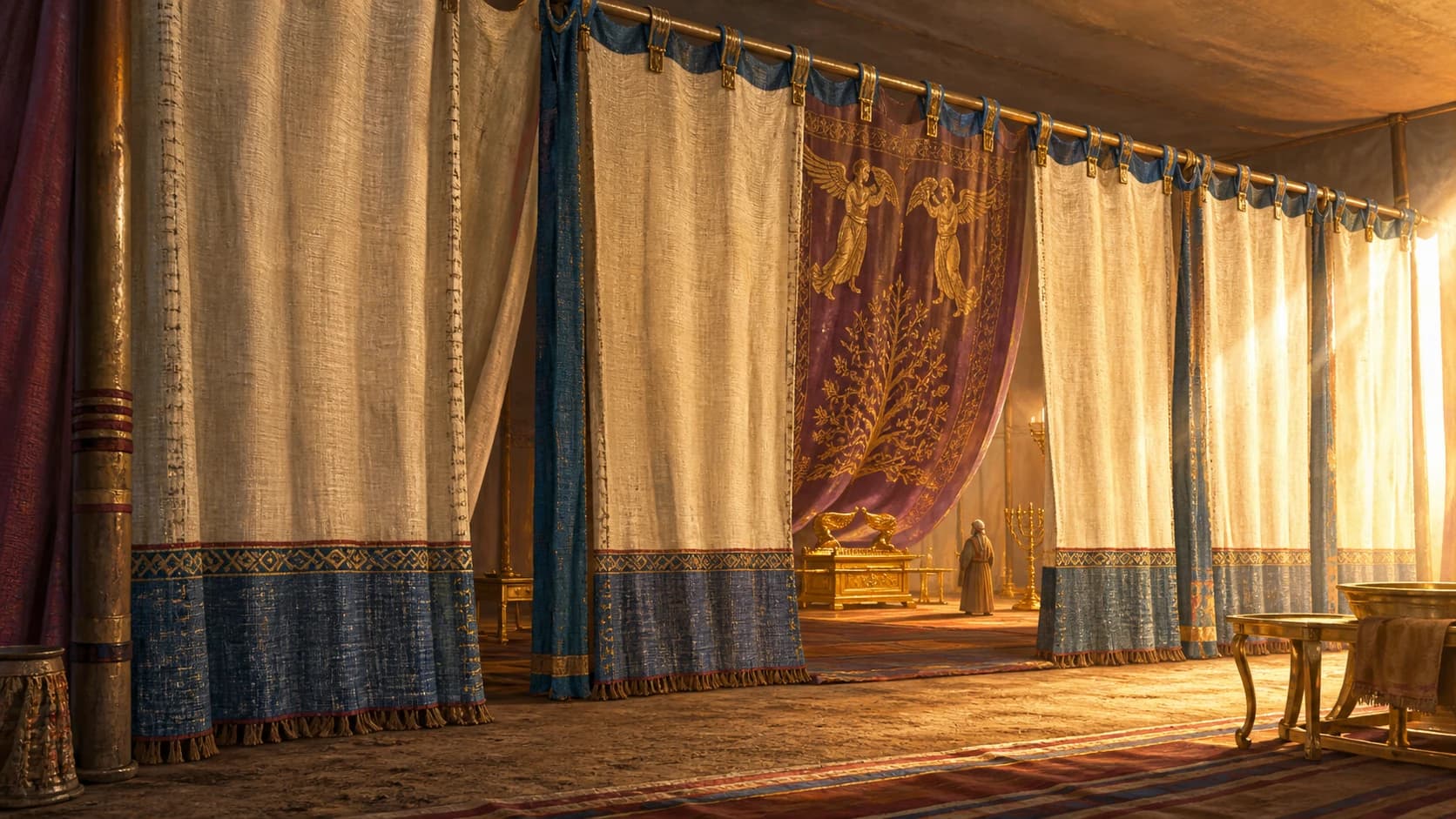
The tabernacle in Exodus 26 is a space where many materials are carefully joined to form one whole, while a veil clearly separates the Holy Place from the Most Holy Place. After giving detailed instructions for joining the curtains and frames, the chapter establishes the boundaries within the tabernacle and the proper location of its furnishings. The point is not merely to create something splendid, but to arrange every connection, distinction, and placement exactly as commanded.
Many Curtains Form One Tabernacle
The inner curtains of the tabernacle were to be made of finely twisted linen and blue, purple, and scarlet yarn—ten curtains in all. Every curtain was to have the same length and width. The ten curtains were first joined into two sets of five.
Fifty blue loops were attached along the edge of each set. With the loops facing one another, the two sets were joined by fifty gold clasps. Scripture describes the result as “one tabernacle.” It did not begin as a single piece of fabric. Instead, multiple curtains made to the same dimensions were fitted together with loops and clasps to become one.
The goat-hair curtains covering the tabernacle followed a similar pattern. Eleven curtains of equal size were made and joined into groups of five and six. Fifty loops were attached along each facing edge, and bronze clasps joined them so that they formed “one tent.” The remaining half-curtain hung down at the rear, while the extra length on both sides covered the tabernacle. A covering of ram skins dyed red and another of durable leather were placed over them.
The two sets of curtains differed in material, number, and the type of clasps used. Yet both followed the same repeated process: several curtains were joined with a specified number of loops and clasps. The tabernacle was not a collection of scattered pieces. It was a structure in which many carefully fitted parts became one tabernacle and one tent.
The Frames and Crossbars Support the Tabernacle
The upright frames of the tabernacle were also made to identical dimensions. Each frame had two projections so that it could be joined to the others, and silver bases beneath it fitted those projections. Twenty frames and forty silver bases stood on both the south and north sides. Eight frames and sixteen silver bases were placed along the west side, including its two corners.
The frames were not simply left standing on their own. Five crossbars were made for the frames on each of the three sides, with the middle crossbar extending from one end to the other. The frames were overlaid with gold and fitted with gold rings to hold the crossbars, which were also overlaid with gold. Just as the curtains were joined by loops and clasps, the frames were held together by projections, bases, and crossbars.
Verse 30 sums up these instructions by commanding that the tabernacle be set up “according to the plan shown you on the mountain.” Its dimensions, quantities, materials, and methods of assembly were not left to the builders’ discretion. Every part of the tabernacle had to be erected in its appointed place and manner according to the revealed plan.
The Veil Separates the Holy Place from the Most Holy Place
After the various parts of the tabernacle were joined together, a veil was made to divide its interior. Woven from blue, purple, and scarlet yarn and finely twisted linen, it was hung from four pillars, and the ark of the covenant was brought behind it. The passage explicitly states that this veil separated the Holy Place from the Most Holy Place.
The ark of the covenant and the atonement cover above it were placed in the Most Holy Place. Outside the veil, the table and lampstand stood opposite each other on the north and south sides. Another curtain was hung at the entrance to the tabernacle. Although the entire tabernacle was joined into one structure, its interior spaces were not blended together. The veil divided the Holy Place from the Most Holy Place, while the ark, atonement cover, table, and lampstand each stood in their commanded position.
Today, read Exodus 26 again and mark the expressions “one tabernacle,” “one tent,” and “separate.” By considering the commands to join the various parts alongside the commands to divide the space, you can trace the order of the tabernacle described in this chapter more clearly.
Related articles
Numbers 19: Why Were the Ashes of the Red Heifer Necessary?
Numbers 19 explains how uncleanness caused by contact with a dead body could spread and how a person could be cleansed by following the prescribed ritual with water made from the ashes of a red heifer.
Numbers 17: Why Did Aaron’s Staff Sprout?
Explore how twelve staffs were placed together, why only Aaron’s staff budded and produced fruit, and why it was preserved before the Ark of the Covenant.
Leviticus 21 Establishes Boundaries for Priestly Service
Leviticus 21 explains how the boundaries of priestly service and the sanctuary were upheld through regulations concerning the dead, marriage, the high priest, and physical defects.
 Bible Habit
Turn this article into today’s reading habit
Keep your McCheyne plan, sequential reading, notes, and progress together so the next passage is always clear.
- Today’s passages
- Reading checklist
- Notes and highlights