

Luke 8 Meditation: Bearing Fruit with Perseverance Amid the Noise That Blocks the Word
Following Jesus' parable of the sower in Luke 8, this meditation examines the soil of our hearts. It considers the road, rocky ground, thorns, and good soil, and reflects on the fruit of persevering to hear and keep the Word.
Meditation on Luke 8: Bearing Fruit with Perseverance Amid the Noise That Blocks the Word
The parable of the sower is so familiar that it can be easy to pass over it. Yet Jesus did not tell this parable simply to divide people into four groups. He wanted to reveal that even when God's Word is proclaimed in the same way, completely different results appear according to the condition of the heart that receives it. In Luke 8:4-15, Jesus spoke to a great crowd in a parable and later explained its meaning personally to his disciples. This passage becomes clearer when we read it according to Jesus' interpretation rather than according to our own impressions or feelings.
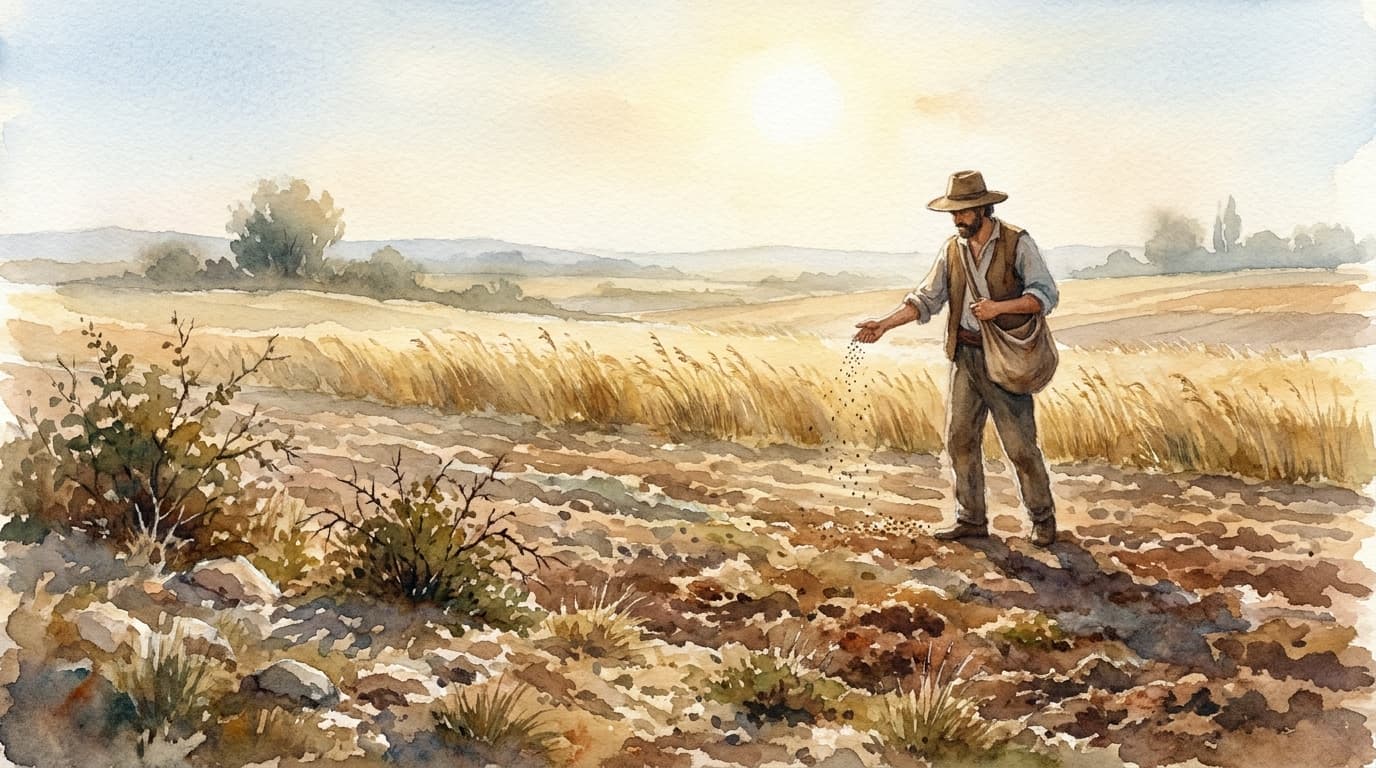
The scene Jesus described becomes more vivid when we remember the farming landscape of Galilee at that time. The farmer sowed seed not in a neatly prepared field like one today, but across ground that included paths hardened by people walking over them, shallow soil, and places where thorns were hidden. From the outside, all the ground might look similar, but as time passed, the condition of the soil determined the result. The Lord explains that the seed is the Word of God. This gives us comfort first. The problem is not with the Word itself. God's Word is living and powerful. Hebrews 4:12 says, “The word of God is living and active.” The Word never fails to accomplish its purpose. But the condition of our hearts as we hear it does not always remain the same.
The first soil is the path. Luke 8:12 explains, “The ones along the path are those who hear; then the devil comes and takes away the word from their hearts, so that they may not believe and be saved.” The path is a place where the seed has no opening through which to enter. A person hears the Word, but it cannot reach the depths of the heart. It is not unfamiliar to us to hear the Word clearly during worship and find that it has already faded before we leave the church. Busy schedules, constant information, and the familiarity that assumes we already know everything harden the heart. We may not say that we reject the Word, but there is no room for it to remain.
This condition usually does not appear all at once. When we postpone repentance, treat small disobedience lightly, and apply what we hear first to someone other than ourselves, the heart gradually becomes hard. The problem of the path is not merely a lack of knowledge; it is an attitude that refuses to become tender before God. The gospel is not news that merely adds information. It is the power of God that gives life to sinners. When we hear the Word, what we need first is not analysis but an attitude of repentance and faith.
The second soil is rocky ground. Luke 8:13 says, “And the ones on the rock are those who, when they hear the word, receive it with joy. But these have no root; they believe for a while, and in time of testing fall away.” Their first response looks very good. There is emotion, resolve, and even something that looks like rapid change. But shallow roots are exposed when the sun grows hot. Scripture teaches that the genuineness of faith is revealed in difficulty. James 1:2-3 says, “Count it all joy, my brothers, when you meet trials of various kinds, for you know that the testing of your faith produces steadfastness.” Trials do not come only to destroy faith; they also reveal what the true root is.
Anyone may look like a strong believer when life is peaceful. But the depth of the root appears when we suffer an injustice, when prayer is not answered immediately, or when obedience requires us to accept a loss. This is why steady obedience matters more than a moment of warmth. Repeatedly holding on to even one verse and trying to live by it that day allows roots to grow. If meditation on the Word is unfamiliar, it can also help to slowly consider What Is Biblical Meditation?. What matters is not the height of our emotions but continually placing ourselves before the Word.
The third soil is the thorny ground. Luke 8:14 explains, “And as for what fell among the thorns, they are those who hear, but as they go on their way they are choked by the cares and riches and pleasures of life, and their fruit does not mature.” This speaks especially sharply to us today. The thorns do not openly reject the Word. They seem to grow alongside it, which makes them more dangerous. Outwardly, a person's life of faith may appear to continue, and it may seem that the Word has been received to some extent, but in the end no fruit appears. The reason is that too many competing voices are present.
Anxiety teaches us to trust our own control more than God; the lure of wealth places the standard of satisfaction in possessions rather than in God; and pleasure trains the heart to seek immediate enjoyment. In Matthew 6:24, the Lord said that no one can serve two masters. The Word and the noise of the world cannot both occupy the center of one heart. The danger of thorns is that they usually arrive in plausible and reasonable forms. We postpone the soul's priorities with reasons such as having too much work, planning to read the Word once there is more time, or needing to solve the urgent problem first.
Of course, living responsibly is not itself a problem. Scripture does not praise laziness. But when anxiety and desire speak more loudly than God, they become thorns. If you end the day having been busy in body but dry in heart, examine the direction of your soul before the amount of your work. The Lord does not want us to escape from the world, but neither does he want us to live crushed under its weight until the Word can hardly breathe. That is why we need the habit of continuing Bible reading and placing our hearts before the Word again.
The last soil is good soil. Luke 8:15 explains, “As for that in the good soil, they are those who, hearing the word, hold it fast in an honest and good heart, and bear fruit with patience.” The important word here is patience. Good soil does not mean a perfect person who never wavers. It means a person who hears the Word, receives it, keeps it, and holds on to it over time. Fruit is not proved by speed; it appears through the seasons. Sometimes fruit is visible in a noticeable change or an act of service, but more often it appears as a change of character. We become slower to anger, less willing to treat sin lightly, and more willing to bow before the Word instead of insisting on our own will.
Love, joy, peace, and patience begin to grow in life like the fruit of the Spirit described in Galatians 5:22-23. Such change is not produced by human resolve alone. It is the work of the Holy Spirit who works through the Word. The central truth of sound faith is always clear. We are not justified by works, but justified by faith in Christ alone. That faith does not remain a dead confession without fruit; through the work of the Spirit, it leads into a life of obedience. Fruit is not a payment that purchases salvation. It is evidence of God's grace working in those who have been saved.
When we read this parable, we easily ask only, “Which soil am I?” A more practical question is, “What is making a path in my heart today, what is revealing rocky ground, and what is growing thorns?” The same person may be hard on one day, shallow on another, and full of competing desires on yet another. This is why the parable should keep us awake rather than drive us to despair. The soil of the heart is prepared not by someone who boasts that it is complete, but by someone who continues to let the Lord work on it.
Here is a brief example. Someone may read the Word in the morning and immediately become overwhelmed by anxiety and comparison on the way to work. Then the person asks again, “What was the Word I read today?” Someone else may be shaken when a small loss comes and obedience requires honesty. That very moment may be where roots are growing. Another person may work busily all day and realize at night that they lived with almost no awareness of God. That realization itself may be the beginning of grace as God levels the soil of the heart again. Faith deepens through these repeated moments more than through grand scenes.
The parable of the sower does not put us before a chart for classifying people; it places us before our attitude toward the Word. God's Word is sown in the same way today. The question is not whether the seed is lacking, but with what kind of heart I stand before it. If your heart has become hard, acknowledge it honestly before the Lord. If it has become shallow, remain before the Word again. If thorns have grown thick, speak your priorities plainly and begin to clear them. And even if the visible fruit is not yet large, there is no need to lose heart. The Lord said that fruit comes with patience. As small acts of hearing and keeping the Word accumulate, the fruit God has grown will one day become clear in the middle of our lives.
In an age when words are easily scattered, it is important to intentionally remain close to the Word. If you want to continue reading a passage within your daily rhythm, you can use the 365-day reading schedule or Today's Word to build consistency. What matters is not how impressive your activity looks, but walking patiently while keeping the Word you have heard. The Lord taught that the Word sown in good soil will certainly bear fruit. Today, open your heart quietly before him again and return to the place where you hear and keep the Word.
Related articles
 Bible Habit
Turn this article into today’s reading habit
Keep your McCheyne plan, sequential reading, notes, and progress together so the next passage is always clear.
- Today’s passages
- Reading checklist
- Notes and highlights