

Bezalel Made the Tabernacle Furnishings According to Their Materials and Design
Exodus 37 records how Bezalel made the ark, the table, the lampstand, and the altar of incense. Explore what the repeated materials and structural details emphasize.
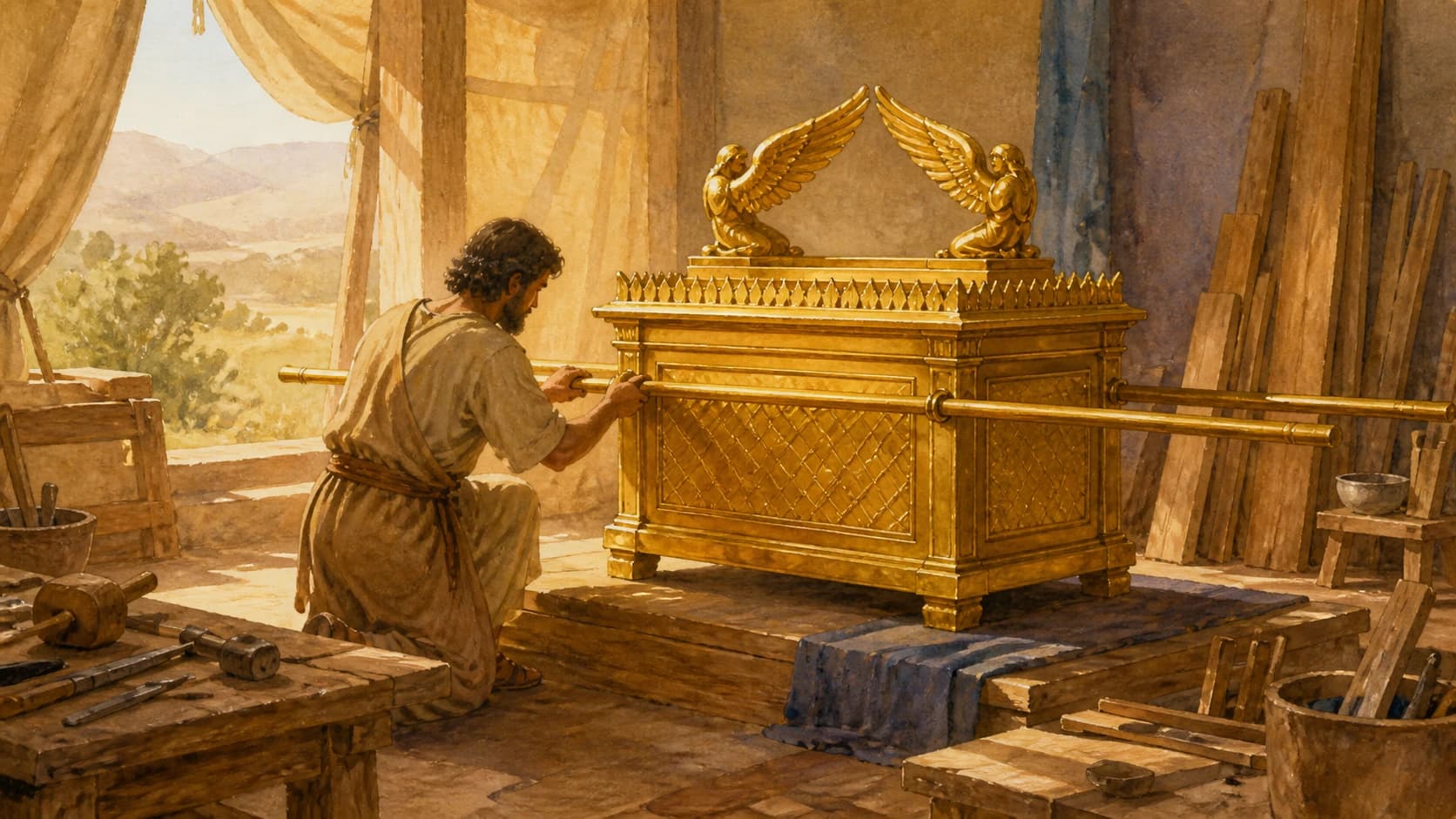
The central focus of Exodus 37 is Bezalel’s work of making the ark, the table, the lampstand, and the altar of incense according to their prescribed materials and design. Rather than merely listing the finished furnishings, the chapter repeatedly explains what they were made from and how their parts were joined together. As we follow Exodus 37, we see that the tabernacle furnishings were not objects made according to personal preference. Each one had clearly defined dimensions, materials, and purposes.
The Ark Was Designed Not Only for Its Appearance but Also for Transport
Bezalel first made the ark from acacia wood. The passage gives its length, width, and height, then records that he overlaid it with pure gold inside and out and made a gold molding around it. The description goes beyond the ark’s outward appearance.
He made four gold rings and attached them to its four feet. He overlaid poles of acacia wood with gold and inserted them into the rings on both sides of the ark. The ark was not simply designed to remain in one place; it was also built to be carried with poles.
A cover of pure gold was placed on top of the ark. Two cherubim were made of one piece with the cover, one at each end. Their wings spread over the cover, and they faced each other while looking toward it. The passage records not only their material and position but even the direction of their wings and faces.
The Table and Lampstand Included Everything Needed for Their Use
Bezalel made the table from acacia wood and overlaid it with pure gold. He placed a gold molding around it and made a rim a handbreadth wide on all four sides. The table was also fitted with four gold rings and poles. Its plates, dishes, bowls, and pitchers for pouring out drink offerings were made of pure gold. The account does not stop at saying that he made a table. It carefully includes the parts needed to carry it and the utensils used upon it.
Unlike the other furnishings, the lampstand was hammered entirely from pure gold. Its base, shaft, cups, buds, and blossoms were formed as one piece. Six branches extended from its sides, three on each side, and both its shaft and branches were decorated with cups shaped like almond flowers, complete with buds and blossoms.
Three times, the passage states that a bud was joined to the shaft beneath each pair of branches. The seven lamps, wick trimmers, and trays were also made of pure gold. This repetition does more than highlight the lampstand’s beauty. It makes clear where the branches and buds emerged and how every part formed a single whole.
The Repeated Gold, Rings, and Poles Left No Detail Unfinished
The altar of incense was also made square from acacia wood. Its horns were formed as one piece with the altar, and its top, sides, and horns were overlaid with pure gold. Two gold rings were attached beneath the molding so that poles overlaid with gold could be inserted through them. The chapter concludes by recording the preparation of the sacred anointing oil and the pure, fragrant incense.
The ark, the table, and the altar of incense were each surrounded by gold molding. All three were equipped with rings and poles. The parts made from acacia wood were overlaid with gold, while the lampstand and various utensils were made from pure gold. Although the same materials and structural elements appear repeatedly, each furnishing had its own dimensions, shape, and accessories.
The detailed account in Exodus 37, therefore, is more than a list of decorations. Bezalel did not make only the main body of each furnishing. He included the gold covering, the surrounding molding, the rings and poles needed for transport, and the accessories required for actual use. Completing the tabernacle furnishings meant attending not only to their most visible features but also to every joint and small utensil.
As you read Exodus 37 again today, mark recurring words and phrases such as “made,” “pure gold,” “rings,” and “poles.” Following these repetitions will help you see more clearly how Bezalel overlooked no detail but equipped every furnishing with the materials and design it required.
Related articles
The Trumpets in Numbers 10 Moved the People in One Order
The silver trumpets in Numbers 10 distinguished between signals for assembly and departure, while the cloud and the ark of the covenant went ahead of Israel to find a place for them to rest.
Exodus 38 Records Even How the Tabernacle Materials Were Used
Exodus 38 describes the making of the altar of burnt offering, the basin, and the courtyard, then accounts for the amounts and uses of the gold, silver, and bronze. See how careful records confirm that the work was completed according to God’s command.
Why Did Moses Tell the People to Stop Bringing Offerings for the Tabernacle?
Exodus 36 recounts how Moses told the people to stop bringing offerings because they had more than enough, and how the skilled workers built the tabernacle according to the prescribed dimensions and methods of assembly.
 Bible Habit
Turn this article into today’s reading habit
Keep your McCheyne plan, sequential reading, notes, and progress together so the next passage is always clear.
- Today’s passages
- Reading checklist
- Notes and highlights