

How Does Exodus 27 Prepare the Altar, Courtyard, and Lamp?
Exodus 27 commands Israel to build a bronze-covered altar and a tabernacle courtyard according to precise dimensions, and to tend the lamps before the LORD each night using pure oil.
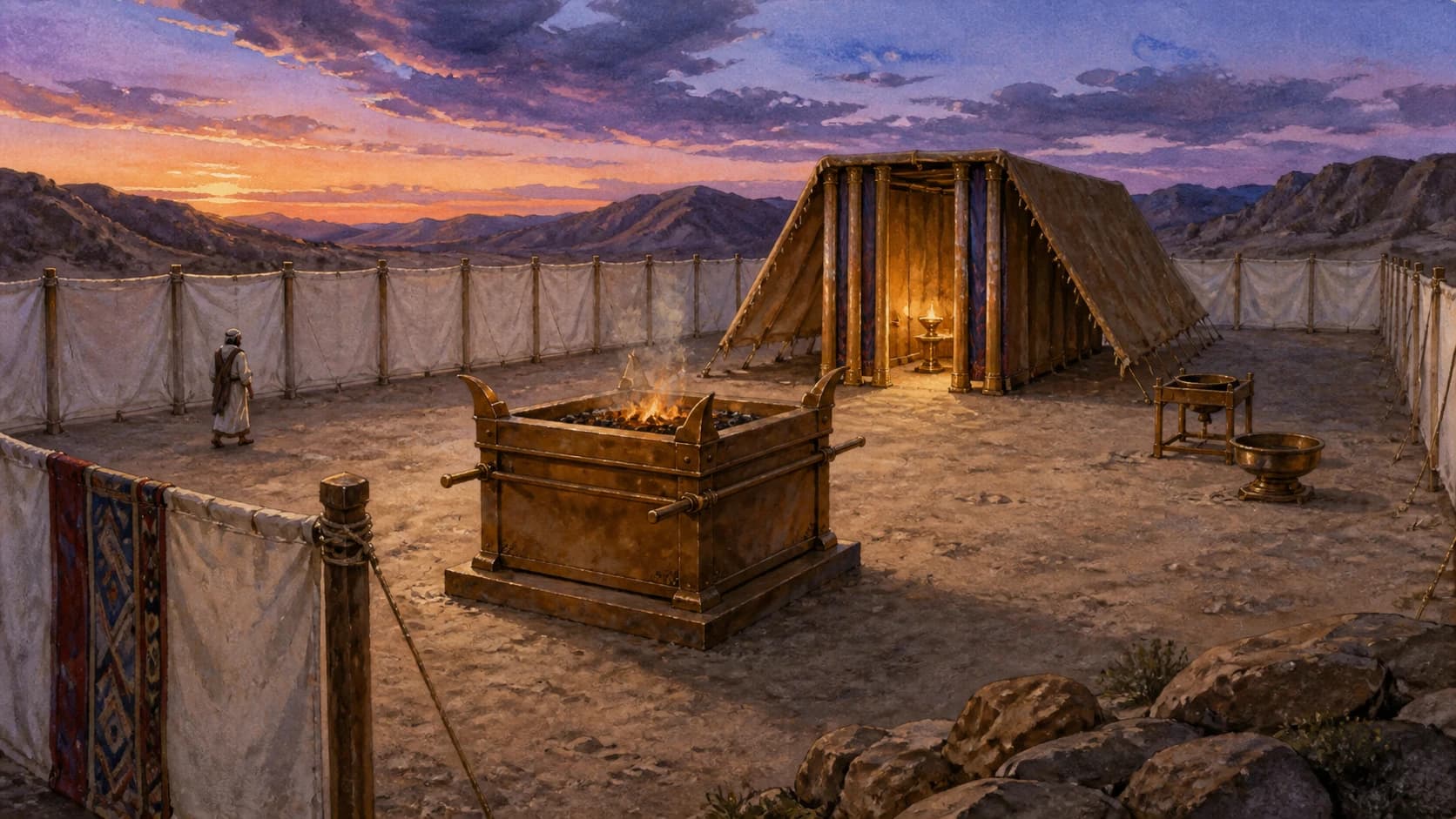
At the heart of Exodus 27 are the commands to build the altar and the tabernacle courtyard according to a prescribed design and to keep the lamps burning continually. The chapter addresses not only structures to be built, but also a duty that had to be carried out every evening until morning. Let us examine how it specifies the altar’s construction, the courtyard’s dimensions, and the people and times appointed for tending the lamps.
Everything About the Altar Was Prescribed, from Its Size to How It Was Carried
First, they were to build a square altar of acacia wood. It was five cubits long, five cubits wide, and three cubits high. A horn joined to the altar was to be made at each of its four corners, and the entire altar was to be overlaid with bronze.
None of its utensils were overlooked. Its pots for removing ashes, shovels, basins, meat forks, and firepans were all to be made of bronze. The grating for the altar and its four rings were also to be made of bronze. Bronze was repeatedly specified for both the altar and its accessories.
The altar was not designed merely to remain fixed in one place. Poles were to be made of acacia wood, overlaid with bronze, and inserted into the rings on both sides so that the altar could be carried. The altar itself was to be hollow and made from boards. The instructions conclude by requiring that it be made exactly as shown on the mountain. Nothing—its dimensions, materials, utensils, or method of transport—was left solely to the judgment of its builders.
The Courtyard’s Dimensions Corresponded to Its Number of Pillars
The south and north sides of the tabernacle courtyard were each to have linen curtains one hundred cubits long. Each side had twenty pillars and twenty bases. The west side was fifty cubits wide, with ten pillars and ten bases. The two long sides facing each other repeated the same length and the same number of supports.
The east side was also fifty cubits wide, but this was where the entrance to the courtyard stood. Curtains fifteen cubits long were to hang on each side of the entrance, with three pillars and three bases on either side. In the center, a twenty-cubit entrance curtain was to be hung from four pillars with four bases. It was to be embroidered with blue, purple, and scarlet yarn and finely twisted linen.
The entire courtyard was one hundred cubits long and fifty cubits wide, and its linen curtains were five cubits high. The hooks and bands on the pillars were to be made of silver, while the bases were to be made of bronze. All the other utensils used in the tabernacle, along with the tent pegs for the tabernacle and the courtyard, were also to be made of bronze. By repeatedly recording the dimensions, number of pillars, and materials on every side, the chapter clearly defines both the courtyard’s boundaries and its entrance.
The Lamps Required Continual Care
After the instructions for building the altar and courtyard comes the command to keep the lamps burning. The Israelites were to bring pure oil made from pressed olives. The people were entrusted with supplying the oil needed for the light.
Aaron and his sons were to tend the lamps in the tent of meeting, outside the curtain that shielded the ark of the covenant. The appointed time was also specific: from evening until morning. The people were to bring the oil, and Aaron and his sons were to watch over the lamps throughout the night. This became a lasting ordinance for generations to come.
Exodus 27 does not end with instructions for constructing the altar and courtyard precisely. It also commands the people to bring oil and the priests to tend the lamps every night so that the light would not go out within the completed sanctuary. Establishing the prescribed structure and faithfully carrying out the prescribed work appear together in the same chapter.
One practical step you can take today is to reread Exodus 27 and make two lists: what the Israelites were told to “make” and what they were told to “keep doing.” Write one line noting the dimensions and materials repeated for the altar and courtyard, and another identifying who was responsible for the lamps, what they had to do, and when they had to do it. This will help you see the chapter’s progression more clearly.
Related articles
Numbers 19: Why Were the Ashes of the Red Heifer Necessary?
Numbers 19 explains how uncleanness caused by contact with a dead body could spread and how a person could be cleansed by following the prescribed ritual with water made from the ashes of a red heifer.
The Cloud Covered the Tabernacle When Moses Set It Up as Commanded
Exodus 40 records how Moses set up the tabernacle and arranged all its furnishings in the commanded order, after which the cloud covered it and directed Israel’s journey.
Exodus 39 Shows the Work Completed as Commanded
Exodus 39 records how the priestly garments and tabernacle furnishings were made just as commanded, and how Moses inspected all the completed work and blessed the people.
 Bible Habit
Turn this article into today’s reading habit
Keep your McCheyne plan, sequential reading, notes, and progress together so the next passage is always clear.
- Today’s passages
- Reading checklist
- Notes and highlights