

Genesis 6: Noah’s Grace in a Corrupt Age
Through Genesis 6, this article examines humanity’s total corruption, God’s holy judgment, and the grace given to Noah. Following the meaning of the ark and obedience, it invites readers to examine their faith and life today.

Explaining Genesis 6: Noah’s Grace in a Corrupt Age
Genesis 6 is a very important turning point in the flow of the whole Bible. The world that began with the goodness of creation has now turned toward comprehensive corruption, and God announces judgment. Yet this chapter does not end as only a story of judgment. In the midst of darkness, God gives grace to Noah and prepares a way of salvation. Genesis 6 therefore shows together the depth of sin and the certainty of grace.
The movement of the chapter can be divided broadly into three parts. Verses 1 through 8 show how widely and deeply human rebellion had spread. Verses 9 through 12 contrast Noah’s life with the condition of the world at that time. Verses 13 through 22 describe God’s command concerning the judgment of the flood and the preparation of the ark. Though the chapter is short, the condition of humanity, God’s holy response, and the obedience of faith all appear clearly.
The first thing that catches our attention is that sin had covered society as a whole, going beyond the level of personal mistakes. Genesis 6:5 says, “The LORD saw how great the wickedness of the human race had become on the earth, and that every inclination of the thoughts of the human heart was only evil all the time.” Sin had polluted not only outward actions but also the plans and thoughts of the heart. People may develop civilization, but they cannot renew their own hearts by themselves. This is the miserable reality of humanity described by Scripture, and it shows that no one can stand righteous without God’s grace.
Verse 6 is also solemn: “The LORD regretted that he had made human beings on the earth, and his heart was deeply troubled.” This does not mean that God made a mistake. It expresses, in a way human beings can understand, how holy the infinite and perfect God is in his response to human sin. God never treats sin lightly. When we grow accustomed to sin and try to excuse compromise by appealing to the mood of the world, Genesis 6 reminds us again how holy God’s gaze is.
But there is not only despair. Verse 8 shines like the center of the chapter: “But Noah found favor in the eyes of the LORD.” Even though the world was corrupt, God knew his own person and held him by grace. Noah was not chosen because he was faultless; God’s grace came to him first. That grace then appeared in the fruit of his life. Verse 9 calls Noah “a righteous man, blameless among the people of his time, and he walked faithfully with God.” This righteousness and blamelessness do not mean sinless perfection, but a life set apart that walked by faith before God. Grace and obedience are not opposites. True grace ultimately leads to a life that walks with God.
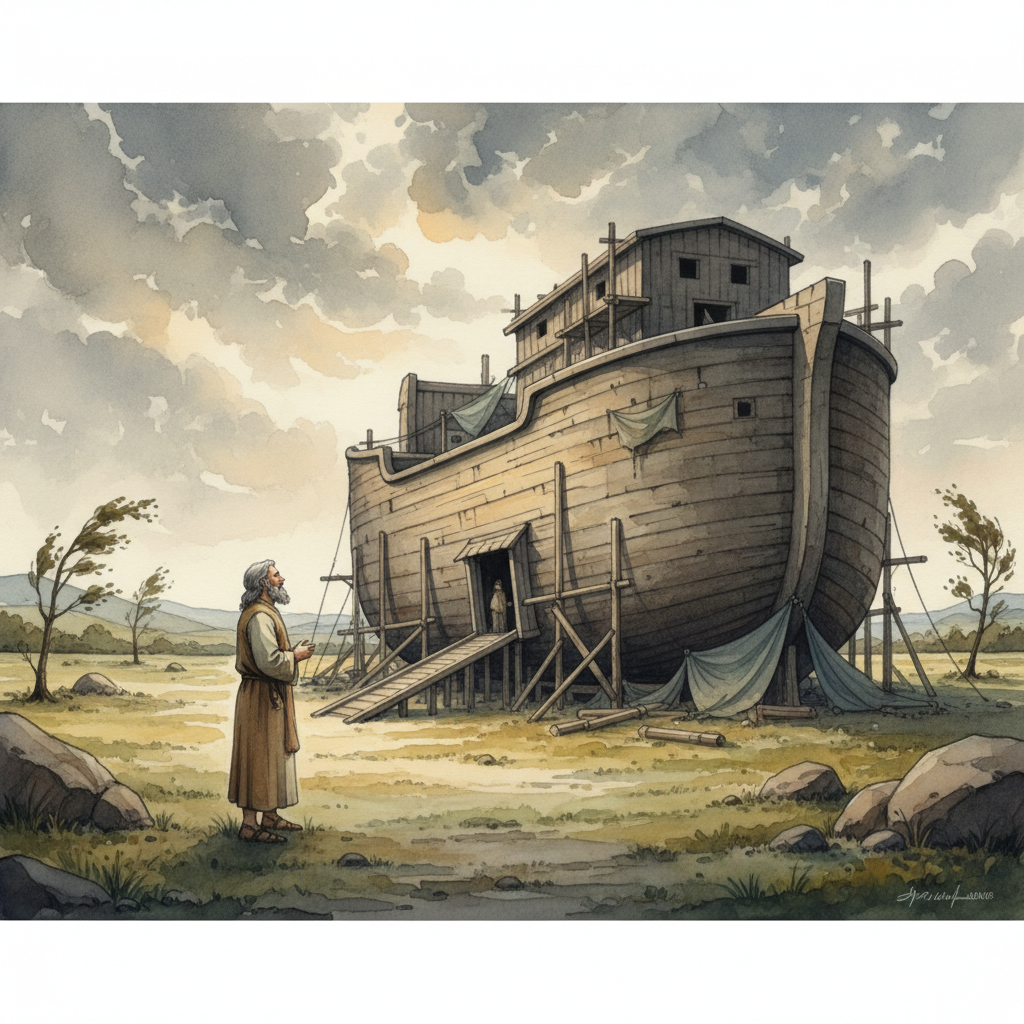
Noah is the central human figure of this chapter. But if we read Noah only as a human hero, we can miss the center of the passage. Its true center is God, who hates sin but also personally prepares the way of salvation. God tells Noah to build an ark and gives him specific instructions about its size, materials, and structure. This shows that salvation is not based on a vague feeling or human imagination, but is given in the way God appoints. Faith is not creating safety in our own way; it is entrusting ourselves to God’s Word.
What is the ark for us today? Ultimately, the ark can be seen as a picture pointing to Jesus Christ, the only Savior in whom there is refuge from judgment. Just as Noah was preserved inside the ark, we receive life only in Christ, though we are sinners. Salvation is not received through human merit or moral achievement, but by faith in the way God has provided. At the same time, in everyday life, a life that obeys God’s Word is itself a form of faith that stands against the current of the world. What everyone calls acceptable may be sin before God. Even amid a culture that rushes, faith walks according to the Word.
When applying Genesis 6 today, we can hold on to at least three things.
We should fear God’s evaluation more than the atmosphere of the age. What the world calls universal is not thereby right. God’s Word is always the final standard.
We must treat sin as a matter of the heart. It is not enough to look orderly on the outside. We must bring our thoughts, desires, and plans into God’s light, because sin grows in the heart before it appears in action.
Obedience does not begin after our understanding is perfect; it begins when we trust the Word. Noah did not build the ark after seeing the flood. He heard God’s warning first and obeyed. Faith is not calculation that moves only after visible evidence is sufficient; it is a response that trusts the faithful God.
Some readers feel interpretive difficulty because of the passage in verses 1 through 4 about the “sons of God” and the “daughters of humans.” Several views have been discussed about this section, but the broad movement of the passage is clear. Scripture emphasizes the corruption of human society as a whole, God’s judgment, and the grace given in the midst of it. Rather than remaining only with details that are difficult to interpret, it is important to hold on to the central message the passage clearly states.
Sometimes we feel lost before a heavy passage like this. When that happens, read the text slowly again in Bible Reading and mark repeated expressions; the flow will become clearer. Words such as “fullness,” “corruption,” “grace,” and “just as he commanded” form the backbone of the chapter. Today’s McCheyne Reading Chart can also help maintain the rhythm of reading a daily portion. If the McCheyne method is unfamiliar, you can consult what the McCheyne Bible reading plan is.
Verse 22, the final verse, summarizes Noah’s response: “Noah did everything just as God commanded him.” True faith is ultimately revealed in obedience. One person cannot change an age of enormous evil all at once, but one person standing rightly before the Word is never a small thing. Genesis 6 asks us: Am I listening to God’s Word more seriously than the noise of the age? Do I see sin according to God’s standard rather than the world’s? And even when I cannot yet see everything, am I taking one step of obedience according to the Lord’s Word?
The more the world shakes, the more clearly believers must stand on a sure standard. That standard is not public opinion or atmosphere, but God’s Word. Just as the age of Noah was especially evil, the human heart today still inclines toward sin. Yet God’s grace still holds his people and guides them by his Word. Genesis 6 is not merely an old record of judgment; it brings both warning and hope to us today. Do not treat sin lightly, do not make grace cheap, and walk trusting the path God has commanded. A life that obeys quietly but to the end is precious before God.
Related articles
What Covenant Did God Establish in Genesis 9?
In Genesis 9, we look at the covenant God made with Noah and all living creatures, the rainbow as its sign, and the standard for how life should be treated.
What Genesis 5 Records from Adam to Noah
Genesis 5 records how Adam’s descendants continued from the human created in God’s image, and tells of Enoch’s walk with God and Noah’s birth.
Holding onto the Heart of the Gospel Between Guilt and Pride, the Bible's Message on Grace
Grace, as portrayed in the Bible, is not merely a comforting feeling but a gift of salvation given through Jesus Christ. Following Ephesians, Romans, and Titus, we explore the true meaning of grace to anchor ourselves amidst guilt and pride, emphasizing that grace is God's love shown to sinners before any human response.
 Bible Habit
Turn this article into today’s reading habit
Keep your McCheyne plan, sequential reading, notes, and progress together so the next passage is always clear.
- Today’s passages
- Reading checklist
- Notes and highlights