

Meditation on Genesis 8: God's Faithfulness Revealed After Waiting
Genesis 8 quietly yet clearly shows God's unwavering faithfulness to His people after judgment, and Noah's obedience in waiting for God's timing amid recovery. Reflect on the meaning of worship after judgment and new beginnings.
Meditation on Genesis 8: God's Faithfulness Revealed After Waiting
Genesis 8 subtly yet firmly demonstrates that God continues to hold onto His people even after the judgment scene has passed. If earlier in the chapter, the great floodwaters covered the earth, here, the waters recede and the land emerges, signaling a fresh start. Yet, the core message is not merely that the disaster has ended. The Bible first states, “But God remembered Noah and all the wild animals and the livestock that were with him in the ark” (Genesis 8:1). The phrase “God remembered” does not mean He simply recollected after forgetting; it signifies that He took action to care for and initiate salvation based on His covenant. God's remembrance is never a fleeting sentiment but manifests as faithful actions throughout history.
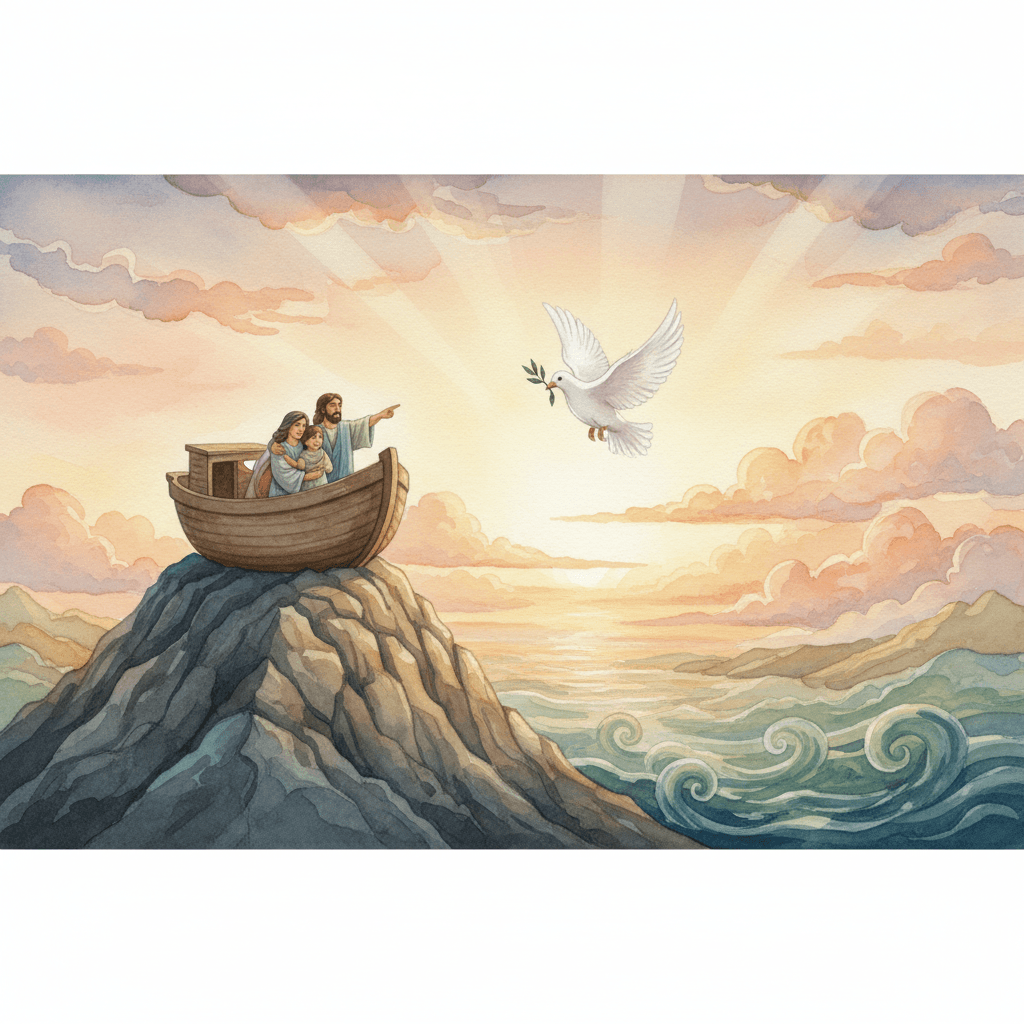
The overall flow of the chapter is very clear. God causes the wind to blow, helping the waters to diminish, while the ark comes to rest on Mount Ararat. The springs of the deep and the windows of the heavens are closed, diminishing the floodwaters gradually. Noah sends out a raven, then a dove to check the land’s condition. The dove initially returns because it finds nowhere to land, then returns with an olive leaf in its beak, and finally, the dove does not return. This process reflects a restoration not as a sudden event, but as something unfolding in God's appointed order and timing. The emergence of the olive leaf through the dove powerfully affirms that God is granting life back to the earth after judgment.
However, Noah does not act immediately upon seeing signs. Even after confirming the land is dry, he waits until God commands, “Come out of the ark, you and your wife and your sons and their wives” (Genesis 8:16). This is a crucial aspect of the faith Genesis 8 teaches us. Faith is not only about enduring crises but also includes obeying God's timing even when the circumstances seem ready. We often seek God's presence during hardships, but when things improve slightly, our own judgment tends to take over. Yet, Noah remained anchored in God's word even in moments of recovery.
There are few characters besides Noah and his family and the creatures inside the ark, but God's sovereignty remains central from beginning to end. It is God who stops the waters, who keeps the ark in place, and who commands Noah to come out. Humanity's response is merely to obey in gratitude and grace. We often want to explain restoration as a result of our patience or plans, but Scripture does not attribute the key role to humans. Genesis 8 is both a story of new beginnings and a lesson in humility. Those saved cannot boast of their own strength but recognize that it is God who accomplishes everything.
The highlight of this chapter is Noah’s reaction immediately after coming out of the ark. He builds an altar and offers a burnt offering to the Lord. Genesis 8:20 records, “Then Noah built an altar to the Lord.” Noah’s first act was not to rebuild his house or reestablish his life’s foundation, but to worship God. This is a vital scene, emphasizing that the first response of a person saved by grace is not self-preservation but worship. Noah understood that his survival was not by chance or his own wisdom, but by God's mercy. His initial act was one of gratitude and dedication.
We too face similar tests. After passing through a major problem, it is easy to immediately focus on fixing our circumstances, calculating losses, or calming anxieties. While organizing life is necessary, Scripture teaches that worship should come first in the process of recovery. When worship leads, we go beyond simply surviving to confidently claiming, “I live again before God,” because who we stand before matters more than merely being alive.
Another crucial message is in Genesis 8:21-22. After accepting Noah’s sacrifices, God declares He will never curse the ground again because of humans, despite ongoing human wickedness. Verse 22 states, “While the earth remains, seedtime and harvest, cold and heat, summer and winter, day and night will never cease.” Here, we see that human sinfulness has not disappeared after the flood; the human heart’s inclination to plan evil remains. Nevertheless, God continually sustains the order of His grace. The recurring seasons, the cycle of day and night, sowing and reaping—all these are not simply natural phenomena but evidence of God's ongoing faithfulness to His creation.
This truth also reshapes how we view daily life today. The fact that the sun rises, the day proceeds, seasons change, and life continues is not a given. It is possible only because God's patience and mercy still uphold the world. Ordinary days are never just routine; they are in fact moments where God's faithfulness is visibly at work. Genesis 8 shows us that after the great flood story, God's character is revealed in a quiet, steady manner. God is not only a judge but also remembers, preserves, and restores in accordance with His covenant.
The application for us today is clear. First, we must not see the waiting period as wasted time. Noah stayed long in the ark, and the waters receded gradually, not instantly. Yet, those moments were not an end to God's hand—they marked the period during which His will was gradually being fulfilled. Likewise, we should not assume God's silence means inactivity. His delays often discipline our impatience and lead us toward safer obedience.
Second, we need to trust more in God's word than in signs of progress. While signs of improvement are blessings, they do not reveal God's full plan. Noah examined the signs but did not depend solely on them. In the end, he waited for God's command. We too should evaluate our direction in light of His word. Reflecting on Genesis 8 through Bible reading, we can see how Noah’s actions closely aligned with God's guidance.
Third, worship must come first in the place of recovery. It is not that we add faith after solving problems but that standing before God must be our priority. In our busy days, holding onto 오늘의 말씀 and examining our hearts reminds us that our purpose is not just to survive but to glorify God. Worship is not a luxury after circumstances improve but the most appropriate response of those who have received grace.
Genesis 8 is a chapter of quiet obedience after a monumental event. What is as important as dramatic salvation is how we respond afterward. God remembered Noah, and Noah worshiped God. These two threads open the door to a new era. Even when life feels confined like the ark, and waters seem to never recede, we must not interpret God's silence as forgetfulness. He remembers His people, speaks at the appointed time, guides us on the safest path, and ultimately leads us to obedience.
If the flow of your Bible reading has faltered, don’t feel overwhelmed. Simply start again at this moment, in your current place. Refer to the 365-day reading plan and begin with today’s section. The key is not to do much all at once but to stand again before the word. Genesis 8 asks us: Am I misinterpreting the waiting as God's forgetfulness? Am I trusting His word more than the changing circumstances? And after being saved, is my first response worry or worship? Honestly confronting these questions can be the beginning of grace itself.
Related articles
What Covenant Did God Establish in Genesis 9?
In Genesis 9, we look at the covenant God made with Noah and all living creatures, the rainbow as its sign, and the standard for how life should be treated.
What Genesis 5 Records from Adam to Noah
Genesis 5 records how Adam’s descendants continued from the human created in God’s image, and tells of Enoch’s walk with God and Noah’s birth.
Meditation on Genesis 16: Faith in Waiting
Reflecting on Genesis 16, we follow Sarai, Hagar, and Abram's choices to understand why rushing often leads to wounds. We connect God's perspective and the faith needed to wait for His promises to our daily lives.
 Bible Habit
Turn this article into today’s reading habit
Keep your McCheyne plan, sequential reading, notes, and progress together so the next passage is always clear.
- Today’s passages
- Reading checklist
- Notes and highlights