

Genesis 28: A Promise in the Unsettling Night
Following Jacob's promise at Bethel in Genesis 28, this article explores God's grace first reaching out to us amid anxiety and regret. We reflect on the words to hold onto during fearful nights and how to apply them today.
Genesis 28: A Promise in the Unsettling Night
The story of Jacob at Bethel appears in Genesis 28. It's a familiar scene, easily overlooked at first glance, but this passage begins on a very dark night. Jacob was fleeing Bethel to avoid Esau’s anger, on his way to Haran. He wasn’t someone who courageously set out carrying a blessing; rather, he was more like a fugitive leaving broken relationships behind.
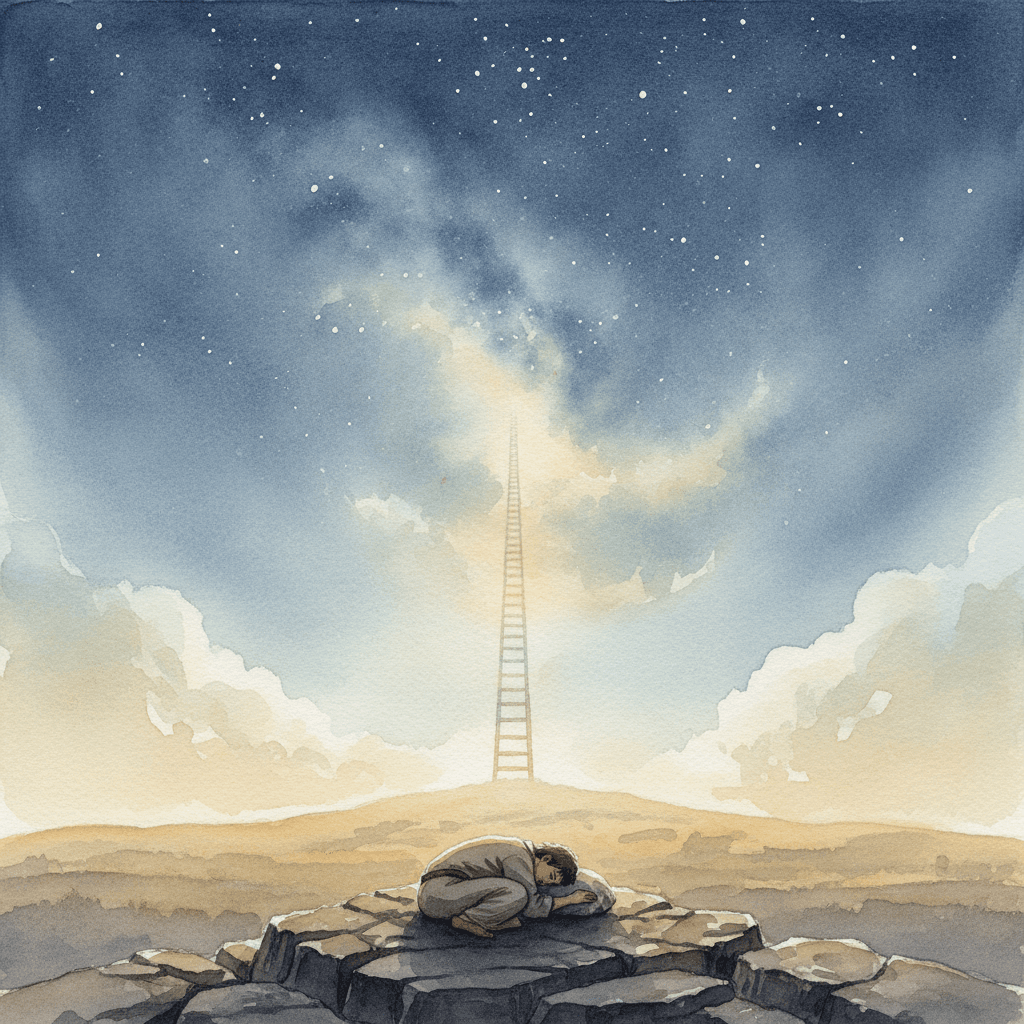
He didn’t seem particularly prepared. In Genesis 28:11, it simply states that he arrived at a place as the sun was setting, and there he rested, taking a stone to use as a pillow. This brief description vividly represents Jacob’s situation. It was not a comfortable sleep but lying on a stone—night on a path with no certainty of tomorrow. Though his body was at rest, his heart must have been restless.
And it was precisely that night that God came to him. Jacob saw a ladder reaching from earth to heaven, with angels ascending and descending on it. Then Jehovah himself spoke, reaffirming the covenant given to Abraham and Isaac, promising land, offspring, and blessing to Jacob. Genesis 28:15 further reassures us: "Behold, I am with you and will keep you wherever you go."
What stands out here isn’t Jacob’s attempt to climb higher. The passage demonstrates more about God's initiative than human effort. Jacob wasn’t a person who had prepared long and hard, nor had he fully organized his life before receiving grace. It was in a moment of fear, regret, and anxiety that God first spoke the covenant. This scene shows us not how high we can climb but how low God is willing to come.
The name Bethel itself is worth noting. After waking up, Jacob names the place Bethel, which means “House of God.” The original name of the place was Luz. It wasn’t a sacred spot because of any special atmosphere, but because God met Jacob there. That location, seemingly just another stone, field, or night, was transformed into a special place in Jacob’s eyes when God's word was spoken.
This context evokes the atmosphere of the patriarchal age. People at that time often connected gods with specific lands, believing certain deities were stronger in certain areas. But the God Jacob met wasn’t confined to just one region. Leaving Beersheba didn’t mean Jacob had escaped God's hand. Whether on unmarked territory or on unfamiliar roads, the same God was present. The promise wasn’t rooted in the place but based on God's faithfulness.
Here, we should also reflect on Jacob himself. He wasn’t a perfect man. His family was already marked by favoritism and conflict, and his relationship with Esau was fractured. Many think of Jacob as clever and calculating. Yet, the fact that God appeared to him shows that God's grace doesn’t wait for people to be perfectly reformed.
We often think that we must be somewhat upright before approaching God, that we need to resolve our shameful issues first. But the night at Bethel gives us the opposite view. God didn’t make the promise after Jacob had fixed everything. Rather, he spoke directly in the very moment of uncertainty and distress, saying, "I am with you."
Genesis 28 also shows Jacob’s response. When he awoke, he said, “Surely the Lord is in this place, and I didn’t know it.” This confession doesn’t fade into a fleeting impression. He was filled with fear but wanted to remember that moment. He set up a pillar and poured oil on it—not to manipulate God but as a sign to remember that he had encountered the Lord.
We find similar Bethel moments in everyday life. Not only during major worship gatherings or trips. Sometimes, we feel overwhelmed in the car on the way to work. Or in the hospital corridor waiting for test results. Short conversations with family can stay with us long into the night. Though on the outside the day seems ordinary, internally there’s a night where we lay our heads on a stone pillow.
At such times, we tend to build our own ladders to cover the unease. Some attempt to suppress anxiety with a more perfect plan; others try to forget by working tirelessly. Some find reassurance in a few words of acknowledgment from others. It’s important to prepare responsibly and live faithfully. But when these efforts take God's place, our hearts become more hollow. Because building ladders doesn’t bring us closer to heaven.
Genesis 28 offers us a different perspective. Our relationship with God isn’t about how much we climb, but about trusting the God who always comes with promises. Faith isn’t vague optimism. It’s about trusting the God who has spoken to us through His word. The promise “I am with you” is not just an abstract comfort but an actual word spoken into Jacob's journey. Even today, this truth resounds just as authentically in our lives.
As you read this passage, hold onto one more thing: God didn’t merely tell Jacob to endure that night. He promised to keep him wherever he went and to lead him back. It wasn’t an immediate promise to end each problem right away, but a pledge not to let go of his entire life. The peace of believers doesn’t come from everything being resolved instantly but from the certainty that we remain in God's hand.
Genesis 28 is especially close to the hearts of those feeling uncertain about the future. Whether a young person unsure about what’s ahead, parents burdened by family problems, or anyone looking back at past decisions—I believe this passage speaks deeply to everyone. Today’s tasks don’t have to be grand. We simply need to acknowledge our situation honestly and quietly trust in God's promises resting upon it.
For example, if today feels like everything is breaking down, try re-reading Genesis 28:15 before bedtime. Before making a new schedule, quietly say, “Lord, you said you will keep me where I am,” and repeat it in your heart. If wounds from relationships surface, don’t ignore the issue; rather, think about God's faithfulness that comes before those wounds. If anxiety feels overwhelming even to pray a single sentence, start by simply remembering that spot—like Jacob did—and hold onto it.
Bethel isn’t an extraordinary sanctuary far away. It’s where God’s word speaks and suddenly the same day looks different. It’s a place where we don’t dismiss broken relationships but see how God's grace moves before our wounds. Today, your room, desk, or a quiet evening at the table can become such a Bethel. As Jacob discovered that night, we too can come to recognize, “Surely the Lord is in this place, and I didn’t know it.”
Related articles
What Did God Promise Jacob in Genesis 28?
God told Jacob, who was leaving for Haran, that He would be with him, protect him, and bring him back. In Genesis 28, we look at that promise and Jacob’s response.
What Should We Do When It Is Time to Return to God?
Genesis 35 shows what Jacob and his household left behind, where they went, and how they worshiped when God called them to return to Him.
Jacob’s Life: Grace in Brokenness
Follow Jacob’s story of deception, fleeing, God’s promises at Bethel, his wrestling and reconciliation at Jabbok, to see how God holds and molds those who are broken, grounded in Genesis. This calm reflection explores how God shapes and sustains broken people through biblical passages, revealing His grace amidst human weakness.
 Bible Habit
Turn this article into today’s reading habit
Keep your McCheyne plan, sequential reading, notes, and progress together so the next passage is always clear.
- Today’s passages
- Reading checklist
- Notes and highlights