

Luke 4 and the Freedom Opened by the Gospel of Jubilee
Following Jesus' proclamation of “the year of the Lord's favor” in Luke 4, this article explores Jubilee and reflects on the freedom of the gospel that renews forgiveness, restoration, relationships, and possessions in our lives today.
Luke 4 and the Freedom Opened by the Gospel of Jubilee
When we think of Jubilee, we usually begin with scenes of debts being canceled, land being returned, and slaves being released. That understanding is correct. Yet the Jubilee described in the Bible does not end with an explanation of a system. Jubilee reveals what kind of God God is and shows how a people who have been saved should treat one another; it is a living sign.
In a world where those who already have more keep clutching it and the weak are pushed farther and farther aside, God showed another way. He prevented one person's failure from becoming an everlasting mark and stopped poverty from hardening across generations. Jubilee was not merely an economic device but a boundary God established so that the community would not forget his character.
It is good to hold on to one passage when considering this subject, but the shape of Jubilee becomes clearer when we read several scenes of Scripture together. Luke 4, in particular, brightly shows how an old promise opens in Jesus Christ. Jubilee does not end as an unfamiliar institution from Israel's past; it continues into the center of the gospel.
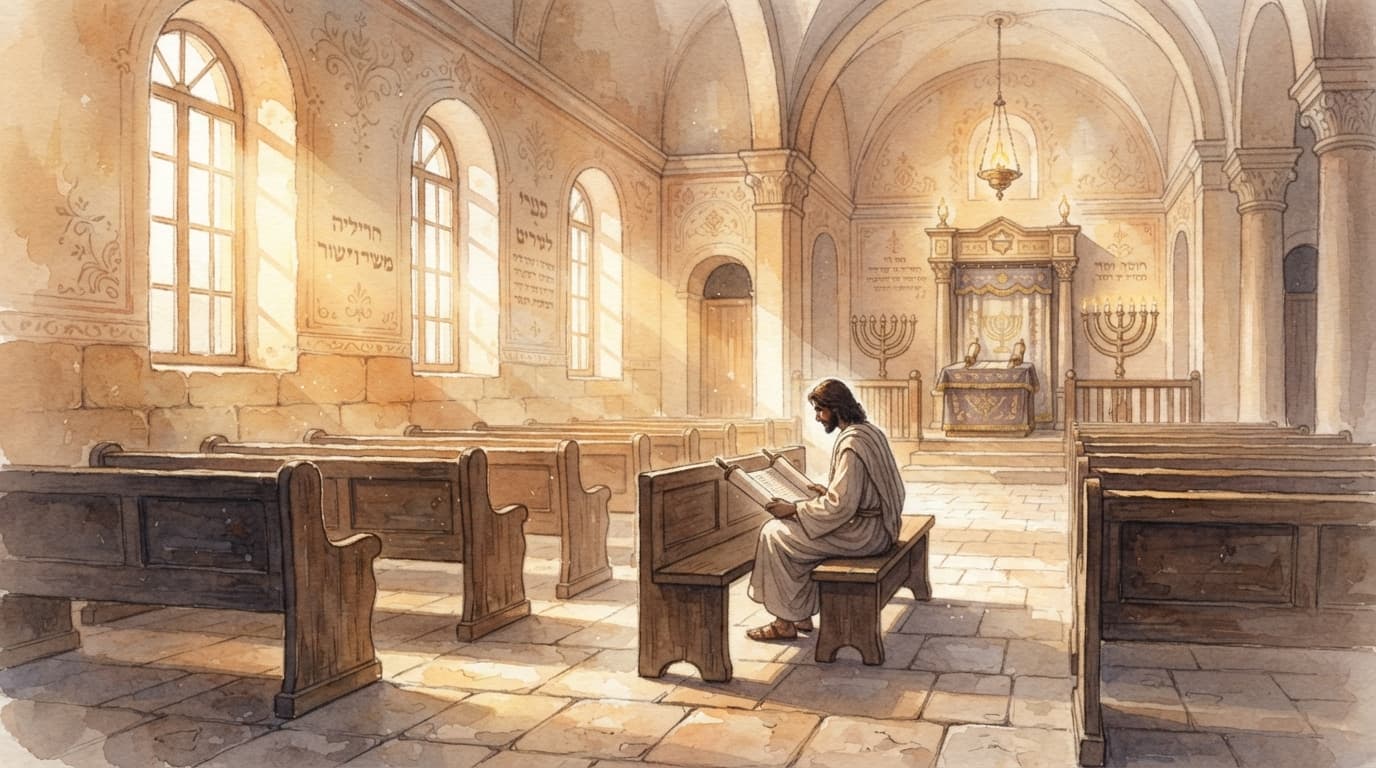
In the synagogue at Nazareth, Jesus opened Isaiah and read: “The Spirit of the Lord is on me, because he has anointed me to proclaim good news to the poor. He has sent me to proclaim freedom for the prisoners and recovery of sight for the blind, to set the oppressed free, to proclaim the year of the Lord's favor” (Luke 4). Then he said, “Today this scripture is fulfilled in your hearing” (Luke 4:21).
What makes this scene remarkable is that Jesus did not introduce himself merely as a wise teacher. He declared that the year of the Lord's favor—the time when God releases, returns, and restores—had now begun in him. This is not liberation that people labor to manufacture; here begins the salvation brought by the Lord, the Messiah.
For Israel in the Old Testament, the memory of freedom was deeply connected to the Exodus. They had been a people enslaved in Egypt. If God had not rescued them with a mighty hand, they would have had no way to escape on their own. Therefore God taught the people he had saved not to live by crushing one another again. A person who has received freedom as a gift cannot live by putting a hand around someone else's throat.
Jeremiah 34 gives a clear picture of this pattern. At that time the people of Judah made a covenant to release their Hebrew slaves. But soon they changed their minds, seized those they had freed, and made them slaves again. God rebuked them severely for this. They spoke of freedom with their mouths while holding people with their hands.
This passage also makes us uncomfortable today. We often say we support freedom while in practice wanting only relationships that benefit us. Even if we do not directly control someone, we can keep reminding them of the help we gave and bind them with a sense of debt. Our words may be gentle, but our inner voice easily stays at “After all I have done for you.” Scripture calls us to release precisely that kind of grip.
The breath of Jubilee can also be felt in Ruth. Even though the word Jubilee does not appear at the front of the story, God's heart for raising up lives that have collapsed flows through the whole account. Famine and death have brought the household low, and Naomi and Ruth return with no clear future. The two women surviving day by day by gathering leftover grain show the vulnerability of that time.
Yet God opens a way through Boaz. Boaz did not act only by cold calculation. He embraced the vulnerable through the channel of mercy left by the law and accepted the responsibility of a guardian-redeemer. He kept a lost name from being erased and allowed a family that seemed cut off to breathe again. In scenes like this, we see that biblical law is not a cold rulebook but an order that gives wounded lives a way to live.
At the foundation of Jubilee is always God's ownership. Psalm 24:1 says, “The earth is the LORD's, and everything in it, the world, and all who live in it.” Without this confession, Jubilee can look like an unrealistic system. But once we accept that the land, time, and people all belong to God, we begin to see why endless monopolizing becomes sin.
We call what has been entrusted to us our property, but in truth there is nothing we can keep in our hands forever. A house, money, a position, and even our bodies are things we temporarily use while God permits them. When we forget this, we quickly become anxious. We clutch more tightly because we are afraid of losing, and become more sensitive because we fear falling behind in comparison. Jubilee slowly opens those hardened fingers. It reminds us that we are not the owners of our lives, and therefore we do not have to hold on to everything until the end.
This does not mean that we can simply transfer Jubilee mechanically to today's economic problems and still keep its meaning. The New Testament shows the center of Jubilee more deeply and clearly in Jesus Christ. The greatest bondage is not poverty itself but sin. The heaviest debt is not merely a number written in a bank account but guilt that cannot be repaid before God.
Colossians 2:13–14 says that God forgave our sins and erased the record of debt that stood against us. The cross is where the document of sin's debt was dealt with. Christ carried the debt we could never repay, however hard we tried. Here is the deepest reality to which Jubilee pointed.
Freedom in the gospel, then, is not permission to live as we please. It is restoration that brings us back to our proper place. A relationship cut off from God is reconciled, our way of seeing people changes, and the way we hold possessions changes as well. A forgiven person cannot condemn as easily as before. A person who has received mercy learns to wait a little longer when facing another person's faults.
This change appears first in small scenes of daily life rather than in grand slogans. At home, words reveal it first. We begin to ask whether we keep bringing up an old family mistake whenever it is useful, even after the matter has passed. Correcting wrong and making someone repay an old debt for life are different things. The gospel sets relationships right, but it does not tie people forever to the place of sinner.
The same is true at work. As competition grows, it is easy to see a colleague not as a name but as a performance chart. Sometimes we want to draw a line quickly rather than give someone who made a mistake another chance. Responsibility must of course remain clear. But a person who learns freedom in Jesus comes to see how barren it is to judge someone only by usefulness. God's way of dealing with us was not a simple transaction.
Jubilee meditation is also very practical when we face money. Wanting a better home and a stable future is not wrong in itself. But when those desires begin to sit on the throne of the heart, rest disappears. We become anxious about falling behind others and see what we do not yet have as larger than the grace already received. Then the gospel of Jubilee asks: Does your security come from numbers, or from God?
Acts 4:32 says that the believers were one in heart and mind and did not claim that any of their possessions was their own. This was not a slogan demanding forced sharing. It was the result of people who had come to know Christ's grace deeply and therefore saw possessions differently. Clutching hands slowly opened, and hearts that had cared only for their own began to see the needs of their neighbors.
All of us are easily bound in one way or another. One person is bound by money, another by recognition. Someone else cannot move forward because of a single scene of failure from long ago. A person may look fine on the outside while being trapped inside by the lie, “This is where my life ends.” The freedom Jesus proclaimed enters precisely such places.
The promise of freedom for prisoners is not only a distant story. It is spoken to the person who lies awake while past mistakes keep returning, to the person who keeps punishing himself even after being forgiven, and to the person whose whole identity collapses when other people's evaluation falls. The Lord makes such souls see again and walk again. Raising up an oppressed heart is at the center of the gospel.
The more we meditate on Jubilee, the more our eyes finally turn to Jesus. The institution itself is not the goal; the One to whom it pointed becomes clear. In the Lord we receive forgiveness, return to God, and begin learning to see people with new eyes. The fears and greed that have held our lives may not disappear all at once, but the gospel surely loosens those knots.
If there is a place in your heart that feels especially tight today, quietly place the words of Luke 4 there. You can read the passage slowly again through Bible reading, or meditate alongside a day's passage in Today's Word. The freedom proclaimed by the Lord is not a vague feeling; it is practical grace that begins with forgiveness and changes relationships, possessions, and our way of seeing. In this way we slowly walk again into the wide place God gives.
Related articles
What Do the Sabbath Year and Jubilee in Leviticus 25 Restore?
In Leviticus 25, the Sabbath year gives the land rest, while the Jubilee restores sold ancestral property and frees fellow Israelites bound by poverty. We explore their meaning through the chapter’s repeated commands.
The Meaning of Sabbath Year: Biblical Principles of Rest and Renewal
Explore the biblical roots of the Sabbath Year, the regulations in Leviticus, and its historical development within the church. Discover essential principles of rest and renewal that today's Christians need to learn from Scripture.
 Bible Habit
Turn this article into today’s reading habit
Keep your McCheyne plan, sequential reading, notes, and progress together so the next passage is always clear.
- Today’s passages
- Reading checklist
- Notes and highlights