

Ruth at a Glance: The Redeeming Grace That Came to Empty-Handed Naomi
Ruth shows loss and loyalty, God’s providence and redemption, in a short but profound story. Following Naomi, Ruth, and Boaz, this article considers how God carries out redemption through ordinary lives.
Reading Ruth at a Glance: A Small but Deep Book
Ruth is a short book of four chapters, yet loss, loyalty, providence, and redemption are woven together in it with astonishing care. Its setting is the time of the judges, but its atmosphere is clearly different from the confusion of Judges. Even in an era when everyone did what was right in his own eyes, God quietly but certainly continued the work of redemption through one family’s tears and one foreign woman’s decision. Ruth is therefore more than a pleasant moral tale or a touching family story. It shows how God holds on to his people in ordinary life and prepares the way for the Messiah.
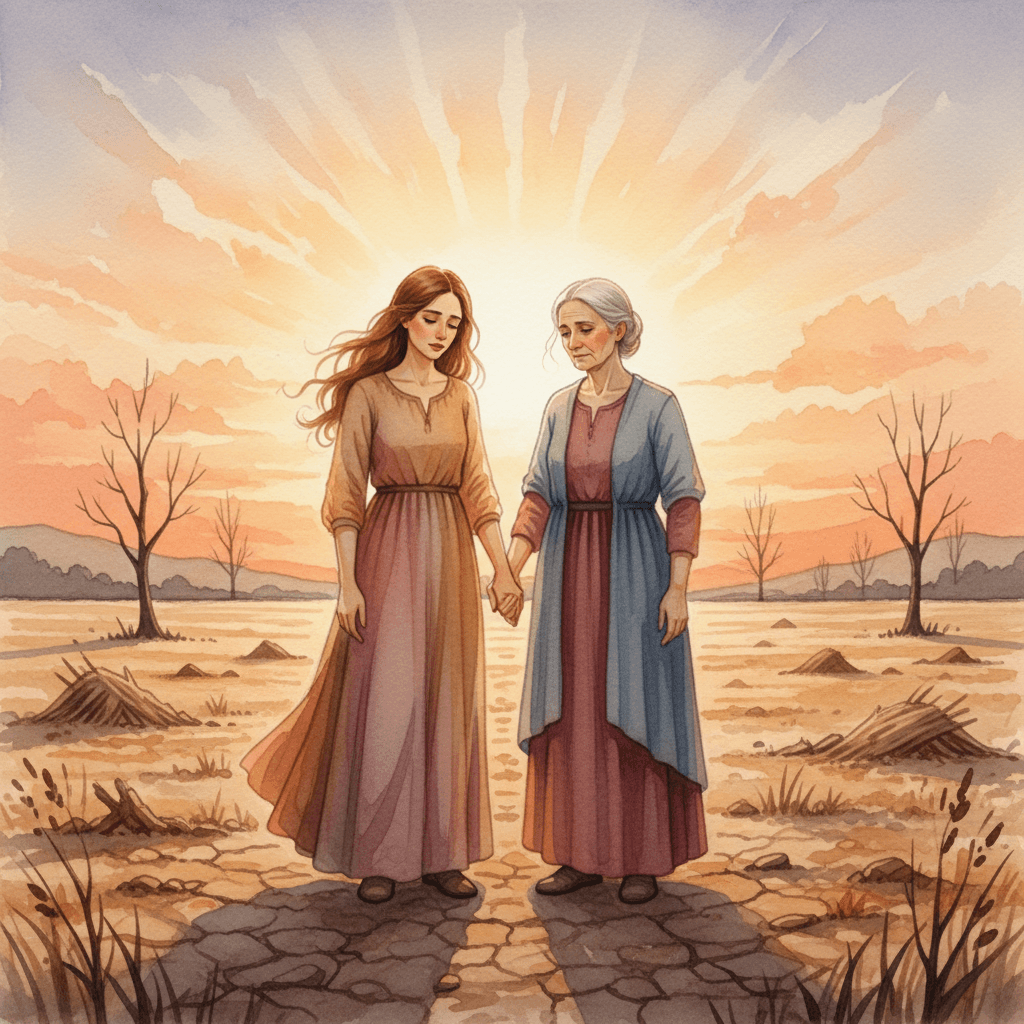
Ruth begins not with abundance but with deprivation. When a famine came to Bethlehem, Elimelek moved to Moab with his wife Naomi and their two sons. But there her husband died, and then both sons died as well. Naomi was left having lost almost everything. As she returned to Bethlehem, she said, “Don’t call me Naomi; call me Mara, because the Almighty has made my life very bitter” (Ruth 1:20). This confession contains both a sorrow that is difficult to explain and the heaviness felt when we cannot understand God’s hand. The Bible does not treat suffering superficially. It records the tears of believers seriously and does not force the reality of loss into a falsely beautiful shape.
Yet precisely in that place of despair, Ruth’s decision of faith appears. Ruth refuses to leave her mother-in-law Naomi and confesses: “Where you go I will go, and where you stay I will stay. Your people will be my people and your God my God” (Ruth 1:16). These words are not merely emotional attachment. Ruth leaves behind her homeland and the familiar foundation of her life and goes toward the God of the covenant. As a Moabite woman, she entrusts her future to the true God through faith. The wonder of Ruth is not only human loyalty, but the faith that takes refuge in God.
In chapter 2, God’s providence becomes even clearer. Ruth goes out to gather leftover grain for a living and “happens” to come to Boaz’s field. Yet from the perspective of the whole Bible, that chance is not chance outside God. Boaz hears of Ruth’s loyalty and good conduct and treats her kindly. He blesses her: “May the LORD repay you for what you have done. May you be richly rewarded by the LORD, the God of Israel, under whose wings you have come to take refuge” (Ruth 2:12). Ruth shows God’s work more delicately than a dazzling miracle. The hand of providence runs through the book, preparing the right person and place at the right time, not only producing sudden reversals.
In chapters 3 and 4, Boaz takes an important role as a guardian-redeemer. He does not act only under the pull of emotion, but acts responsibly within the order of the law. He first confirms that there is a closer guardian-redeemer, then handles the matter through a proper procedure before the community. In the end, Boaz takes Ruth as his wife and becomes the means by which Naomi’s household is rebuilt. The women say to Naomi, “Praise be to the LORD, who this day has not left you without a guardian-redeemer” (Ruth 4:14). God began restoration in a place that looked like an empty life. This restoration does not end with one family’s stability. Obed is born, his line continues to David, and it is finally connected to the genealogy of Jesus Christ, the Messiah. It looks like a small story, but it actually lies within the great line of redemption.
The central messages to hold on to when reading Ruth are clear.
God works quietly even during a season of loss. Naomi felt as though everything had ended, but God was preparing not an ending but the next chapter. Our experience cannot explain all of God. The fact that we cannot see him working does not mean that he is not working.
Faith is not merely an emotion inside the heart; it is a decision that changes the direction of life. Ruth left the familiar land and chose the path belonging to God. True faith does not remain only in a confession; it appears in the road we walk and in the one we hold on to.
Redemption is not an abstract religious idea but grace that rebuilds real life. Boaz becomes the means of restoring Naomi’s family as guardian-redeemer. This foreshadows the true Redeemer, Jesus Christ, who will deliver his people from sin and death. Boaz does not completely replace Christ, of course, but Ruth brings the Bible’s great theme of redemption into an ordinary event and directs our eyes toward the greater Redeemer.
Ruth also speaks very practically to Christians today. When life runs differently from what we expected, we may feel bitter like Naomi. But the darkness of an emotion does not mean God is absent. At other times, like Ruth, we need to choose to follow God rather than the calculations directly before us. Loyalty in protecting a relationship, faithfulness in carrying out entrusted work, and honesty in an unnoticed place can all become fruit of faith.
If you want to read Ruth more deeply, follow the whole book slowly in Bible Reading. Though it is short, its structure, repetitions, and the emotional movement of its characters become clearer with repeated reading. If you pause with what meditation is in mind, Ruth’s confession, Naomi’s lament, and Boaz’s sense of responsibility come closer. Reading one scene at a time rather than only reading quickly helps connect Ruth’s message to life. When needed, you can also use Today’s Word to turn one verse over each day. The shorter the book, the more benefit repeated reading can bring instead of rushing through it.
Ruth tells us clearly that God does not turn away a life that returns empty-handed. He holds those empty hands and brings the person back into the story of redemption. Loss is not the final sentence of life, and God’s providence works more deeply and precisely than people expect. Today we can ask whether we are defining ourselves by the name of loss, or whether we are taking one step while trusting the hand of God, who is working for good even when we cannot yet see everything. In a quiet but strong way, Ruth gives us confidence that God does not abandon his people.
One-line summary: Ruth shows that even amid loss and ordinary faithfulness, God rebuilds life through the grace of providence and redemption.
Related articles
Reading Nehemiah: Restoring the Broken Places
A comprehensive overview of the book of Nehemiah, highlighting its main themes and how the restoration of the walls, community, repentance, and renewal of God's Word relate to our faith today. Discover how the rebuilding process extends beyond physical structures to heart and community renewal.
An Overview of Numbers: Learning Faith and Obedience Through Wilderness Tests
Numbers is not merely a book of census figures; it reveals how God's holiness and mercy are expressed in the wilderness, teaching us faith and obedience. By following the stories of the spies, Moses' intercession, and the bronze serpent, it prompts reflection on our own faith journeys.
A Quick Read of Leviticus: Learning About God's Presence Through Holiness and Atonement
This summary explores the core themes of Leviticus through offerings, purity, the Day of Atonement, and a holy life. We examine how approaching a holy God and Christ's complete atonement connect to our daily lives.
 Bible Habit
Turn this article into today’s reading habit
Keep your McCheyne plan, sequential reading, notes, and progress together so the next passage is always clear.
- Today’s passages
- Reading checklist
- Notes and highlights